Introduction
Keeping students engaged in learning has become an important challenge for modern schools. Students are exposed to interactive content, digital media, games, videos, and personalized online experiences outside the classroom, which has also changed their expectations from education.
Traditional teaching methods remain important, but technology can add new ways for students to explore concepts, practise skills, receive feedback, and participate actively.
Artificial Intelligence (AI) can support this shift by making digital learning experiences more responsive to individual students. Instead of providing exactly the same content and activities to every learner, AI-powered systems can use learning information to support more relevant and interactive experiences.
AI does not make learning engaging simply because it is new technology. Its value comes from how it is used to improve the learning experience.
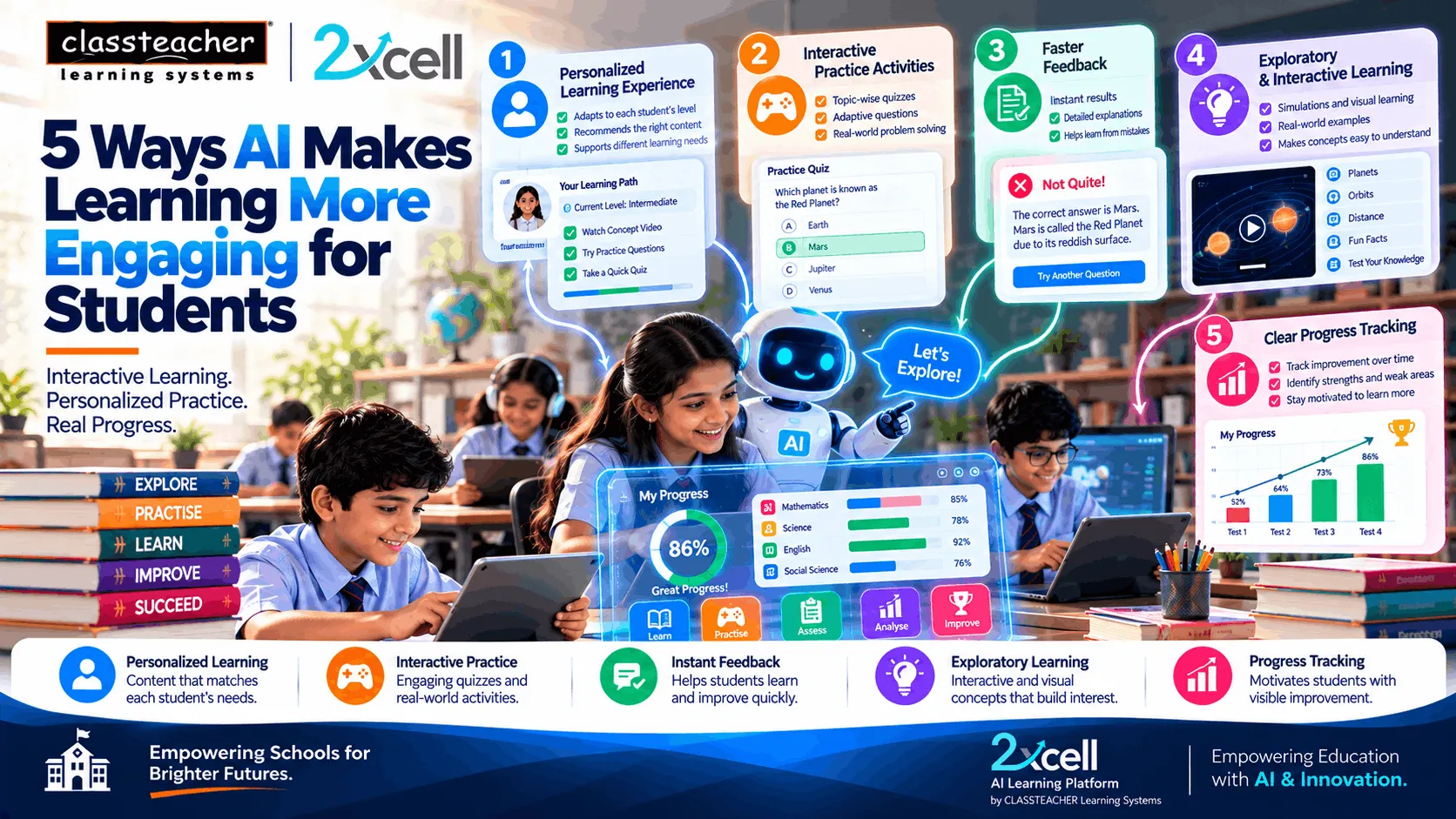
Here are five ways AI can make learning more engaging for students.
1. AI Can Personalize the Learning Experience
Every student enters the classroom with different levels of knowledge, interests, strengths, and areas requiring improvement.
A single learning activity may therefore be too easy for some students and too difficult for others.
AI-powered learning platforms can use student performance information to support more personalized learning experiences.
For example:
Student A may need additional practice with fractions.
Student B may already understand fractions and be ready for application-based questions.
Student C may need visual explanations before attempting practice questions.
Instead of giving all three students exactly the same activity, a personalized digital learning environment can provide different learning pathways.
This can make learning more relevant to individual needs.
Personalized Learning Cycle
Assess → Understand → Recommend → Practise → Improve
When students receive content that matches their learning stage, they may have more opportunities to participate meaningfully.
2. AI Can Make Practice More Interactive
Practice is essential for developing understanding, but repetitive exercises can sometimes become less engaging.
AI can support interactive practice by helping create different types of learning activities.
Depending on the platform, students may experience:
- Topic-wise quizzes
- Adaptive questions
- Interactive exercises
- Practice recommendations
- Application-based problems
- Instant question feedback
- Revision activities
For example, after completing a set of mathematics questions, a student may receive additional questions focused specifically on the concept where they made mistakes.
This makes practice more purposeful.
Instead of:
Complete more questions
the experience becomes:
Practise what you need to improve.
3. AI Can Provide Faster Feedback
Feedback plays an important role in learning.
When students complete an activity, they often want to know whether their answer was correct and where they went wrong.
Traditional assessment may sometimes require students to wait until the teacher checks their work.
Digital AI-supported systems can provide immediate or near-immediate feedback for certain types of activities.
Students can understand:
- Which answers were correct
- Where mistakes occurred
- Which concepts need revision
- What they should practise next
- How their performance is changing
For example:
Answer → Feedback → Explanation → Retry
This allows students to learn from mistakes while the concept is still fresh.
However, teacher feedback remains important, especially when students need deeper explanations, guidance, or encouragement.
4. AI Can Turn Learning Into an Exploration
Engagement increases when students are encouraged to explore rather than simply receive information.
AI can support exploratory learning through simulations, interactive activities, question-based learning, and digital resources.
For example, instead of only reading about the solar system, students could explore:
- Planet characteristics
- Distances and comparisons
- Interactive visualizations
- Question-based activities
- Scenario-based problems
Similarly, in science, students can explore concepts through simulations and practical digital activities.
In mathematics, students can work through different problem-solving situations.
In language learning, AI-enabled tools can support practice with vocabulary, comprehension, and writing activities.
The goal is to make students active participants in the learning process.
5. AI Can Help Students See Their Own Progress
Students are often more engaged when they can see that their efforts are producing progress.
AI-powered learning systems can organize information about student performance and present it through progress indicators, dashboards, reports, or learning analytics.
For example:
Assessment 1: 52%
Practice: Completed
Assessment 2: 64%
Revision: Completed
Assessment 3: 73%
The student can see a progression rather than just a final score.
Progress tracking can help students understand:
- What they have learned
- Where they have improved
- Which topics require more attention
- What they should practise next
- How their performance has changed
This can encourage students to focus on their own learning journey.
How AI Changes the Classroom Experience
AI can contribute to a more interactive classroom when it is integrated with effective teaching.
A technology-supported learning cycle can look like:
Learn
↓
Practise
↓
Assess
↓
Analyse
↓
Receive Feedback
↓
Improve
↓
Learn Again
This creates more opportunities for students to interact with learning content instead of experiencing education only through lectures and examinations.
AI Can Support Different Types of Learners
Students do not all engage with learning in the same way.
Some may prefer visual resources.
Others may benefit from repeated practice.
Some students enjoy challenging questions, while others need additional foundational support before moving forward.
AI-supported learning can help schools provide different types of resources and activities.
Students Requiring Additional Support
Can receive additional explanation, revision, and foundational practice.
Students Making Progress
Can continue practising and applying their knowledge.
Advanced Learners
Can explore challenging questions and higher-level activities.
This flexibility can make classroom learning more inclusive.
AI and Gamification Can Increase Participation
AI can also work alongside gamification techniques to make learning activities more interactive.
Schools can use elements such as:
- Progress badges
- Learning milestones
- Achievement indicators
- Interactive quizzes
- Challenge-based activities
- Progress levels
These features can make certain learning activities feel more interactive.
However, gamification should support educational objectives rather than become a distraction from learning.
The primary goal should remain understanding and skill development.
AI Can Help Teachers Create More Engaging Activities
Student engagement is not only the responsibility of technology.
Teachers play a central role in designing meaningful classroom experiences.
AI can assist teachers by helping organize learning resources, generate practice ideas, analyse student performance, and identify areas that may require additional activities.
For example, if a teacher notices that students are struggling with a particular topic, digital learning tools can support the creation of additional practice and revision activities.
This gives teachers more information to design learning experiences around actual student needs.
AI Does Not Replace the Teacher
One of the most important points about AI in education is that technology should support teachers rather than replace them.
AI can help with:
Data → Analysis → Recommendations
Teachers contribute:
Context → Explanation → Guidance → Encouragement
For example, an AI system may identify that a student's performance has declined.
The teacher can investigate why.
Perhaps the student needs:
- A different explanation
- Additional examples
- One-to-one support
- More practice
- Encouragement
- A different learning approach
The teacher remains central to understanding the learner.
How 2xcell Can Support Engaging Learning
2xcell AI Learning Platform by CLASSTEACHER Learning Systems is designed to support a connected digital learning environment involving learning content, practice, assessment, personalized learning, and analytics.
A connected learning journey can be represented as:
Learn → Practise → Assess → Analyse → Personalize → Improve
By connecting these stages, schools can provide students with more opportunities to interact with digital content, practise concepts, receive feedback, and understand their progress.
The platform can support schools working towards technology-enabled and more personalized learning experiences.
Benefits of AI-Enabled Engagement
For Students
- More personalized learning experiences
- Interactive practice
- Faster feedback
- Greater visibility into progress
- Targeted revision
- Opportunities for exploration
For Teachers
- Better visibility into student performance
- More targeted learning activities
- Additional digital resources
- Support for differentiated learning
- Learning analytics for classroom planning
For Schools
- Connected digital learning
- Continuous assessment
- Learning analytics
- Personalized learning support
- Technology-enabled classrooms
What Schools Should Consider Before Using AI
AI should not be introduced simply because it is becoming popular.
Schools should consider whether the technology:
Supports Learning Objectives
Technology should contribute to clearly defined academic goals.
Is Easy to Use
Teachers and students should be able to use the system without unnecessary complexity.
Provides Meaningful Insights
Analytics should help educators understand learning rather than create information overload.
Supports Teachers
Technology should complement classroom teaching.
Protects Student Information
Schools should establish appropriate practices for student data privacy, security, and access.
Encourages Real Learning
Engagement should ultimately lead to better understanding, practice, and skill development.
The Future of Engaging Learning
As AI, digital content, learning analytics, and personalized learning continue to develop, classrooms can become increasingly responsive to student needs.
Future learning environments may combine:
AI + Digital Content + Interactive Practice + Teacher Expertise + Learning Analytics
The objective is not to make every lesson dependent on technology.
Instead, technology can provide additional ways for students to:
Explore → Practise → Receive Feedback → Improve → Progress
This can create learning experiences that are more connected to individual student needs.
Conclusion
AI can make learning more engaging by helping schools personalize learning, create interactive practice, provide faster feedback, support exploration, and make student progress more visible.
However, technology alone does not create engagement.
Meaningful engagement comes from combining effective teaching with relevant learning content, appropriate challenges, timely feedback, and opportunities for students to actively participate.
With 2xcell AI Learning Platform by CLASSTEACHER Learning Systems, schools can explore a connected approach to AI-enabled learning, digital content, assessment, personalized learning, and analytics.
The goal is simple:
Make Learning Interactive. Make Progress Visible. Make Every Student Part of the Journey.
2xcell AI Learning Platform
By CLASSTEACHER Learning Systems
Empowering Education with AI & Innovation.