Introduction
Artificial Intelligence is becoming an increasingly visible part of everyday life, influencing how people search for information, communicate, create content, and solve problems. As these technologies become more accessible, students need more than the ability to operate AI tools. They need to understand how AI works, recognise its limitations, and make informed decisions about when and how to use it.
This is where AI literacy becomes important.
AI literacy helps students develop the knowledge and judgement needed to interact with artificial intelligence thoughtfully. It encourages them to ask questions, examine information critically, recognise possible errors, and consider the consequences of using technology.
For schools, introducing AI literacy is an opportunity to prepare students for a world in which intelligent systems may influence their education, future careers, and daily decisions.
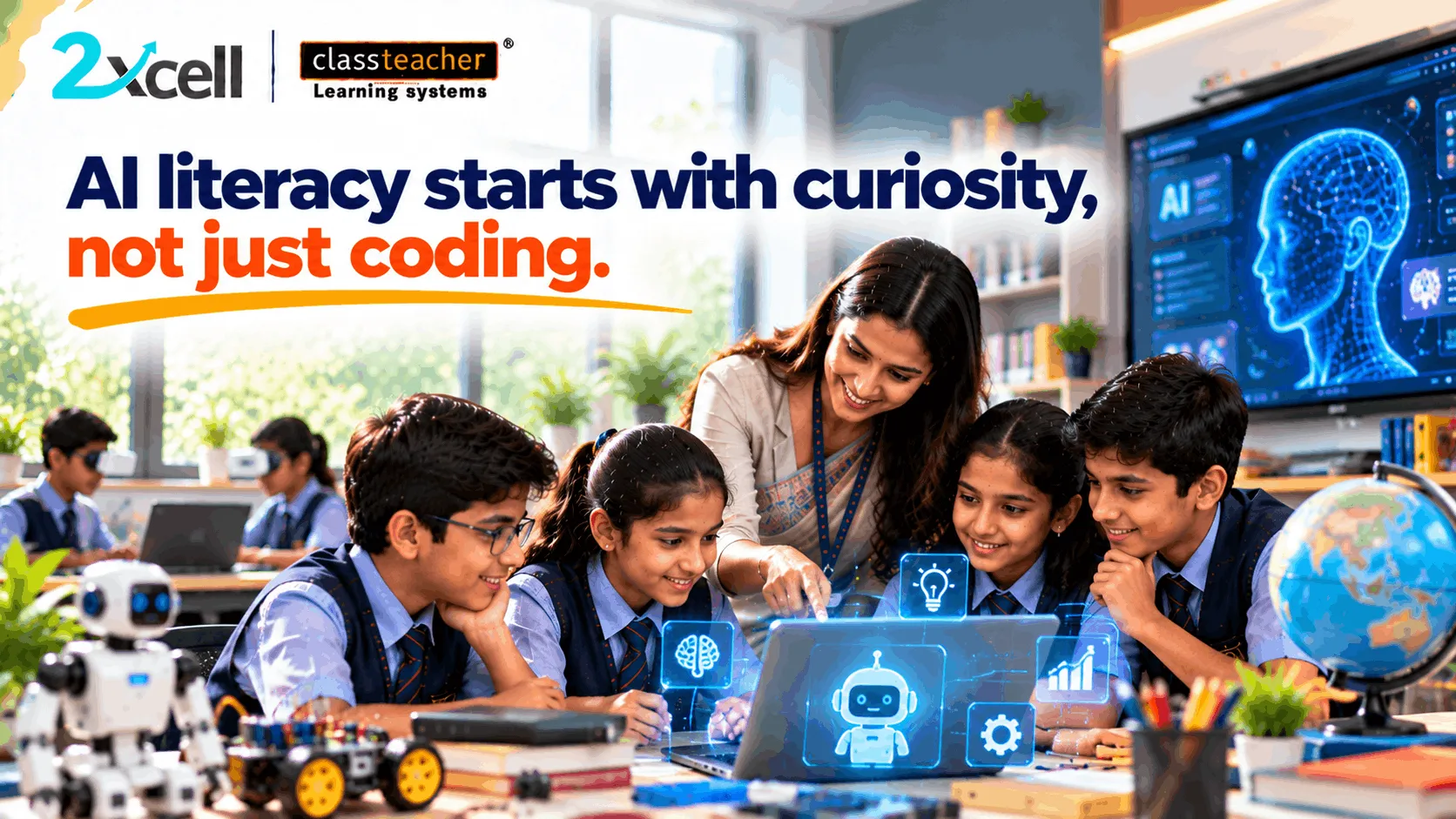
The starting point does not have to be advanced programming. It can begin with something much simpler: curiosity.
What Is AI Literacy?
AI literacy is the ability to understand, evaluate, and use artificial intelligence appropriately.
It involves learning about what AI systems can do, how their outputs should be interpreted, and why responsible use matters.
A student with developing AI literacy should be encouraged to ask questions such as:
- How does an AI system produce an answer?
- Can its response contain incorrect information?
- What information should I verify independently?
- Is it appropriate to share personal information with a tool?
- When should I rely on my own reasoning instead of an AI-generated response?
These questions help students move beyond simply using technology towards understanding it.
AI literacy can be introduced through classroom discussions, demonstrations, guided activities, and age-appropriate examples. Students do not necessarily need advanced technical knowledge to begin exploring these ideas.
1. Curiosity Is a Better Starting Point Than Coding Alone
Programming can be a valuable part of AI education, but it is not the only way students can begin learning about artificial intelligence.
Before exploring technical concepts, students can investigate where AI appears in everyday life and how it influences the information they encounter.
For example, teachers might discuss recommendation systems, voice assistants, image recognition, or AI-powered search tools.
Students can consider why a system makes a particular recommendation and whether that recommendation will always be suitable.
A classroom discussion could begin with questions such as:
- Why does a digital platform recommend particular content?
- How might a computer recognise an image?
- Can two people receive different recommendations?
- What might cause an AI system to make an incorrect prediction?
These activities encourage students to investigate technology rather than accept its outputs without question.
Curiosity creates a foundation for deeper learning, including programming and more advanced AI concepts later.
2. Teach Students to Ask Better Questions
AI tools can produce answers quickly, but the quality and usefulness of those answers depend on several factors, including the information provided and the capabilities of the system.
Students should learn that receiving an answer is not the same as understanding a subject.
Teachers can encourage learners to examine how a question is framed, identify missing information, and consider whether the response actually addresses the original problem.
For example, students could ask an AI tool to explain a scientific concept and then compare the explanation with their textbook or trusted educational resources.
They could identify which parts are clear, which claims require verification, and what additional questions they should investigate.
This approach encourages students to become active participants in learning rather than passive recipients of generated information.
3. Help Students Understand That AI Can Make Mistakes
One of the most important lessons in AI literacy is recognising that AI-generated information is not automatically accurate.
AI systems can produce incorrect answers, misunderstand instructions, omit important context, or present uncertain information confidently.
Students should therefore learn to verify information instead of assuming that a polished response must be correct.
Schools can introduce simple verification activities.
For example, a teacher could present an AI-generated explanation of a historical event and ask students to compare it with reliable learning materials.
Students can identify discrepancies, check relevant facts, and explain which sources provide stronger evidence.
A practical verification process can follow:
Read → Question → Check Sources → Compare Evidence → Form a Conclusion
This helps students develop habits that are useful not only when using AI but also when evaluating information across the internet.
4. Develop Critical Thinking Alongside AI Use
AI literacy should strengthen students' independent thinking rather than encourage them to accept automated responses without reflection.
Students need opportunities to analyse arguments, compare viewpoints, recognise assumptions, and explain their own conclusions.
Teachers can create activities in which students first solve a problem independently and then compare their reasoning with an AI-generated suggestion.
They can discuss where the approaches differ, which evidence supports each answer, and whether the AI response contains weaknesses.
For example, students could examine two explanations of an environmental issue and identify the evidence, assumptions, and limitations in each.
The objective is not to assume that human reasoning is always correct or that AI is always wrong. It is to help students evaluate both thoughtfully.
Critical thinking becomes particularly important when AI-generated content appears convincing but lacks sufficient evidence.
5. Make Responsible Use Part of Every AI Lesson
Understanding AI also means understanding how to use it responsibly.
Students should learn that different activities require different levels of assistance and that school policies may determine when AI tools can be used for assignments.
Teachers can explain the difference between using AI to explore a difficult concept and submitting AI-generated work as though it were entirely their own.
Schools can establish clear expectations around acknowledgement, independent work, verification, and academic honesty.
For example, a student might use an approved AI tool to generate practice questions for revision, then answer those questions independently.
Another student might use an AI explanation as a starting point for research but verify the information before including it in an assignment.
Clear guidance helps students understand that AI should support learning, not replace the effort required to develop knowledge and skills.
6. Teach Students to Protect Their Personal Information
AI literacy also includes understanding privacy and the risks of sharing information online.
Students may not always recognise that information entered into a digital tool could be processed or retained according to the service's policies and settings.
Schools should therefore teach students to avoid entering sensitive personal information into tools unless the activity is specifically approved and appropriate.
Important lessons include:
- Do not share passwords or login credentials.
- Avoid uploading private documents without permission.
- Do not disclose sensitive personal or family information.
- Follow school rules when using digital tools.
- Ask a teacher or trusted adult when unsure.
- Understand that different services have different data practices.
Teachers should also model safe practices during demonstrations.
Schools selecting AI tools should review their privacy, security, age-appropriateness, and data-handling requirements before introducing them to students.
Responsible technology use begins with understanding that convenience should not come at the expense of personal safety.
7. Explain AI Bias and Fairness Through Everyday Examples
AI systems can reflect limitations in their training data, design, or evaluation. As a result, their outputs may be incomplete, unfair, or less reliable for some situations than others.
Students can begin exploring this topic through age-appropriate examples.
For instance, a class could discuss whether an image-recognition system would work equally well under different lighting conditions or whether a recommendation system might overlook useful information.
Teachers can ask students whose experiences might be missing from a dataset and how those gaps could influence an outcome.
Such discussions introduce important questions about fairness, representation, and responsibility.
Students do not need to study complex algorithms to begin understanding that technology is designed by people and that its outcomes deserve careful examination.
8. Use Practical Activities to Make AI Concepts Understandable
AI literacy can be taught through activities that encourage students to predict, observe, compare, and explain.
The exact activity should depend on the students' ages, learning objectives, and available resources.
Possible examples include:
Pattern recognition: Students identify patterns in a collection of shapes or objects and discuss which features they used.
Classification: Learners organise examples into categories and consider what happens when an example does not fit neatly into one group.
Prediction: Students make predictions based on a small dataset and compare their reasoning with a computer-generated result, where appropriate.
Output evaluation: Students examine AI-generated text or images and identify possible inaccuracies or missing context.
Decision-making: Learners discuss how a system's recommendations might affect people and why human review may be necessary.
These activities help students explore ideas related to AI without requiring every lesson to involve programming or specialised equipment.
9. Explain the Difference Between AI Assistance and Human Judgement
AI tools can support certain tasks, but students should understand that their outputs require interpretation.
A generated summary may omit an important detail. A recommendation may not account for a student's circumstances. An answer may need additional evidence before it can be accepted.
Teachers can help students understand when independent judgement is necessary.
For example, students might use an AI tool to generate possible solutions to a classroom problem. They can then compare those suggestions, identify practical limitations, and select an approach based on evidence.
This teaches students to treat AI as a resource for exploration rather than an unquestionable authority.
The skill is not simply knowing how to obtain an answer. It is knowing how to evaluate that answer and decide what to do next.
10. How Teachers Can Introduce AI Literacy Across Subjects
AI literacy does not have to be confined to a single computer science lesson.
Teachers can introduce relevant concepts across different subjects, provided the activities support the intended learning objectives.
Science: Discuss how data and pattern recognition can support scientific investigations, while examining the need to verify results.
Mathematics: Explore patterns, classifications, predictions, and the importance of checking calculations.
Languages: Compare AI-generated explanations or summaries with original texts and examine meaning, accuracy, and context.
Social science: Discuss privacy, fairness, responsible decision-making, and the social impact of technology.
Computer science: Introduce suitable programming activities and explore how instructions and data affect system behaviour.
Media literacy: Examine AI-generated content, identify possible inaccuracies, and practise checking information against credible sources.
This cross-curricular approach can help students recognise AI as a technology that interacts with many aspects of modern life.
11. Prepare Teachers to Guide AI Learning
Teachers do not need to know every technical detail of artificial intelligence before introducing foundational AI literacy concepts. However, they need suitable guidance, age-appropriate resources, and clear school policies.
Professional development can help educators understand basic AI concepts, recognise common limitations, discuss responsible use, and design meaningful classroom activities.
Schools can support teachers through:
- Practical AI literacy workshops.
- Ready-to-adapt classroom activities.
- Guidance on academic integrity.
- Privacy and safeguarding procedures.
- Examples of age-appropriate learning tasks.
- Opportunities to share experiences with colleagues.
Teacher preparation is especially important because students may encounter new AI tools outside school.
Educators need to be able to respond to students' questions and help them evaluate technology critically, even when a particular tool is unfamiliar.
12. How Schools Can Build an AI Literacy Programme
A structured programme can help schools introduce AI concepts gradually instead of relying on occasional demonstrations.
Step 1: Identify Learning Objectives
Decide what students should understand about AI, its limitations, and responsible use.
Step 2: Adapt Activities to Age and Readiness
Select concepts and examples suitable for the students' developmental levels.
Step 3: Establish Clear Usage Rules
Define which tools students may use, what information they may share, and how AI assistance should be acknowledged.
Step 4: Prepare Teachers
Provide training, resources, and guidance for classroom implementation.
Step 5: Encourage Exploration and Discussion
Give students opportunities to ask questions, test ideas, and discuss their observations.
Step 6: Evaluate Understanding
Use student explanations, classroom discussions, practical tasks, and reflection activities to assess learning.
Step 7: Review and Improve
Update activities and guidance as student needs, educational priorities, and technology change.
This approach makes AI literacy an ongoing educational priority rather than a one-time technology introduction.
13. The Role of Educational Technology in AI Literacy
Educational technology can provide resources for demonstrations, guided activities, practice, and assessment. However, schools should evaluate whether a tool supports their learning objectives before introducing it.
CLASSTEACHER Learning Systems offers education-focused solutions that schools can evaluate as part of their wider digital learning strategy.
The 2xcell AI Learning Platform by CLASSTEACHER Learning Systems may also be considered according to its available features and the school's requirements.
When evaluating a platform for AI-related learning, school leaders should examine curriculum relevance, age-appropriateness, teacher support, student privacy, and the quality of available educational resources.
The objective is to ensure that technology contributes to meaningful learning while teachers continue to guide students' understanding and judgement.
14. How to Measure AI Literacy Beyond Tool Usage
A student who can operate an AI tool does not necessarily understand how to use it responsibly.
Schools should therefore assess students' reasoning and decision-making, not just their ability to complete a task using technology.
Teachers can look for evidence that students can:
- Explain AI concepts at an appropriate level.
- Recognise that AI outputs may contain errors.
- Verify information using suitable sources.
- Identify information that should remain private.
- Explain when AI assistance is appropriate.
- Discuss possible bias or limitations.
- Develop and communicate their own conclusions.
For example, students could review an AI-generated response, identify a questionable claim, verify it, and explain how they reached their final conclusion.
Such activities help teachers assess whether students are developing thoughtful habits around AI use.
Conclusion
AI literacy starts with curiosity, questioning, and a willingness to examine how technology works. Coding can be an important part of the journey, but students also need to understand the limitations, responsibilities, and decisions associated with using AI.
Schools can begin with simple activities that encourage learners to investigate information, verify claims, protect personal data, recognise possible errors, and think independently.
Teachers play a vital role in guiding these experiences. With appropriate training, clear expectations, and meaningful learning activities, schools can help students become more informed and responsible users of artificial intelligence.
The goal is not merely to prepare students to use today's AI tools. It is to help them develop the judgement needed to evaluate and adapt to technologies that will continue to evolve.
AI literacy is not just about using artificial intelligence. It is about understanding it, questioning it, and using it wisely.