Introduction
Every classroom contains students who learn at different speeds.
Some students understand a new concept after one explanation, while others may need additional examples, practice, revision, or more time before they feel confident. At the same time, some learners may already understand the topic and be ready for more challenging activities.
Managing these differences in a single classroom can be difficult.
Traditional teaching often follows a common pace because teachers need to cover the curriculum within a defined academic schedule. However, digital learning and Artificial Intelligence (AI) are creating new possibilities for supporting students according to their individual learning needs.
AI can help analyse learning activity, identify patterns, recommend suitable practice, and provide teachers with information about where students may require additional support.
The goal is not to create a separate curriculum for every student.
It is to make the learning journey more responsive.
Different Pace → Different Support → Better Learning Opportunities
What Does "Every Student's Pace" Mean?
Learning at an individual pace does not mean that every student studies completely different subjects or follows an unlimited timetable.
It means students can receive appropriate levels of:
- Explanation
- Practice
- Revision
- Feedback
- Difficulty
- Learning resources
- Academic support
For example, if one student understands fractions quickly while another struggles with the basic concept, giving both students exactly the same additional worksheet may not be equally useful.
AI-supported learning environments can help identify these differences and provide information that teachers can use to respond appropriately.
Why Learning Gaps Develop in Classrooms
Learning gaps can appear for many reasons.
A student may:
- Miss an important lesson
- Have difficulty with prerequisite concepts
- Need more practice
- Struggle with a particular type of question
- Learn better through visual explanations
- Require additional revision
- Move through concepts more slowly
- Lack confidence in a particular subject
Sometimes a student may appear to understand a topic during a classroom discussion but struggle when applying the concept independently.
This is why identifying learning gaps requires more than looking at one examination score.
1. AI Can Identify Individual Learning Patterns
One of the potential benefits of AI in education is its ability to analyse multiple learning signals.
These may include:
- Quiz responses
- Assessment results
- Practice activity
- Assignment performance
- Topic-wise scores
- Repeated mistakes
- Learning progress
- Concept mastery
Instead of looking only at the final percentage, AI-supported systems can help organize these signals into a broader picture.
For example, a student may perform well in multiplication but repeatedly struggle with word problems.
The overall mathematics score may not fully explain this difference.
Detailed learning information can help teachers identify the specific area that needs attention.
2. AI Can Help Students Receive the Right Level of Practice
Giving every student the same practice material may not always address individual learning needs.
An AI-enabled platform can potentially support different levels of practice.
Foundation Practice
For students who need to strengthen basic concepts.
Guided Practice
For students who understand the basics but need additional application.
Advanced Practice
For students who have demonstrated strong understanding and are ready for greater challenge.
This creates a more flexible learning environment without changing the core curriculum.
3. Students Can Spend More Time on Difficult Concepts
In a traditional classroom, the teacher may need to move forward after completing a scheduled lesson.
A student who has not fully understood the concept may then move to the next topic with an incomplete foundation.
AI-supported digital learning can provide opportunities to revisit difficult concepts.
A student could follow a cycle such as:
Learn → Practise → Identify Difficulty → Revise → Practise Again
This allows additional learning time to be directed towards areas where it is actually needed.
4. AI Can Support Personalized Learning Paths
Personalization does not necessarily mean creating completely separate lessons for every student.
Instead, students can follow different learning activities within the same broader curriculum.
For example:
Common Topic
↓
Student Performance
↓
Learning Requirement
↓
Recommended Activity
↓
Practice
↓
Reassessment
One student may receive additional foundational questions, while another may receive application-based problems.
This can help students progress without forcing every learner through exactly the same sequence.
5. Teachers Can See Who Needs Support
AI should not be responsible for deciding which students are "good" or "weak."
Instead, learning analytics can provide teachers with useful signals.
For example, a teacher may see that:
- A group of students is struggling with the same concept.
- One student has shown repeated improvement.
- Several students need additional practice.
- Some learners have already mastered the topic.
- A particular question is creating difficulty across the class.
The teacher can then decide what action is appropriate.
This keeps professional judgement at the centre of the learning process.
6. AI Can Help Students Who Need More Repetition
Repetition can be an important part of learning.
Some students may require several examples before a concept becomes clear.
Digital learning systems can make it easier to provide repeated practice without requiring the teacher to manually create a new worksheet every time.
For example:
Concept Explanation → Example → Practice Question → Feedback → New Example
The student can continue practising until the concept becomes more familiar.
The objective is not simply to increase the number of questions.
It is to provide meaningful practice based on the learner's needs.
7. AI Can Also Support Students Who Learn Faster
Bridging the learning gap is not only about helping students who are struggling.
Students who understand concepts quickly also need opportunities to continue developing.
If advanced learners repeatedly receive only basic revision, they may not get enough opportunities to apply their knowledge.
AI-supported platforms can potentially recommend:
- Advanced questions
- Application-based problems
- Higher-order thinking activities
- Subject challenges
- Additional learning resources
- Complex problem-solving exercises
This creates space for students to progress beyond basic understanding.
8. Immediate Feedback Can Help Students Correct Mistakes
Feedback becomes more useful when students receive it close to the learning activity.
For certain digital assessments, students can receive immediate information about their responses.
Instead of waiting until the next classroom session, they may be able to identify:
What was correct?
Where did I make a mistake?
Which concept should I review?
What should I practise next?
Teacher feedback remains important, especially for complex answers and deeper misconceptions, but technology can support faster feedback for suitable activities.
9. AI Can Help Detect Repeated Mistakes
A single mistake may not indicate a significant learning problem.
Repeated mistakes can provide more useful information.
For example, if a student repeatedly makes errors while solving equations, an analytics system may highlight a pattern.
The teacher can then investigate whether the student needs:
- A simpler explanation
- More examples
- Foundational practice
- Visual learning material
- One-to-one support
- A different teaching approach
The AI does not determine the reason.
It can help make the pattern easier to notice.
10. Learning Gaps Can Be Addressed Earlier
One of the challenges with traditional examination cycles is that learning gaps may become visible only after a major test.
By then, several new concepts may already have been introduced.
Continuous digital activities can provide earlier signals.
For example:
September: Difficulty identified
October: Targeted practice provided
November: Progress measured
December: Additional support adjusted
This allows schools to treat learning gaps as an ongoing academic issue rather than something discovered only during final examinations.
AI Can Support Teachers Without Replacing Them
The role of the teacher remains essential.
AI can process learning information, but teachers understand the context behind that information.
For example, a student's performance may decline because of:
- A difficult concept
- Lack of practice
- A change in learning environment
- Confusion about prerequisite knowledge
- Need for additional explanation
Analytics may show the change.
The teacher investigates the reason and decides what should happen next.
A useful model is:
AI Identifies Patterns → Teacher Understands Context → Teacher Provides Support → Student Progress Is Measured
From One Classroom Pace to Multiple Learning Pathways
A classroom does not necessarily need to operate at only one learning speed.
A teacher can introduce the same core concept to the entire class and then provide different follow-up activities.
For example:
Learning StageStudent RequirementPossible SupportBeginningUnderstand the conceptExplanation + ExamplesDevelopingStrengthen understandingGuided PracticeApplyingUse knowledge independentlyApplication QuestionsAdvancedExtend understandingHigher-Level Problems
This approach allows the classroom to remain connected while giving students different forms of support.
How AI Can Support Teachers in Large Classrooms
The challenge becomes more significant when a teacher is responsible for many students.
Manually tracking every quiz, assignment, practice session, and learning gap can consume considerable time.
AI-powered analytics can help organize information and highlight patterns.
Instead of reviewing every data point individually, teachers can focus their attention on information such as:
Students Requiring Support
Topics With Low Performance
Students Showing Improvement
Concepts Already Mastered
Areas Requiring Reassessment
This can help teachers use their limited time more strategically.
AI and Differentiated Classroom Activities
Differentiated teaching does not mean lowering expectations for some students.
It means adjusting the type of support according to learning requirements.
For example:
Group 1 – Concept Reinforcement
Students receive additional explanation and foundational activities.
Group 2 – Skill Development
Students work on regular practice and application.
Group 3 – Advanced Application
Students solve challenging problems and explore deeper concepts.
All three groups can continue working towards the broader learning objective.
The Role of Assessments in Bridging Learning Gaps
Assessment should not only determine marks.
It can also help schools understand whether learning support is working.
A useful cycle is:
Teach → Assess → Analyse → Support → Reassess
Suppose a student initially scores 48% on a topic.
After targeted practice, the student scores 63%.
Following additional revision, the score reaches 74%.
These results provide evidence about the student's progress and can help the teacher decide what to do next.
How 2xcell Can Support Learning at Different Paces
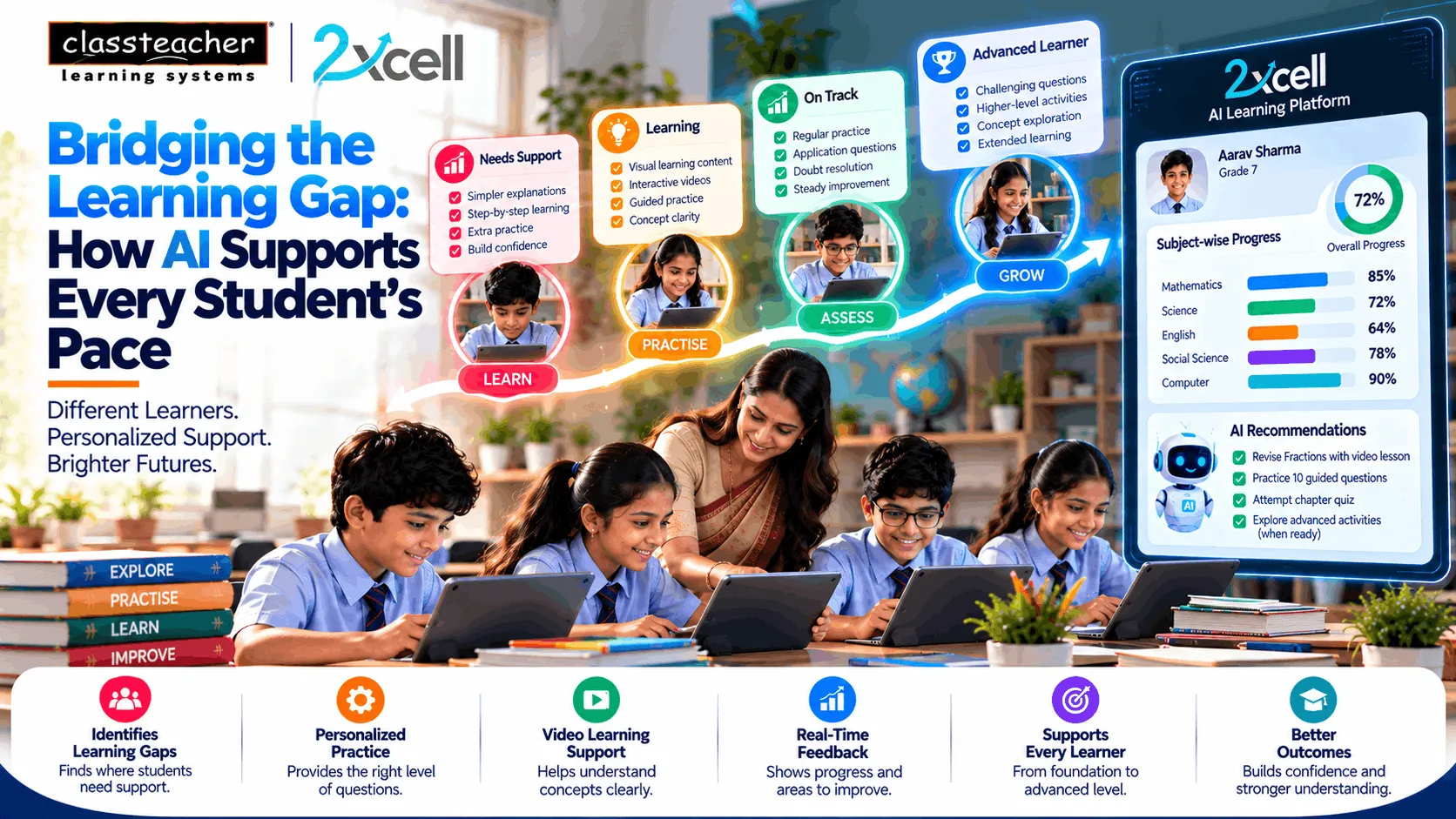
2xcell AI Learning Platform by CLASSTEACHER Learning Systems can support a connected digital learning environment involving learning content, practice, assessment, analytics, and personalized learning.
A possible learning journey can be structured as:
Learn → Practise → Assess → Analyse → Personalize → Improve
The platform can help schools connect different learning activities so that student performance information is not treated as isolated data.
For teachers, connected learning information can provide greater visibility into student performance.
For students, digital learning and practice can support more targeted learning experiences.
For schools, analytics can provide broader visibility into academic progress.
The objective is to support teachers in creating learning experiences that respond more effectively to different student needs.
How Schools Can Build a More Inclusive Learning Environment
AI is only one part of the solution.
Schools can combine technology with strong teaching practices.
1. Identify Learning Objectives
Clearly define what students should understand.
2. Use Frequent Formative Checks
Do not wait for major examinations to understand student progress.
3. Analyse Learning Patterns
Look beyond overall marks.
4. Provide Targeted Support
Give students the practice or explanation they actually need.
5. Allow Relearning
Give students opportunities to revisit difficult concepts.
6. Provide Greater Challenge
Students who demonstrate mastery should have opportunities to extend their learning.
7. Measure Progress Again
Check whether the support produced improvement.
Avoiding Over-Personalization
Personalized learning should still maintain academic structure.
Schools need to ensure that technology does not create unnecessary complexity or isolate students from classroom interaction.
Students still benefit from:
- Teacher guidance
- Peer collaboration
- Classroom discussions
- Group activities
- Practical learning
- Projects
- Social interaction
AI should therefore complement classroom learning rather than create a completely separate learning environment for every student.
Responsible Use of AI in Student Learning
Schools should also consider responsible use of student data.
Important areas include:
- Data privacy
- Appropriate access
- Data security
- Transparency
- Teacher oversight
- Accuracy of recommendations
- Responsible interpretation of analytics
AI recommendations should be treated as supporting information rather than unquestionable decisions.
Teachers and schools should remain responsible for academic decisions.
Measuring Whether AI Is Actually Helping
Schools should evaluate outcomes rather than simply measuring technology usage.
Useful indicators can include:
- Improvement in assessment performance
- Reduction in repeated mistakes
- Progress across learning periods
- Student participation
- Intervention effectiveness
- Concept mastery
- Teacher adoption
- Student completion of targeted practice
The important question is not:
"How much AI are we using?"
It is:
"Is the technology helping students learn more effectively?"
The Future of Learning at Every Student's Pace
As AI, learning analytics, digital content, and personalized learning continue to develop, schools may be able to create more flexible learning environments.
A future learning cycle could look like:
Student Activity
↓
Learning Data
↓
AI Analysis
↓
Personalized Insight
↓
Teacher Review
↓
Targeted Learning Support
↓
New Practice
↓
Progress Measurement
This creates a continuous feedback loop.
The objective is not to make every student follow a completely different educational system.
It is to ensure that students receive the right support at the right stage of their learning journey.
Conclusion
Every student learns differently.
Some need more explanation. Some need additional practice. Some require more time, while others are ready for greater challenges.
AI can help schools recognize these differences by analysing learning activity, identifying patterns, supporting personalized practice, and providing teachers with timely academic insights.
However, technology alone cannot bridge every learning gap.
The strongest approach combines AI capabilities with teacher expertise, classroom interaction, meaningful assessment, and appropriate intervention.
With 2xcell AI Learning Platform by CLASSTEACHER Learning Systems, schools can explore a connected approach to digital learning, personalized practice, assessment, analytics, and academic support.
The goal is simple:
Different Pace. Right Support. Every Student Moving Forward.
2xcell AI Learning Platform
By CLASSTEACHER Learning Systems
Empowering Education with AI & Innovation.