Introduction
Education is about more than memorizing facts, completing assignments, and achieving high marks in examinations. While academic knowledge provides an essential foundation, students also need practical skills that help them understand the world, solve problems, communicate ideas, and adapt to changing circumstances.
As technology continues to influence education and the workplace, schools have an important opportunity to prepare students for challenges beyond the classroom.
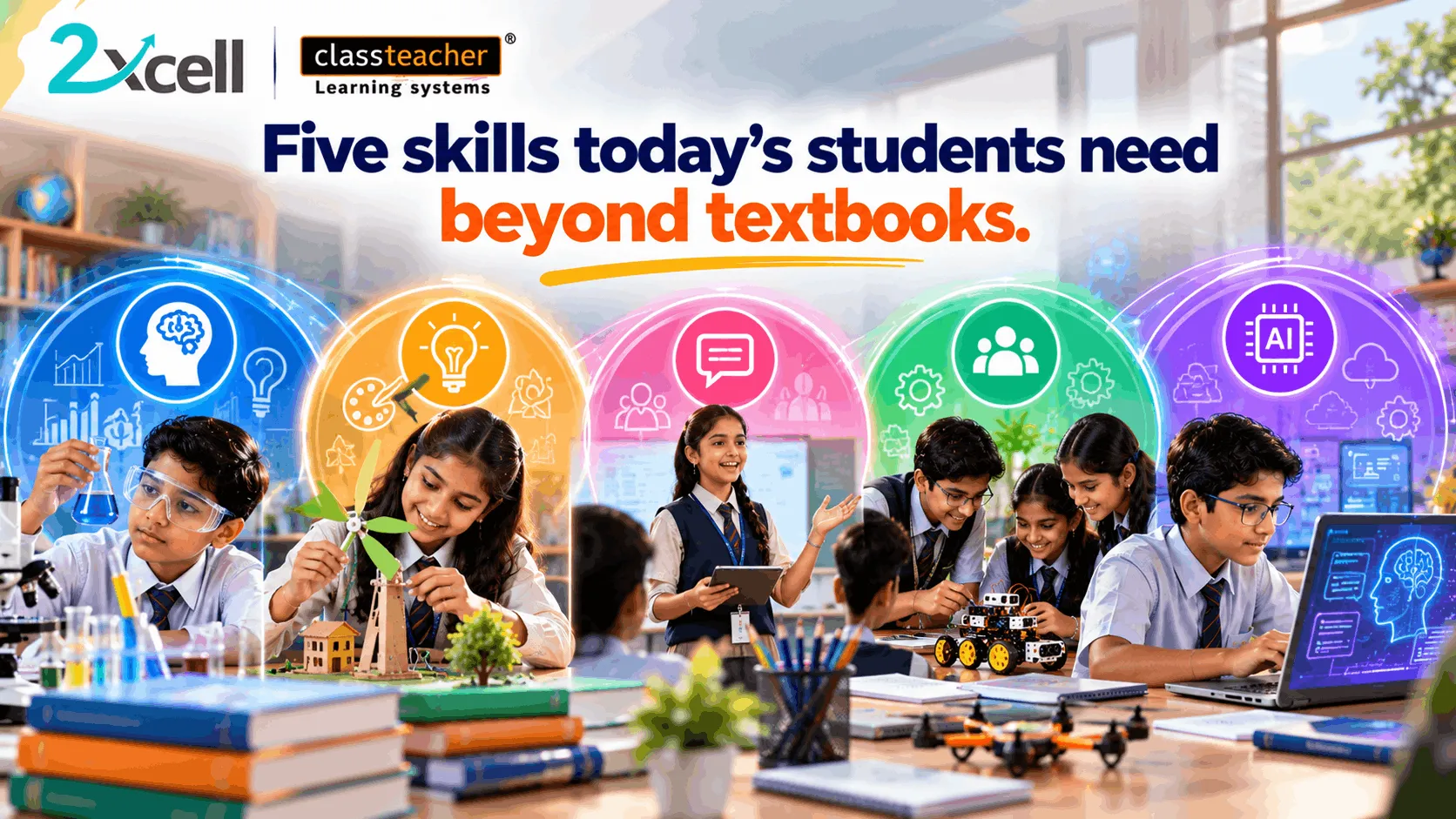
Five skills deserve particular attention: critical thinking, creativity and innovation, communication, collaboration, and digital and AI literacy.
These capabilities develop when students are encouraged to ask questions, explore different ideas, participate in meaningful discussions, work on projects, and learn through practical experiences.
The goal is not to reduce the importance of textbooks. It is to complement academic learning with opportunities that help students apply what they know.
Why Students Need Skills Beyond Academic Knowledge
Textbooks introduce concepts, explain theories, and provide structured knowledge. However, students also need to understand how to use that knowledge in unfamiliar situations.
For example, learning scientific principles is important, but students benefit further when they can investigate a question, interpret observations, and explain their conclusions.
Similarly, studying a language builds vocabulary and grammar, while discussions and presentations help students communicate their ideas confidently.
Schools can create these opportunities by combining classroom instruction with projects, experiments, group activities, and appropriate technology.
A balanced learning approach can follow:
Learn → Question → Explore → Apply → Reflect → Improve
This approach connects academic understanding with the skills students need for lifelong learning.
1. Critical Thinking: Teaching Students to Question and Analyse

Critical thinking helps students evaluate information, examine evidence, identify assumptions, and develop logical conclusions.
In a world where information is easily accessible, students need to learn how to distinguish reliable information from unsupported claims. Finding an answer online is only the beginning; understanding whether that answer is accurate is equally important.
Schools can nurture critical thinking through activities such as:
- Asking open-ended questions during lessons.
- Comparing different explanations of the same topic.
- Analysing information from multiple sources.
- Conducting experiments and interpreting results.
- Discussing real-world situations.
- Explaining the reasoning behind an answer.
For example, in a science lesson, students could investigate why a particular material floats while another sinks. Instead of immediately providing the explanation, the teacher can encourage predictions, observations, and evidence-based conclusions.
This helps students develop the habit of thinking independently rather than relying only on memorized answers.
How schools can encourage it: Create classroom environments where asking questions, explaining reasoning, and learning from mistakes are welcomed.
2. Creativity and Innovation: Helping Students Develop New Ideas

stem.orchidsinternationalschool.com
Creativity enables students to imagine possibilities, explore alternatives, and approach challenges from different perspectives. Innovation takes this further by turning ideas into practical solutions.
These skills are useful across subjects. A student can demonstrate creativity through a science model, a mathematical strategy, a storytelling activity, a design project, or a technology-based invention.
Schools can provide opportunities for creativity through:
- Project-based learning.
- Design and building challenges.
- Science exhibitions.
- Robotics and coding projects.
- Creative writing and presentations.
- Environmental problem-solving activities.
Imagine a classroom project focused on reducing plastic waste. Students could research the problem, develop different solutions, create awareness materials, and present their ideas to the school community.
There may be several effective solutions rather than one fixed answer. Students learn to explore possibilities, evaluate ideas, and improve their work through feedback.
How schools can encourage it: Give students meaningful challenges, room to experiment, and opportunities to develop and present their own ideas.
3. Communication: Helping Students Express Ideas Clearly

Communication involves more than speaking confidently. Students also need to listen carefully, organize their thoughts, explain complex ideas, ask useful questions, and respond respectfully to others.
These abilities support classroom participation, teamwork, presentations, and future academic and professional activities.
Schools can strengthen communication through:
- Classroom presentations.
- Group discussions and debates.
- Reading and storytelling.
- Written explanations.
- Project demonstrations.
- Peer feedback.
- Question-and-answer sessions.
For instance, after completing a mathematics problem, students could explain the steps they followed and why they selected a particular method.
This allows teachers to understand the student's reasoning, while students practise expressing their understanding clearly.
Communication also includes listening. Students should have opportunities to consider different viewpoints, ask follow-up questions, and respond thoughtfully.
How schools can encourage it: Make communication part of everyday learning rather than limiting it to occasional speeches or formal presentations.
4. Collaboration: Learning to Work Effectively with Others

Collaboration teaches students how to contribute to a shared goal, divide responsibilities, respect different opinions, and solve problems as a team.
In real-world situations, people often need to combine their knowledge and abilities to achieve results. Classroom collaboration gives students an opportunity to practise these behaviours in a supportive environment.
Schools can develop collaboration through:
- Group research projects.
- Team-based science experiments.
- Robotics and coding challenges.
- Classroom problem-solving activities.
- Peer-learning sessions.
- Group presentations and discussions.
Consider a project in which students design a model of an environmentally friendly school. One student might research renewable energy, another could create the model, and another could prepare the presentation. The team must coordinate its work to produce a complete result.
Teachers should ensure that each student contributes meaningfully rather than allowing one or two members to complete the entire project.
How schools can encourage it: Design group activities with shared goals, individual responsibilities, and opportunities for students to reflect on how they worked together.
5. Digital and AI Literacy: Preparing Students for a Technology-Driven World

Digital technology and Artificial Intelligence are changing how people access information, communicate, create content, and solve problems.
Students need to understand how to use these technologies effectively, evaluate the information they provide, and recognize their limitations.
Digital and AI literacy includes more than operating devices or using applications. It also involves responsible decision-making, information evaluation, online safety, and an understanding of how AI-generated outputs should be checked.
Schools can develop these skills through:
- Digital research and information verification.
- Coding and computational thinking.
- Age-appropriate AI learning activities.
- Online safety and privacy education.
- Digital presentations and content creation.
- Robotics and technology projects.
- Discussions about AI accuracy, bias, and responsible use.
For example, students could compare an AI-generated explanation of a scientific concept with their textbook and trusted educational sources. They could identify differences, verify the facts, and explain which information is reliable.
This approach encourages students to use AI as a learning aid while continuing to think independently.
How schools can encourage it: Introduce age-appropriate digital learning, teach responsible technology use, and ensure teachers guide students in evaluating digital information.
How These Five Skills Work Together
These skills are most useful when students have opportunities to practise them together rather than treating each as a separate subject.
Consider a school project focused on saving water.
Critical thinking
Students investigate water usage and identify the main problem.
Creativity and innovation
Students develop ideas for reducing water waste.
Communication
Students explain their findings and present their recommendations.
Collaboration
Teams divide responsibilities and combine their ideas.
Digital and AI literacy
Students use appropriate digital tools to research information and prepare their presentation.
One project can therefore support academic understanding, practical application, teamwork, and responsible technology use.
How Schools Can Integrate These Skills into Everyday Teaching
Developing future-ready skills does not necessarily require a complete change to the curriculum. Schools can start by incorporating small, purposeful activities into existing lessons.
Step 1: Connect skills with curriculum objectives
Identify which skills naturally support the topic being taught. A science experiment may develop critical thinking, while a history presentation may strengthen research and communication.
Step 2: Introduce practical activities
Use projects, discussions, experiments, simulations, and real-world scenarios to help students apply what they learn.
Step 3: Encourage student participation
Give students opportunities to ask questions, explain their reasoning, share ideas, and make decisions.
Step 4: Use technology purposefully
Select digital resources and educational tools that support a clear learning objective rather than introducing technology simply for its own sake.
Step 5: Provide constructive feedback
Help students understand what they did well, what they can improve, and how they can approach similar challenges in the future.
Step 6: Review progress
Use classroom observations, project work, presentations, and appropriate assessments to understand how students are developing these skills.
The aim is to make skill development a consistent part of the learning experience.
How Teachers Can Assess Skills Beyond Marks
Not every important skill can be measured through a conventional written examination.
Schools can use a combination of assessment methods to understand student development more comprehensively.
Skill
Possible assessment method
Critical thinking
Evaluate reasoning and evidence
Creativity
Review original ideas and project development
Communication
Assess presentations and explanations
Collaboration
Observe participation and shared responsibility
Digital and AI literacy
Evaluate research, fact-checking, and responsible tool use
Assessment criteria should be clear, age-appropriate, and connected to learning objectives.
Students should also receive constructive feedback so they understand how to improve. The purpose is not to assign a score to every behaviour, but to help learners recognize their strengths and develop the skills they need.
The Role of Teachers in Developing Future-Ready Skills
Teachers play a central role in helping students build these capabilities.
They create opportunities for inquiry, guide discussions, support experimentation, encourage respectful collaboration, and help students learn from mistakes.
Technology can provide useful resources and additional learning opportunities, but it cannot replace the professional judgement, encouragement, and human connection that teachers bring to the classroom.
Schools should therefore support teachers with appropriate training, curriculum-aligned resources, and practical strategies for integrating these skills into their teaching.
How 2xcell Can Support a Connected Learning Experience
2xcell AI Learning Platform by CLASSTEACHER Learning Systems can form part of a school's wider digital learning strategy.
Depending on the features available and implemented, a connected digital learning environment can support learning content, practice, assessments, analytics, personalized learning, and student progress tracking.
A learning journey can follow:
Learn → Practise → Assess → Analyse → Improve
These resources can complement teacher-led instruction and practical classroom activities. For example, digital content and practice can reinforce subject understanding, while teachers create opportunities for students to discuss ideas, collaborate, and apply their knowledge.
Schools should evaluate any platform according to its actual capabilities, curriculum alignment, ease of use, privacy safeguards, and educational value.
The wider goal is to combine academic learning with experiences that encourage students to think critically, explore possibilities, communicate effectively, work with others, and use technology responsibly.
Conclusion
Preparing students for the future requires more than helping them remember information from textbooks.
Critical thinking enables students to evaluate ideas. Creativity encourages them to explore possibilities. Communication helps them express their understanding. Collaboration teaches them to work towards shared goals. Digital and AI literacy prepares them to navigate a technology-driven world responsibly.
These skills develop through consistent practice, meaningful projects, classroom discussions, experimentation, and guidance from teachers.
Schools do not need to abandon academic foundations to develop these capabilities. They can strengthen both by creating learning experiences that connect knowledge with real-world application.
With thoughtful teaching, appropriate educational technology, and platforms such as 2xcell AI Learning Platform by CLASSTEACHER Learning Systems, schools can explore ways to make learning more connected and engaging.
The future of education is not simply about what students can remember. It is also about how they think, create, communicate, collaborate, and apply what they know.