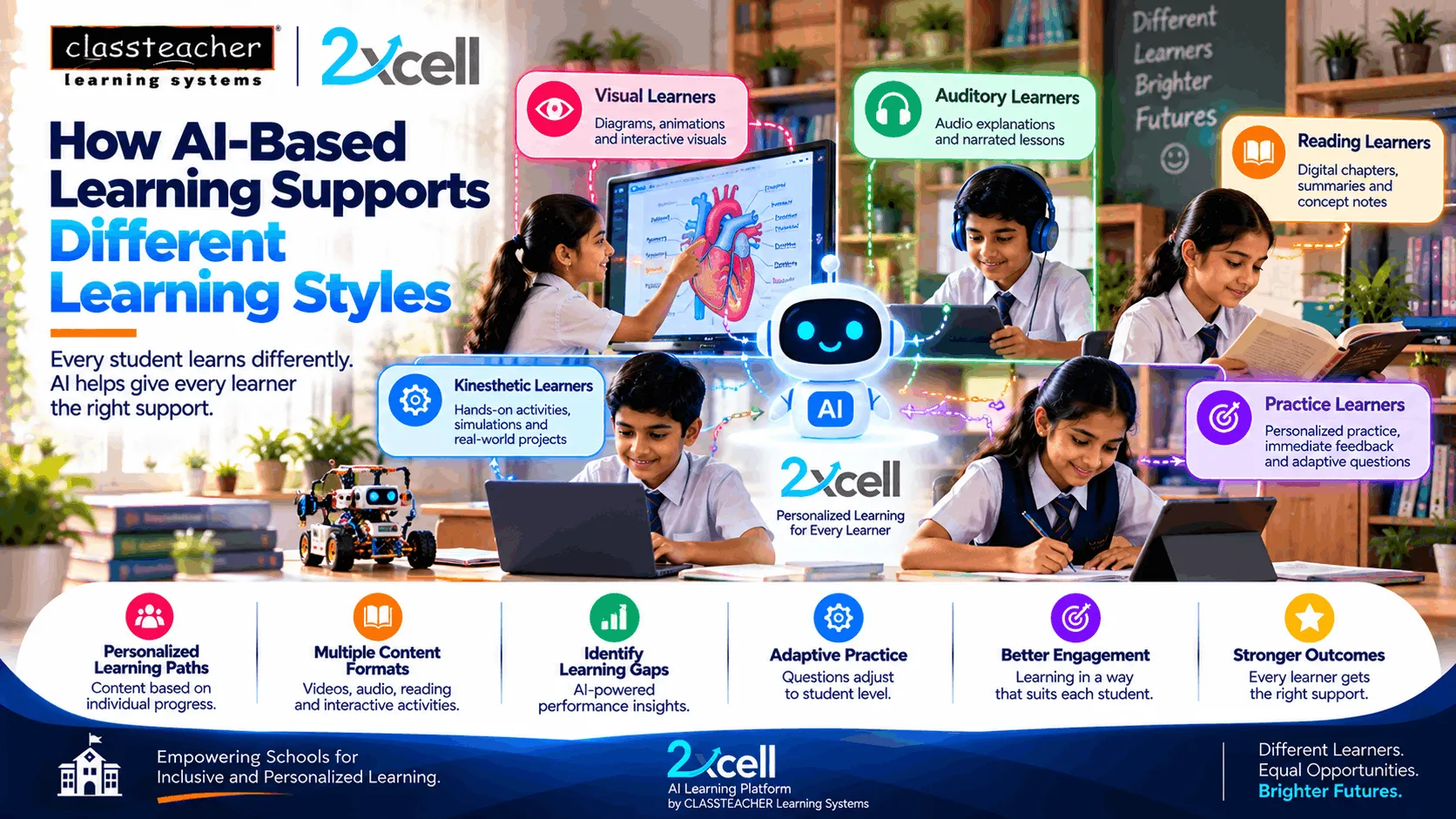
Introduction
Every classroom includes students who understand information in different ways.
Some students respond well to diagrams and visual demonstrations. Others prefer listening to explanations, discussing ideas, reading detailed material, or learning through practical activities.
Traditional teaching often needs to balance these differences within a shared classroom environment.
AI-based learning can provide another layer of support by helping schools deliver different types of learning resources, practice activities, explanations, and feedback according to student requirements.
The objective is not to place every learner into a fixed category.
Instead, AI can help provide multiple ways to explore the same concept.
A flexible learning journey can look like:
Understand → Explore → Practise → Receive Feedback → Adapt → Improve
What Is AI-Based Learning?
AI-based learning refers to digital learning systems that use artificial intelligence to analyse learning information and support personalized educational experiences.
Depending on the platform, AI can help with:
- Personalized learning resources
- Adaptive practice
- Performance analysis
- Learning-gap identification
- Content recommendations
- Automated feedback
- Progress tracking
- Difficulty adjustment
- Learning pathways
This can help schools provide students with learning experiences that respond to their progress rather than relying on exactly the same activity for everyone.
What Do We Mean by Different Learning Preferences?
Students may have different preferences for how they interact with educational material.
Some may find visual representations helpful.
Others may prefer listening to explanations or discussing concepts.
Some students may understand a topic better after reading.
Others may benefit from solving problems or completing practical activities.
These preferences can overlap and can change depending on the subject and task.
Therefore, AI-based learning should not treat learning styles as rigid labels.
Instead, it can provide multiple representations and learning activities so students have different ways to engage with a concept.
1. AI Can Support Visual Learning Experiences
Visual resources can make certain concepts easier to understand.
AI-enabled learning platforms can recommend or organize resources such as:
- Diagrams
- Animations
- Infographics
- Interactive illustrations
- Educational videos
- Graphs
- Visual simulations
For example, a science concept involving a complex process can be presented through an animation rather than relying only on written instructions.
A student can observe the sequence and then connect it with the teacher's explanation.
The learning flow becomes:
See → Understand → Practise
2. AI Can Support Students Who Prefer Listening
Some students benefit from explanations delivered through spoken language.
Digital learning environments can include:
- Audio explanations
- Narrated lessons
- Video lectures
- Spoken instructions
- Interactive discussions
- Voice-enabled learning experiences
For example, a language lesson can combine written text with pronunciation and spoken examples.
This gives students another way to interact with the same concept.
3. AI Can Support Reading-Based Learning
Reading remains an important part of academic learning.
AI-enabled systems can help students access written resources according to their learning requirements.
These may include:
- Digital chapters
- Concept notes
- Summaries
- Explanations
- Definitions
- Examples
- Revision material
AI can potentially recommend additional reading material when a student requires more explanation about a particular concept.
4. AI Can Support Learning Through Practice
Some students understand concepts more effectively when they actively solve problems.
AI-powered platforms can provide personalized practice based on performance.
For example:
Learn → Question → Answer → Feedback → Try Again
If a student answers several questions incorrectly, the system can identify the topic and provide additional practice or supporting resources.
This creates a more active learning experience.
5. AI Can Support Hands-On and Experiential Learning
Technology does not have to limit learning to screens.
AI-based learning can be combined with:
- Robotics
- Coding
- Simulations
- Experiments
- Projects
- Problem-solving activities
- Real-world challenges
For example, students learning about automation can build a simple robotics project and observe how sensors, code, and logic work together.
This connects theoretical knowledge with practical application.
6. AI Can Recommend Different Resources for the Same Concept
One of the useful possibilities of AI is content recommendation.
Suppose a student is struggling with fractions.
The platform could potentially provide:
Explanation → Visual Example → Guided Practice → Additional Questions → Assessment
Another student who already understands the basics may receive more challenging application questions.
This means the topic remains the same while the learning pathway can vary.
7. AI Can Adjust Practice Difficulty
Students do not always need the same level of difficulty.
AI-based adaptive learning can use performance information to adjust practice.
For example:
Beginning Level
Basic concept questions.
Developing Level
Application-based questions.
Advanced Level
Complex problems and higher-order applications.
If a student performs consistently well, the system can potentially provide more challenging activities.
If the student struggles, additional foundational practice may be recommended.
8. AI Can Help Students Learn at Their Own Pace
Classroom teaching generally follows a common schedule.
Digital learning can provide greater flexibility for individual practice.
Students may be able to:
- Rewatch an explanation
- Repeat an activity
- Review a concept
- Attempt additional questions
- Move to advanced material
- Practise difficult topics again
This can help students spend more time where they need it.
9. AI Can Identify Learning Gaps
Sometimes students know that they are struggling but cannot identify the exact concept causing difficulty.
AI-powered learning systems can analyse assessment and practice patterns.
For example:
Mathematics
Algebra — Strong
Geometry — Developing
Fractions — Needs Practice
Data Handling — Strong
This provides a more detailed picture than a single overall score.
Teachers can then decide which concept needs additional attention.
10. AI Can Provide Personalized Feedback
Feedback is an important part of learning.
AI-enabled systems can potentially provide immediate feedback for certain types of activities.
Students can understand:
- Which answer was incorrect
- Which concept was involved
- Whether additional practice is required
- What type of question they should attempt next
The cycle becomes:
Attempt → Feedback → Understand → Improve
Teachers can then provide additional guidance where necessary.
11. AI Can Connect Learning Preferences With Personalized Paths
Instead of asking which single learning style a student belongs to, schools can provide different learning resources and observe what supports learning effectively.
For example:
Student A
Needs visual explanation + basic practice.
Student B
Benefits from reading material + problem-solving.
Student C
Needs demonstration + practical activity.
The system can use learning performance and activity data to support more appropriate resources.
This is more flexible than assigning a permanent learning-style label.
12. AI Can Support Language Learning
Language learning often involves several forms of interaction.
AI-enabled learning can combine:
- Reading
- Listening
- Speaking
- Writing
- Vocabulary practice
- Pronunciation
- Conversation activities
For example, a student can read a sentence, listen to its pronunciation, practise speaking, and then complete a short exercise.
This creates a multi-dimensional learning experience.
13. AI Can Support Mathematics Learning
Mathematics often benefits from step-by-step practice.
AI-based systems can provide:
Concept → Example → Practice → Feedback → Additional Practice
Students can receive different questions based on their performance.
A student struggling with fractions may receive foundational questions, while another student may move towards application-based problems.
14. AI Can Support Science Learning
Science includes processes, structures, experiments, and real-world applications.
AI-supported digital learning can combine:
- Animations
- Simulations
- Videos
- Diagrams
- Experiments
- Practice questions
- Concept assessments
For example, a digital simulation can help students visualize a process that may be difficult to observe directly in a classroom.
15. AI Can Support Social Science Learning
Social science topics can benefit from multiple forms of representation.
Students can explore:
- Maps
- Timelines
- Historical images
- Videos
- Written explanations
- Interactive activities
AI can potentially recommend resources based on the topic and student performance.
This can help students explore the same concept from different perspectives.
16. AI Can Support Computer Science and Coding
Coding requires active practice.
AI-based learning environments can support students through:
Concept → Code Example → Practice → Debugging → Improvement
Students can experiment with code and learn from mistakes.
More advanced students can move towards projects and real-world applications.
17. AI Can Combine Multiple Learning Formats
The strongest digital learning experiences do not necessarily depend on one format.
A single topic can combine:
Text + Video + Animation + Practice + Assessment + Feedback
This gives students multiple opportunities to interact with the concept.
For example, a lesson could begin with a short explanation, continue with an animation, move into practice questions, and finish with an assessment.
18. AI Can Help Teachers Understand Student Preferences and Performance
Teachers already observe students closely.
AI can provide additional information based on digital learning activity.
For example, the system may show:
- Which resources students access
- Which topics require repeated practice
- Which question types cause difficulty
- How performance changes over time
- Which concepts have been mastered
This can help teachers decide which resources or teaching approaches may be useful.
The relationship remains:
AI Provides Insights → Teacher Adds Context → Student Receives Support
19. AI Can Support Inclusive Learning Environments
Students may have different academic needs, levels of preparation, and learning requirements.
Digital learning platforms can provide flexibility through:
- Different difficulty levels
- Multiple content formats
- Additional practice
- Revision resources
- Personalized recommendations
- Flexible pacing
This can help schools create learning environments where students have more than one pathway to understand a concept.
20. AI Does Not Replace the Teacher
AI can recommend resources, analyse performance, and support practice.
But teachers remain essential.
Teachers provide:
- Explanation
- Context
- Mentoring
- Encouragement
- Classroom interaction
- Emotional support
- Individual guidance
- Academic judgement
An AI system may identify that a student is struggling with a topic.
The teacher can determine why and decide the most appropriate intervention.
Technology supports the process.
The teacher leads it.
How 2xcell Supports Personalized Learning
2xcell AI Learning Platform by CLASSTEACHER Learning Systems can support a connected digital learning environment involving:
- Learning content
- Practice
- Assessment
- Analytics
- Personalized learning
- Student progress tracking
A connected learning journey can follow:
Learn → Practise → Assess → Analyse → Personalize → Improve
This approach can help schools provide different learning resources and practice opportunities based on student performance.
For example, students can access relevant content, complete practice activities, receive feedback, and continue with additional learning support where required.
The objective is not to place students into fixed learning-style categories.
It is to provide flexible learning pathways that respond to student needs and progress.
AI-Based Learning and Personalized Education
Personalized learning is broader than simply changing the difficulty of a question.
A personalized environment can consider:
- Current performance
- Previous learning
- Practice results
- Learning gaps
- Progress over time
- Content interaction
- Assessment outcomes
This information can help create more relevant learning pathways.
The cycle becomes:
Understand the Student → Recommend Learning → Measure Progress → Adapt Support
What Schools Should Consider Before Adopting AI-Based Learning
Schools should evaluate AI learning platforms carefully.
Curriculum Alignment
Does the content support the school's academic framework?
Content Quality
Are explanations accurate, age-appropriate, and educationally useful?
Personalization
Can the platform adapt learning based on meaningful performance information?
Teacher Control
Can teachers review, modify, and guide the learning experience?
Assessment
Can the platform connect learning resources with practice and assessment?
Analytics
Are the insights understandable and useful?
Data Privacy
Are student learning records handled responsibly?
Ease of Use
Can teachers and students use the platform without unnecessary complexity?
Avoiding the Problem of Fixed Learning Labels
It is important not to assume that every student has one permanent learning style.
A student may prefer visual resources for science but benefit from reading when studying history.
The same student may learn mathematics best through repeated practice.
Therefore, the focus should be on learning flexibility rather than rigid categorization.
AI can support this by offering different ways to interact with content and using learning performance to guide recommendations.
The Future of AI-Based Personalized Learning
As AI learning systems continue to develop, educational platforms may increasingly connect:
AI + Digital Content + Adaptive Practice + Assessment + Analytics
A future learning journey could look like:
Student Learns
↓
System Observes Performance
↓
AI Identifies Learning Needs
↓
Relevant Resource Recommended
↓
Student Practises
↓
Performance Reassessed
↓
Learning Path Updated
This creates a continuous learning cycle.
Conclusion
Students do not always learn in exactly the same way, at the same pace, or with the same level of prior understanding.
AI-based learning can help schools provide more flexible educational experiences by combining different forms of content, personalized practice, feedback, assessments, and learning recommendations.
The goal should not be to label students according to a fixed learning style.
Instead, AI can help create an environment where students have multiple ways to understand concepts and personalized opportunities to practise and improve.
With 2xcell AI Learning Platform by CLASSTEACHER Learning Systems, schools can explore a connected approach to digital learning, adaptive practice, assessment, analytics, and personalized learning.
The future of education is not about teaching every student in exactly the same way.
It is about creating learning environments that can adapt, support, and respond to the needs of every learner.
Learn Differently. Practise Personally. Improve Continuously.
2xcell AI Learning Platform
By CLASSTEACHER Learning Systems
Empowering Education with AI & Innovation.