Introduction
Not every student who struggles academically shows an obvious problem immediately.
A student may gradually stop participating in class, repeatedly make mistakes in one topic, submit fewer assignments, or show a decline in assessment performance. By the time these patterns become visible through a major examination, the learning gap may already have become significant.
This is where AI-powered learning analytics can provide valuable support.
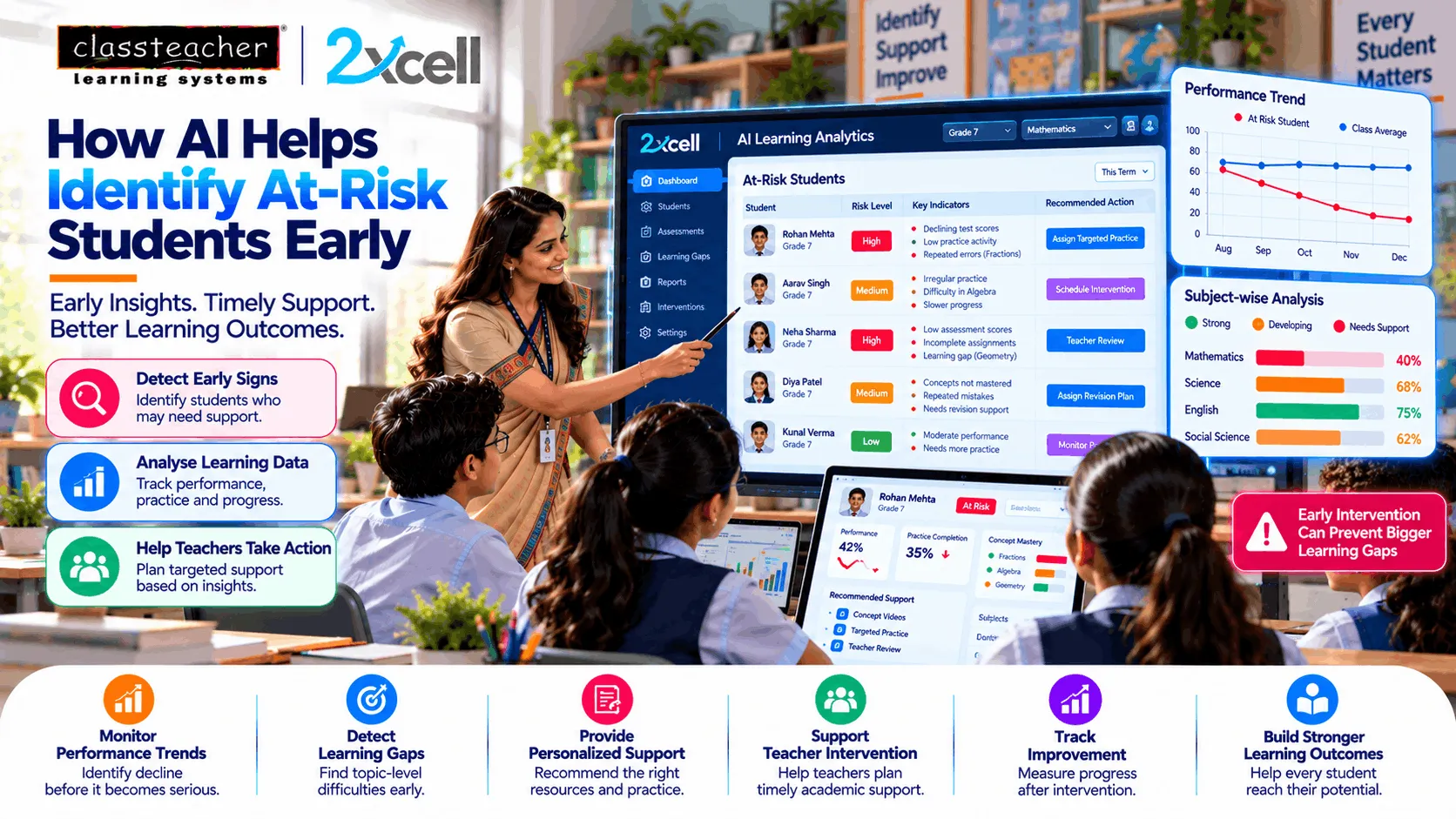
AI can analyse relevant information from assessments, practice activities, learning progress, and digital interactions to identify patterns that may require attention.
The purpose is not to label a student as “at risk.”
Instead, the purpose is to help schools ask an earlier and more useful question:
What signs suggest that this student may need additional academic support?
A proactive learning cycle can look like:
Observe → Identify Patterns → Understand → Support → Monitor → Improve
What Does “At-Risk Student” Mean?
In an academic context, an at-risk student may be a learner who shows signs that they could face difficulties in achieving expected learning outcomes without additional support.
Possible indicators may include:
- Repeated low assessment scores
- Declining performance
- Difficulty with foundational concepts
- Incomplete practice activities
- Repeated incorrect answers
- Low participation
- Irregular learning activity
- Slow progress
- Persistent learning gaps
These indicators do not automatically explain why a student is struggling.
They simply provide signals that may deserve further attention from teachers and academic teams.
Why Early Identification Matters
Academic difficulties can become more complicated when they remain unnoticed.
For example:
Concept Not Understood
↓
More Difficult Topic Introduced
↓
Student Continues Without Foundation
↓
Repeated Mistakes
↓
Performance Declines
Early identification can interrupt this pattern.
Instead of waiting for a final examination, schools can provide support when the first meaningful signs appear.
1. AI Can Detect Changes in Student Performance
A single examination result may not provide enough information to understand a student's learning journey.
AI-powered analytics can compare performance across multiple assessments.
For example:
Assessment 1 → 76%
Assessment 2 → 69%
Assessment 3 → 61%
A gradual decline may indicate that the student needs closer academic attention.
The important point is not the number alone.
It is the change over time.
2. AI Can Identify Repeated Learning Difficulties
One incorrect answer does not necessarily indicate a problem.
Repeated difficulty with the same concept can be more informative.
For example:
Mathematics
Algebra — Strong
Geometry — Developing
Fractions — Repeated Errors
Data Handling — Strong
This type of topic-level information can help teachers focus their attention on the specific area where support may be required.
3. AI Can Highlight Learning Gaps Before Major Exams
Traditional academic monitoring may depend heavily on periodic examinations.
AI-supported systems can provide more frequent learning signals through:
- Practice activities
- Topic assessments
- Quizzes
- Digital assignments
- Revision exercises
This can help schools identify potential learning gaps before they become visible in major examinations.
The cycle becomes:
Practice Data → Pattern → Teacher Review → Intervention
4. AI Can Track Progress Over Time
Student performance should be viewed as a journey rather than a collection of isolated scores.
AI can help organize information across different learning periods.
For example:
September: 58%
October: 63%
November: 67%
December: 72%
The upward trend may indicate improvement.
Similarly, a declining trend may suggest that additional support should be considered.
5. AI Can Identify Students Who Need Additional Practice
Some students may require more practice before moving to advanced concepts.
AI-powered learning platforms can analyse performance and recommend additional activities where appropriate.
For example:
Low Performance → Targeted Practice → Reassessment
This is more focused than simply asking the student to revise an entire subject.
6. AI Can Detect Repeated Mistakes
Repeated errors can reveal more than a low overall score.
For example, a student may repeatedly:
- Make calculation errors
- Misunderstand a particular formula
- Confuse similar concepts
- Struggle with application-based questions
- Skip specific question types
Identifying these patterns can help teachers provide more precise intervention.
7. AI Can Monitor Practice Behaviour
Academic performance is one signal, but learning activity can provide additional context.
Depending on the platform, schools may be able to review:
- Practice completion
- Assessment attempts
- Revision activity
- Topic engagement
- Learning resource usage
- Frequency of practice
For example, declining performance combined with very limited practice may indicate a need for a conversation with the student.
However, activity data should always be interpreted carefully.
8. AI Can Help Identify Students With Slowing Progress
Not every at-risk student experiences a sudden decline.
Some students may simply stop progressing at the expected pace.
For example:
Student A: 60% → 68% → 75%
Student B: 62% → 63% → 63%
Student B may not have a dramatic decline, but the lack of progress could still be worth investigating.
AI can help bring such patterns to the attention of teachers.
9. AI Can Compare Performance Across Topics
Overall subject scores can sometimes hide important differences.
Imagine a student has scored 70% in science.
A detailed analysis may show:
Physics: 82%
Chemistry: 74%
Biology: 55%
The overall score appears reasonable, but the topic-level information indicates that biology may require additional attention.
This makes intervention more specific.
10. AI Can Support Earlier Teacher Intervention
Once a potential concern is identified, the teacher can investigate the situation.
The teacher may decide to provide:
- Additional explanation
- One-to-one support
- Extra practice
- Remedial activities
- Peer learning
- Revision material
- Alternative examples
The process becomes:
AI Identifies Pattern → Teacher Investigates → Support Is Planned
This keeps the teacher at the centre of intervention.
11. AI Can Help Track Whether Intervention Worked
Identifying a problem is only the first step.
Schools also need to understand whether the support provided has made a difference.
A useful intervention cycle is:
Identify Gap
↓
Provide Support
↓
Practise
↓
Reassess
↓
Compare Progress
If performance improves, the intervention may have been useful.
If difficulties continue, the teacher can consider another strategy.
12. AI Can Help Prioritize Academic Support
Teachers may work with dozens of students at the same time.
It can be difficult to manually review every learning signal.
AI-powered analytics can help organize students according to indicators that may require attention.
For example:
Priority Support
Repeated difficulty or significant performance decline.
Monitor
Some concerns but relatively stable performance.
Progressing
Consistent improvement and expected performance.
This does not replace teacher judgement.
It simply helps teachers decide where to look first.
13. AI Can Help Identify Foundational Problems
Some academic difficulties originate from earlier concepts.
For example:
Basic Fractions → Ratios → Percentages → Algebraic Applications
If a student has not understood fractions properly, later topics may become increasingly difficult.
AI can help identify repeated performance patterns that suggest a student may need to revisit foundational concepts.
14. AI Can Support Personalized Intervention
Once a learning gap has been identified, every student may not require the same intervention.
For example:
Student A
Needs a concept explanation.
Student B
Needs guided practice.
Student C
Needs additional application questions.
Student D
Needs teacher-led support.
This creates:
One Learning Goal → Different Support Pathways
15. AI Can Help Teachers Recognize Positive Changes Too
Early-warning systems should not focus only on problems.
AI can also highlight improvement.
For example:
Low Performance → Targeted Practice → Higher Accuracy → Improved Assessment
Recognizing improvement can help teachers understand which learning strategies are working.
It can also give students evidence of their own progress.
16. AI Can Support Parent-Teacher Conversations
Parents may notice that a child is struggling, but may not know exactly where the difficulty lies.
Teachers may have classroom observations, while digital analytics can provide additional learning information.
Together, these can support more focused conversations.
Instead of:
“Your child needs to study more.”
the conversation can become:
“The student is doing well in most mathematics topics but needs additional practice with fractions.”
This makes academic support more actionable.
17. AI Can Help Schools Monitor Grade-Level Trends
At-risk identification does not have to happen only at the individual student level.
Schools can also identify patterns across:
- Classes
- Grades
- Subjects
- Sections
- Branches
For example, if several classes show difficulty with the same topic, the academic team may review:
- Teaching resources
- Curriculum pacing
- Assessment design
- Practice material
- Teacher support
This turns individual data into broader academic insight.
18. AI Can Help Reduce Delayed Intervention
Without continuous monitoring, schools may discover learning difficulties only during:
- Term examinations
- Annual examinations
- Parent-teacher meetings
- Major assessments
AI-supported monitoring can provide additional checkpoints throughout the academic journey.
This creates opportunities for earlier action.
Early Signal → Early Review → Early Support
19. AI Can Connect Assessment With Intervention
Assessment becomes more valuable when its results lead to action.
Instead of:
Test → Marks → Report
schools can build:
Test → Analyse → Identify Gap → Practise → Reassess
This creates a feedback loop where assessment becomes part of the learning process rather than simply a measurement at the end.
20. How 2xcell Can Support Early Academic Identification
2xcell AI Learning Platform by CLASSTEACHER Learning Systems can support a connected digital learning environment involving:
- Digital learning content
- Practice
- Assessments
- Analytics
- Personalized learning
- Student progress tracking
A connected learning cycle can follow:
Learn → Practise → Assess → Analyse → Identify → Support → Improve
Relevant learning information can help schools gain greater visibility into:
- Student performance
- Topic-level difficulties
- Practice patterns
- Progress trends
- Learning gaps
- Areas requiring additional support
The objective is not to automatically label students.
It is to help teachers and schools notice meaningful signals earlier and respond appropriately.
AI Should Identify Signals, Not Make Final Judgements
This is one of the most important principles of AI-supported academic monitoring.
A system may detect:
Performance Decline
But it cannot automatically know the complete reason.
There may be many possible explanations:
- Difficulty with the topic
- Change in learning environment
- Lack of practice
- Temporary circumstances
- Different assessment difficulty
- Need for additional explanation
Therefore:
AI Detects Pattern → Teacher Investigates → Context Is Added → Support Is Planned
Human judgement remains essential.
Continuous Monitoring Is Better Than One-Time Checking
A student can change significantly throughout an academic year.
Therefore, schools can benefit from reviewing learning information regularly.
A continuous model can look like:
Observe → Analyse → Support → Measure → Adjust
This allows academic teams to respond to changing student needs.
What Schools Should Monitor
A useful early-support framework can include several categories.
Academic Performance
- Assessment scores
- Subject performance
- Topic performance
Learning Activity
- Practice completion
- Assessment participation
- Revision activity
Progress
- Improvement
- Decline
- Learning pace
Concept Understanding
- Repeated errors
- Mastery
- Learning gaps
Intervention
- Support provided
- Practice assigned
- Follow-up assessment
This creates a more complete view of student learning.
Building an Early Academic Support System
Schools can introduce early identification through a structured approach.
Step 1: Define Meaningful Indicators
Identify which academic signals require attention.
Step 2: Collect Relevant Learning Data
Bring together appropriate assessment and practice information.
Step 3: Analyse Patterns
Look for changes, repeated difficulties, and unusual trends.
Step 4: Involve Teachers
Allow teachers to interpret the information within classroom context.
Step 5: Provide Targeted Support
Offer appropriate intervention based on the student's needs.
Step 6: Reassess
Measure whether the intervention helped.
Step 7: Continue Monitoring
Track progress over time.
This creates:
Detect → Understand → Support → Measure → Improve
The Future of Early Student Support
As AI, learning analytics, and personalized education continue to develop, schools may gain more sophisticated ways to identify students who could benefit from additional support.
A future academic ecosystem could connect:
Student Activity
↓
Assessment
↓
AI-Assisted Analysis
↓
Early Signal
↓
Teacher Review
↓
Personalized Intervention
↓
Reassessment
↓
Progress Tracking
The goal is not prediction for its own sake.
The real value lies in using information to provide timely and meaningful academic support.
Conclusion
Students do not always announce when they are struggling.
Sometimes the signs appear gradually through declining scores, repeated mistakes, incomplete practice, slow progress, or difficulty with foundational concepts.
AI-powered learning analytics can help schools bring these patterns to attention earlier by analysing relevant academic and learning information.
However, AI should not make final judgements about students.
The most effective approach combines:
AI Insights + Teacher Expertise + Targeted Support + Continuous Monitoring
With 2xcell AI Learning Platform by CLASSTEACHER Learning Systems, schools can explore a connected approach to digital learning, assessment, analytics, personalized learning, and student progress tracking.
The objective is simple:
Identify Earlier. Support Better. Help Every Student Progress.
2xcell AI Learning Platform
By CLASSTEACHER Learning Systems
Empowering Education with AI & Innovation.