Introduction
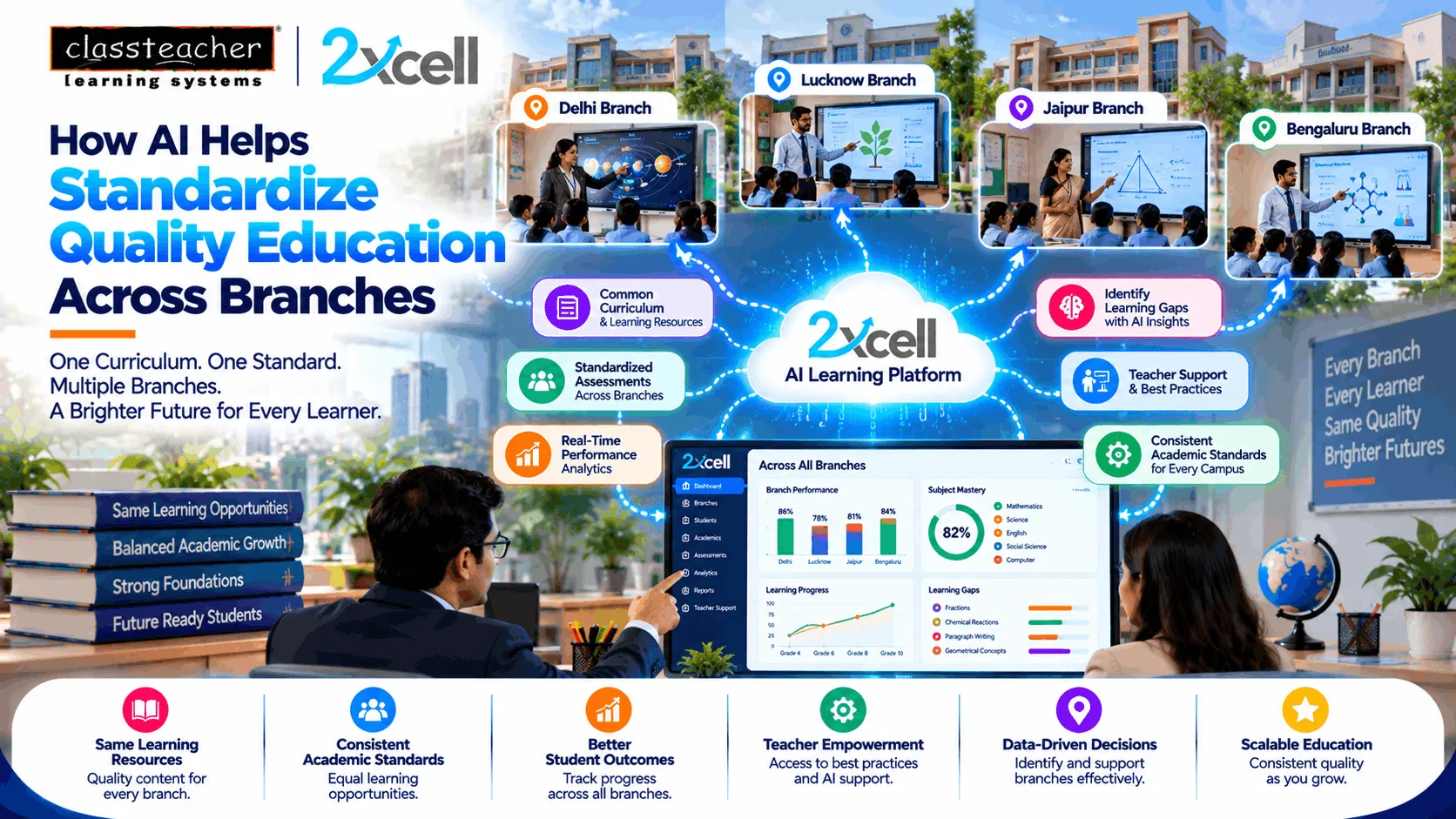
Schools with multiple branches often face a common challenge: how to maintain the same standard of education across every campus.
Each branch may have different teachers, classrooms, student groups, infrastructure, and local requirements. Even when all branches follow the same curriculum, the actual learning experience can vary.
One campus may have highly interactive lessons, while another may depend more heavily on traditional teaching methods. Some branches may conduct frequent assessments, while others may review student performance less often.
Artificial Intelligence can help schools create greater consistency by connecting curriculum, digital content, assessments, learning analytics, teacher support, and student progress.
The objective is not to make every classroom identical.
It is to establish a common academic foundation while still allowing teachers to adapt their teaching to their students.
A connected approach can follow:
Common Standards → Consistent Resources → Monitor → Analyse → Support → Improve
What Does Standardized Quality Education Mean?
Standardized quality education does not mean that every teacher must teach in exactly the same way.
Instead, it means that students across different branches should have access to comparable:
- Curriculum coverage
- Learning resources
- Academic expectations
- Assessment standards
- Learning opportunities
- Teacher support
- Progress monitoring
For example, if a school operates branches in Delhi, Lucknow, Jaipur, and Bengaluru, students should not experience dramatically different academic standards simply because they attend different campuses.
AI can help schools create systems that make these standards easier to maintain.
Why Maintaining Quality Across Multiple Branches Is Difficult
Managing academic consistency across branches can involve several challenges.
Different Teaching Approaches
Teachers may explain the same concept using different methods and resources.
Different Resource Availability
Some campuses may have more digital learning resources than others.
Assessment Variations
Tests may differ in difficulty, structure, and frequency.
Different Student Profiles
Each branch may have students with different learning requirements.
Manual Reporting
School leadership may depend on spreadsheets and periodic reports to compare academic performance.
Communication Gaps
Important academic practices may not always be shared consistently between branches.
These challenges can make centralized academic monitoring difficult.
1. AI Can Help Create Consistent Learning Resources
One of the first steps toward consistency is ensuring that students have access to appropriate learning material.
AI-enabled platforms can help organize digital resources around:
- Subjects
- Grades
- Topics
- Learning objectives
- Difficulty levels
- Curriculum requirements
This gives branches access to a common digital learning environment.
Teachers can then supplement these resources with their own classroom explanations and activities.
The model becomes:
Common Content Foundation + Teacher Expertise
2. AI Can Help Align Learning With Curriculum Goals
Different branches may progress through the curriculum at different speeds.
A centralized digital learning environment can help schools monitor:
- Topics completed
- Topics pending
- Learning objectives covered
- Assessments conducted
- Student performance
This can help academic leaders understand whether branches are broadly aligned with planned academic expectations.
3. AI Can Support Consistent Assessment Standards
Assessment is an important part of academic quality.
If branches use very different assessments, comparing performance can become difficult.
AI-supported assessment platforms can help schools create common question structures around:
- Concepts
- Competencies
- Difficulty
- Application
- Subject knowledge
For example, a school can establish a common assessment framework while allowing teachers to add branch-specific questions where appropriate.
This creates greater consistency without eliminating teacher involvement.
4. AI Can Compare Performance Across Branches
A multi-branch school may generate a large amount of academic data.
AI-powered analytics can help organize information across:
- Branches
- Grades
- Sections
- Subjects
- Assessments
- Topics
School leaders can then examine patterns such as:
Branch A → Strong Performance
Branch B → Developing
Branch C → Requires Academic Support
The purpose of such comparison should not simply be to rank campuses.
It should be to identify where support, resources, or academic intervention may be useful.
5. AI Can Identify Learning Gaps at Different Levels
Learning gaps can occur at the student, classroom, grade, or branch level.
For example, analytics might indicate that students across several branches are struggling with the same mathematics concept.
This could encourage the academic team to investigate:
- Teaching resources
- Practice opportunities
- Assessment design
- Lesson pacing
- Teacher support
The cycle becomes:
Identify Pattern → Understand Cause → Provide Support → Measure Again
6. AI Can Help Schools Share Best Practices
One branch may develop an effective teaching activity that produces strong student engagement.
Without a connected system, that practice may remain limited to that campus.
Digital platforms can help schools document and share:
- Lesson resources
- Activities
- Assessment approaches
- Teaching material
- Project ideas
- Learning resources
This allows successful approaches to become available across the wider school network.
7. AI Can Support Teacher Planning
Teachers across branches may spend significant time preparing:
- Lesson plans
- Worksheets
- Practice questions
- Assessments
- Revision activities
AI-powered tools can help teachers generate or organize relevant educational resources while keeping them aligned with the school's academic framework.
Teachers can then review, modify, and adapt the material according to their classroom.
This can improve consistency while preserving teacher control.
8. AI Can Help Standardize Learning Objectives
A common learning objective provides a shared academic direction.
For example:
Instead of simply saying:
"Teach Fractions."
the learning objective could be:
"Students should be able to compare, simplify, and apply fractions in practical problems."
Teachers across branches can work towards the same outcome while using different classroom activities.
This creates:
Common Outcome → Flexible Teaching Approach
9. AI Can Monitor Student Progress Continuously
Traditional academic reports often provide information at specific points during the academic year.
Digital systems can provide a more continuous view of progress.
For example:
Practice → Assessment → Analysis → Intervention → Reassessment
This allows schools to understand whether students are progressing towards expected learning outcomes.
10. AI Can Support Personalized Learning Across Branches
Standardization does not mean every student should receive identical learning activities.
Students within the same branch may have different learning needs.
AI can help recommend different levels of practice based on performance.
For example:
Student A
Requires foundational revision.
Student B
Needs regular practice.
Student C
Is ready for advanced application.
The academic standard remains common, while the learning pathway can be more flexible.
11. AI Can Help Identify Branch-Level Academic Trends
Imagine a school group operates 20 branches.
If several branches show a similar decline in performance in one subject, the pattern may be worth investigating.
AI-powered analytics can help surface such trends.
For example:
Branch Data → Subject Analysis → Topic Pattern → Academic Review
School leadership can then explore whether additional training, resources, or intervention may be required.
12. AI Can Support Consistent Teacher Development
Maintaining educational quality requires continuous teacher development.
Digital analytics can help academic teams identify areas where teachers may need additional support.
Training programs can then focus on:
- New teaching methodologies
- Digital learning
- Assessment practices
- AI tools
- Subject-specific challenges
- Classroom engagement
- Competency-based learning
This creates a feedback loop:
Academic Data → Identify Need → Teacher Training → Classroom Application → Review
13. AI Can Make Academic Reporting More Structured
Multi-branch school groups often need reports for:
- Principals
- Academic coordinators
- School management
- Teachers
- Parents
AI-enabled reporting can organize information into structured dashboards.
Reports can include:
- Student progress
- Assessment performance
- Topic mastery
- Learning gaps
- Practice activity
- Branch-level trends
This can make academic information easier to review.
14. AI Can Help Maintain Consistent Digital Assessments
Digital assessments can provide a common framework across branches.
Schools can establish shared:
- Question banks
- Assessment formats
- Learning objectives
- Difficulty levels
- Competency areas
AI can then help analyze results and identify patterns.
This can support more consistent academic monitoring across campuses.
15. AI Can Help Schools Respond Faster to Academic Problems
Without continuous monitoring, a problem may only become visible after a major examination.
Digital analytics can help identify concerns earlier.
For example:
Repeated Low Performance → AI Insight → Teacher Review → Targeted Practice → Follow-Up Assessment
This gives schools an opportunity to respond while learning is still taking place.
16. AI Can Connect Classroom Learning With School Leadership
Teachers see individual students.
Branch leaders see classroom and grade-level performance.
Central academic teams may need to understand trends across the entire school network.
A connected digital system can create different levels of visibility.
Teacher
Student and classroom insights.
Branch Leadership
Grade and subject-level patterns.
Central Academic Team
Cross-branch trends and academic consistency.
This creates a more connected academic structure.
17. AI Can Help Reduce Differences in Resource Availability
Physical resources may vary between branches.
Digital learning can provide common access to:
- Videos
- Interactive lessons
- Practice material
- Assessments
- Digital worksheets
- Revision resources
- Learning analytics
This can help reduce dependence on locally available academic resources.
18. AI Can Support Quality Assurance
Quality assurance is not only about checking examination results.
Schools can also review:
- Curriculum coverage
- Assessment practices
- Learning outcomes
- Student progress
- Intervention activities
- Teacher support
- Digital resource usage
AI can help organize these indicators into a broader academic monitoring framework.
19. AI Can Create a Continuous Improvement Cycle
Standardization should not be a one-time activity.
Schools can continuously review:
Plan → Teach → Assess → Analyse → Improve
For multiple branches, this becomes:
Branch Data → Central Insight → Academic Action → Branch Implementation → New Data
Over time, this can help schools refine their academic processes.
20. How 2xcell Can Support Multi-Branch Learning
2xcell AI Learning Platform by CLASSTEACHER Learning Systems can support a connected digital learning environment involving:
- Digital learning content
- Practice
- Assessments
- Analytics
- Personalized learning
- Student progress tracking
For a multi-branch school network, a connected approach can help bring these elements into a common digital environment.
A possible learning cycle is:
Learn → Practise → Assess → Analyse → Support → Improve
Schools can use relevant learning information to understand student performance and identify areas where additional support may be required.
The objective is to create consistency in academic standards while allowing teachers and branches to retain the flexibility needed for their students.
Standardization Does Not Mean Identical Teaching
This distinction is important.
A school can establish common standards without forcing every teacher to use exactly the same teaching method.
For example, the school may define:
Common Learning Outcome:
Students should understand and apply a particular scientific principle.
One teacher may use an experiment.
Another may use a simulation.
Another may use a project.
The methods are different, but the expected learning outcome remains aligned.
This creates:
Common Standards + Flexible Teaching
What Schools Should Consider Before Using AI Across Branches
Schools should evaluate AI systems based on their actual academic requirements.
Curriculum Alignment
Can the platform support the school's curriculum?
Centralized Management
Can academic teams manage common resources and standards?
Branch Flexibility
Can individual branches adapt learning where necessary?
Assessment
Can the system support consistent evaluation?
Analytics
Can school leaders understand meaningful trends?
Teacher Support
Does the platform help teachers rather than add unnecessary complexity?
Personalization
Can students receive support according to their learning requirements?
Data Security
Are student records handled responsibly?
Scalability
Can the platform support additional branches as the school network grows?
The Role of Teachers in AI-Supported Standardization
AI can organize information and support academic processes, but teachers remain central to education.
Teachers understand:
- Student behaviour
- Classroom context
- Individual learning needs
- Local challenges
- Academic difficulties
Therefore, AI should support teachers rather than replace their professional judgement.
The relationship can be:
AI Provides Insights → Teacher Interprets → School Supports → Student Improves
The Future of Multi-Branch Education
As AI, digital learning, analytics, and personalized education develop further, school networks may increasingly operate through connected academic ecosystems.
A future model could look like:
Common Curriculum
↓
Shared Digital Resources
↓
Branch-Level Teaching
↓
Common Assessments
↓
AI-Assisted Analysis
↓
Cross-Branch Insights
↓
Teacher Support
↓
Targeted Intervention
↓
Continuous Improvement
This can help schools maintain academic consistency while still recognizing the differences between branches and students.
Conclusion
Maintaining consistent education across multiple school branches is a complex challenge.
Different teachers, student groups, resources, teaching approaches, and academic environments can naturally create differences between campuses.
AI can help schools address some of these challenges by connecting digital content, curriculum alignment, assessments, learning analytics, teacher support, and personalized learning.
The goal should not be to make every branch identical.
It should be to ensure that every student has access to a consistent academic foundation, meaningful learning opportunities, appropriate support, and measurable progress.
With 2xcell AI Learning Platform by CLASSTEACHER Learning Systems, schools can explore a connected approach to digital learning, assessment, analytics, personalized learning, and student progress tracking.
The future of multi-branch education can be built around:
One Standard. Multiple Learning Paths. Consistent Quality.
2xcell AI Learning Platform
By CLASSTEACHER Learning Systems
Empowering Education with AI & Innovation.