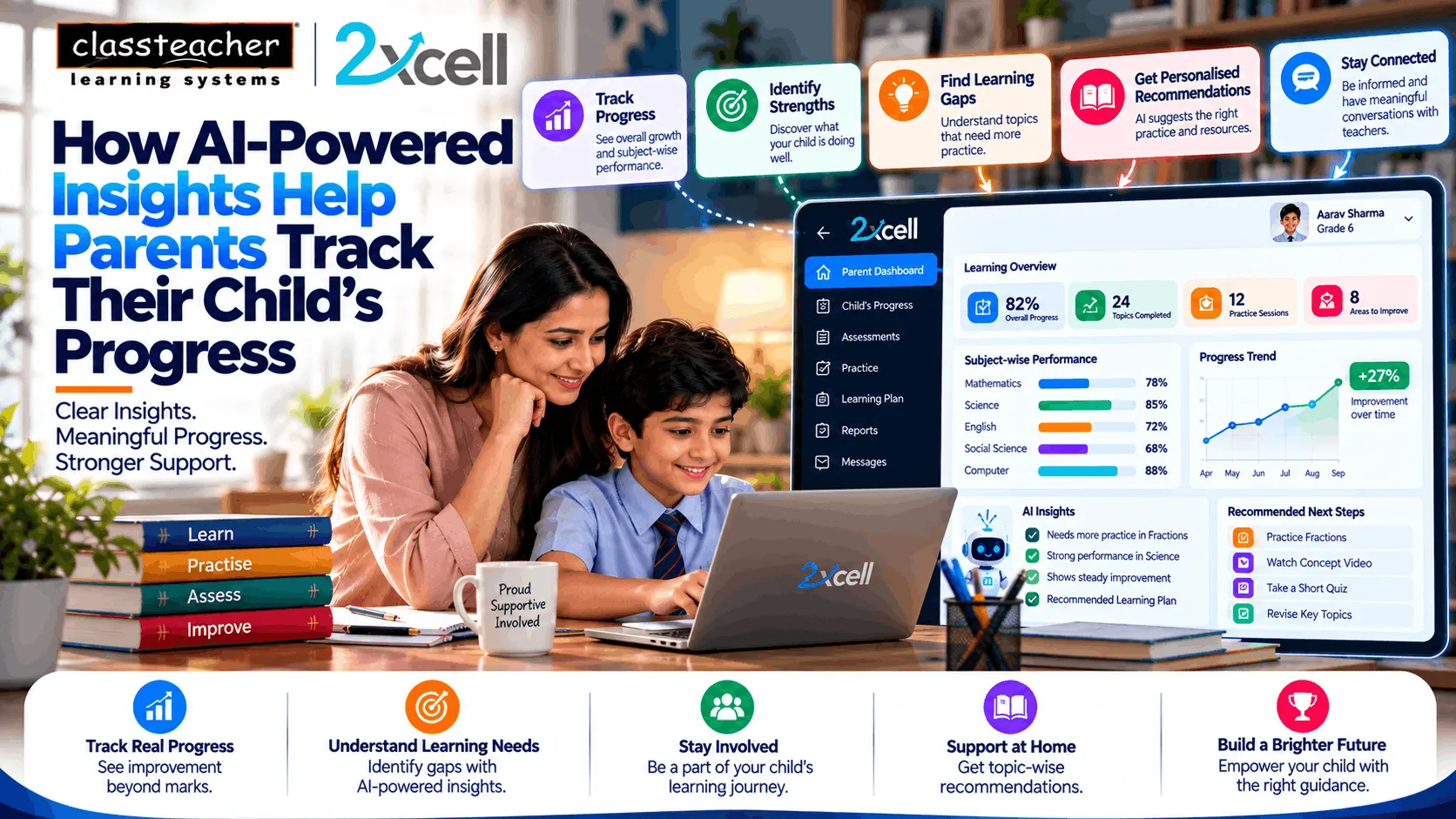
Introduction
For parents, understanding a child's academic progress has traditionally meant looking at report cards, examination marks, homework, and occasional conversations with teachers.
While these sources remain important, they may not always show the complete learning journey.
A student can score well in one examination while struggling with a particular concept. Another student may show gradual improvement that is not obvious from two examination scores. Parents may also want to know whether their child is practising regularly, which subjects require attention, and whether academic performance is improving over time.
This is where AI-powered learning insights can provide additional visibility.
By analysing relevant learning information from digital activities, assessments, practice sessions, and progress records, AI-enabled platforms can help present academic information in a more understandable form.
The objective is not to turn parents into academic analysts.
It is to help them understand:
Where is my child today? → What is improving? → Where is support needed? → What can we do next?
What Are AI-Powered Insights for Parents?
AI-powered insights are information generated by analysing learning and performance data through digital systems.
Depending on the platform, these insights may include:
- Assessment performance
- Topic-wise results
- Practice activity
- Learning progress
- Concept mastery
- Areas requiring improvement
- Performance trends
- Personalized learning recommendations
- Assessment history
- Progress over time
Instead of presenting parents with only a percentage or grade, a digital learning platform can organize relevant information into a broader picture of the student's academic journey.
Why Parents Need More Than Examination Marks
An examination score answers one question:
How did the student perform in that assessment?
But parents may have many other questions:
- Which topics has my child understood?
- Where is my child struggling?
- Is performance improving?
- Does my child need additional practice?
- Which subjects require more attention?
- Is the current learning support helping?
- What should we focus on next?
A single score cannot answer all these questions.
AI-powered analytics can potentially bring together multiple learning signals to provide more context.
1. AI Can Turn Learning Data Into Understandable Insights
Digital learning platforms can generate large amounts of information.
Parents may not need to see every individual data point.
Instead, AI can help organize relevant information into categories such as:
Strengths
Topics or skills where the student is performing consistently well.
Areas to Improve
Concepts where performance may require additional attention.
Progress
Changes in performance across different assessments or learning periods.
Recommended Focus
Areas where additional practice or revision may be useful.
This can make academic information easier for parents to understand.
2. Parents Can Track Progress Over Time
A single test provides a snapshot.
Progress tracking provides a timeline.
For example:
Assessment 1: 58%
Practice: Additional revision
Assessment 2: 66%
Targeted Practice: Topic-specific activities
Assessment 3: 75%
The numbers alone are useful, but the progression provides additional context.
Parents can see that the student's performance changed over time rather than judging progress from one examination.
3. Topic-Wise Insights Can Reveal Hidden Learning Gaps
Overall marks can sometimes hide differences between subjects or topics.
Imagine a student receives an overall mathematics score of 72%.
A detailed learning report may show:
Algebra: Strong
Geometry: Developing
Fractions: Needs additional practice
Data Handling: Strong
This gives parents a more specific understanding of where their child may need support.
Instead of saying:
"You need to study more mathematics."
Parents can have a more focused conversation:
"Let's spend some additional time practising fractions."
4. AI Can Highlight Changes in Performance
Performance is not always consistent.
A student who usually performs well may suddenly show a decline in a particular subject.
Similarly, a student who previously struggled may begin showing steady improvement.
AI-powered analytics can help identify changes across multiple learning activities.
For example:
Previous Performance → Current Performance → Trend → Possible Area for Attention
This can help parents notice changes earlier instead of waiting for the next major examination.
5. Parents Can Understand Their Child's Learning Strengths
Progress tracking should not focus only on weaknesses.
Understanding strengths is equally important.
A learning platform may reveal that a student demonstrates strong performance in:
- Problem solving
- Reading comprehension
- Science concepts
- Coding
- Mathematics
- Creative activities
- Application-based questions
Parents can use these insights to encourage areas where their child is already developing confidence.
A balanced progress report should answer both:
What needs improvement?
and
What is the child doing well?
6. AI Can Help Identify the Need for Additional Practice
Students may not always know which topics they should practise.
AI-powered systems can analyse assessment and practice information to identify areas where additional activities may be useful.
For example:
Low Topic Performance → Additional Practice → Reassessment
A student may then receive practice focused specifically on the concept that requires attention.
Parents can understand why that practice has been recommended instead of simply asking the child to revise an entire subject.
7. Parents Can Follow Learning Activity, Not Just Results
Marks are only one part of learning.
Depending on the platform, parents may also be able to understand learning activity such as:
- Practice completed
- Assessments attempted
- Topics studied
- Learning resources accessed
- Progress across activities
- Areas revisited
This can provide additional context around academic performance.
For example, a student who receives an average score but is consistently practising may be showing a positive learning trend.
8. AI Can Help Parents Have More Meaningful Conversations
Parent-child conversations about education sometimes become focused only on marks.
AI-powered insights can help make these conversations more specific.
Instead of asking:
"How much did you score?"
Parents can ask:
"Which topic did you find difficult?"
"What did you learn this week?"
"Would you like some help with this concept?"
"Do you think the extra practice is helping?"
This can shift the conversation from marks alone towards learning and improvement.
9. Parents Can Better Understand Teacher Recommendations
Teachers may recommend additional revision, practice, or support based on classroom observations and assessment results.
Digital learning insights can provide additional context around these recommendations.
For example:
Teacher Observation + Assessment Data + Learning Analytics
Together, these can provide a broader understanding of the student's needs.
AI does not replace the teacher's judgement.
Instead, it can organize learning information that teachers and parents can discuss.
10. AI Can Help Track Whether Support Is Working
Providing additional practice is only the beginning.
Parents and teachers also need to know whether the intervention helped.
Consider this cycle:
Identify Gap → Provide Support → Practise → Reassess → Compare Progress
If performance improves, the learning support may have contributed to progress.
If difficulties continue, the teacher may consider another strategy.
This makes academic support an ongoing process rather than a one-time recommendation.
AI Insights Can Support Earlier Parent Intervention
Waiting for a final examination can delay conversations about academic difficulties.
If learning analytics indicate a repeated issue, parents and teachers can discuss it earlier.
For example:
September: Difficulty identified
October: Additional practice
November: Progress reviewed
December: Support adjusted
This gives families and schools more opportunities to respond during the learning journey.
AI Does Not Judge a Child
This is an important distinction.
An AI system may identify that a student's performance has declined.
But it cannot automatically know the complete reason.
There may be many factors behind a change in performance.
Therefore, AI insights should be treated as signals for discussion, not final conclusions about a student.
The appropriate approach is:
AI Shows the Pattern → Teacher Adds Context → Parent Understands the Situation → Support Is Planned
The Teacher-Parent Connection Becomes More Important
Technology can make information easier to access, but meaningful student support still requires collaboration.
Teachers understand classroom behaviour, academic context, and learning requirements.
Parents understand the child's home environment, routines, interests, and individual circumstances.
AI can provide another layer of information connecting these perspectives.
This can create a more collaborative model:
School Data + Teacher Expertise + Parent Understanding = Better Student Support
How AI Can Support Different Parent Needs
Not every parent wants the same type of information.
Parents Looking for Academic Progress
They may focus on:
- Performance trends
- Assessment results
- Topic-wise progress
Parents Supporting Revision
They may focus on:
- Weak concepts
- Recommended practice
- Upcoming assessments
Parents Monitoring Improvement
They may focus on:
- Progress over time
- Intervention results
- Concept mastery
Parents Preparing for Parent-Teacher Meetings
They may use learning insights to prepare more specific questions.
How 2xcell Can Support Parent-Centred Learning Insights
2xcell AI Learning Platform by CLASSTEACHER Learning Systems can support a connected digital learning environment involving content, practice, assessment, analytics, and personalized learning.
A connected learning journey can follow:
Learn → Practise → Assess → Analyse → Support → Improve
Within such an environment, learning information can help schools gain greater visibility into student progress while supporting communication with parents.
Parents can potentially use meaningful progress information to understand:
- Areas of strength
- Topics requiring attention
- Learning progress
- Practice requirements
- Changes in performance
The objective is to make academic information more useful for conversations between students, teachers, schools, and parents.
What Parents Should Look for in an AI Learning Platform
Parents and schools should not judge a learning platform only by how much data it displays.
Useful parent-facing insights should be:
Clear
Information should be easy to understand.
Relevant
Reports should focus on meaningful learning information.
Actionable
Parents should understand what the information may suggest doing next.
Consistent
Progress should be tracked across appropriate learning activities.
Responsible
Student information should be handled with appropriate privacy and security practices.
Teacher-Supported
AI insights should complement, not replace, teacher guidance.
Avoiding Information Overload for Parents
More information does not necessarily mean better understanding.
A parent dashboard containing hundreds of charts and statistics may become difficult to interpret.
A useful parent report could instead highlight:
Current Progress
Key Strengths
Areas Requiring Attention
Recent Improvement
Recommended Practice
Next Learning Goal
This makes information more practical for families.
AI Insights Should Encourage Learning, Not Pressure
Student analytics should be used carefully.
Parents should avoid treating every score as a judgment of their child's ability.
Learning involves:
- Progress
- Practice
- Mistakes
- Curiosity
- Confidence
- Application
- Improvement
AI-powered insights should therefore support constructive conversations rather than create unnecessary pressure.
The purpose of tracking should be:
Understand → Support → Encourage → Improve
Responsible Use of Student Data
Parent access to student information should also be managed responsibly.
Schools and EdTech providers should consider:
- Data privacy
- Secure authentication
- Appropriate access controls
- Protection of academic records
- Responsible AI use
- Transparency about data processing
- Secure storage
- Appropriate data retention
Parents should also understand what information is available to them and how it is being used.
How Schools Can Make AI Insights Useful for Parents
Schools can introduce parent-facing analytics through a structured process.
Step 1: Define What Parents Need to Know
Focus on meaningful learning information.
Step 2: Connect Relevant Learning Data
Bring together appropriate assessment and practice information.
Step 3: Present Clear Insights
Avoid unnecessary technical details.
Step 4: Connect Insights With Teacher Guidance
Provide context around important changes.
Step 5: Encourage Constructive Conversations
Use data as a starting point for discussion.
Step 6: Track Progress
Review whether the student's learning improves over time.
The Future of Parent-Connected Education
As AI-powered learning systems develop, parents may receive increasingly useful information about their child's academic journey.
A future learning ecosystem could connect:
Student Learning
↓
Digital Activity
↓
Assessment
↓
AI Analysis
↓
Teacher Insight
↓
Parent Visibility
↓
Targeted Support
↓
Progress Measurement
This creates a stronger connection between what happens inside the classroom and the support students receive outside it.
The objective is not to turn parents into teachers.
It is to give them better information so they can participate more meaningfully in their child's learning journey.
Conclusion
Parents want to know more than their child's latest examination score.
They want to understand whether their child is progressing, which concepts are difficult, where strengths are developing, and what kind of support may be useful.
AI-powered learning insights can help bring together relevant academic information and present it in a more understandable form.
When combined with teacher expertise, meaningful assessments, personalized practice, and responsible data management, these insights can help create stronger communication between schools and families.
With 2xcell AI Learning Platform by CLASSTEACHER Learning Systems, schools can explore a connected approach to digital learning, assessment, analytics, personalized learning, and student progress tracking.
The goal is simple:
Better Insights. Better Conversations. Better Support for Every Child.
2xcell AI Learning Platform
By CLASSTEACHER Learning Systems
Empowering Education with AI & Innovation.