Introduction
India’s National Education Policy (NEP) 2020 calls for a shift towards education that emphasizes conceptual understanding, critical thinking, creativity, flexibility, and the holistic development of students.
For schools, implementing these goals involves more than updating textbooks or introducing new classroom activities. It requires changes in teaching practices, assessment methods, curriculum planning, teacher development, and the way student progress is monitored.
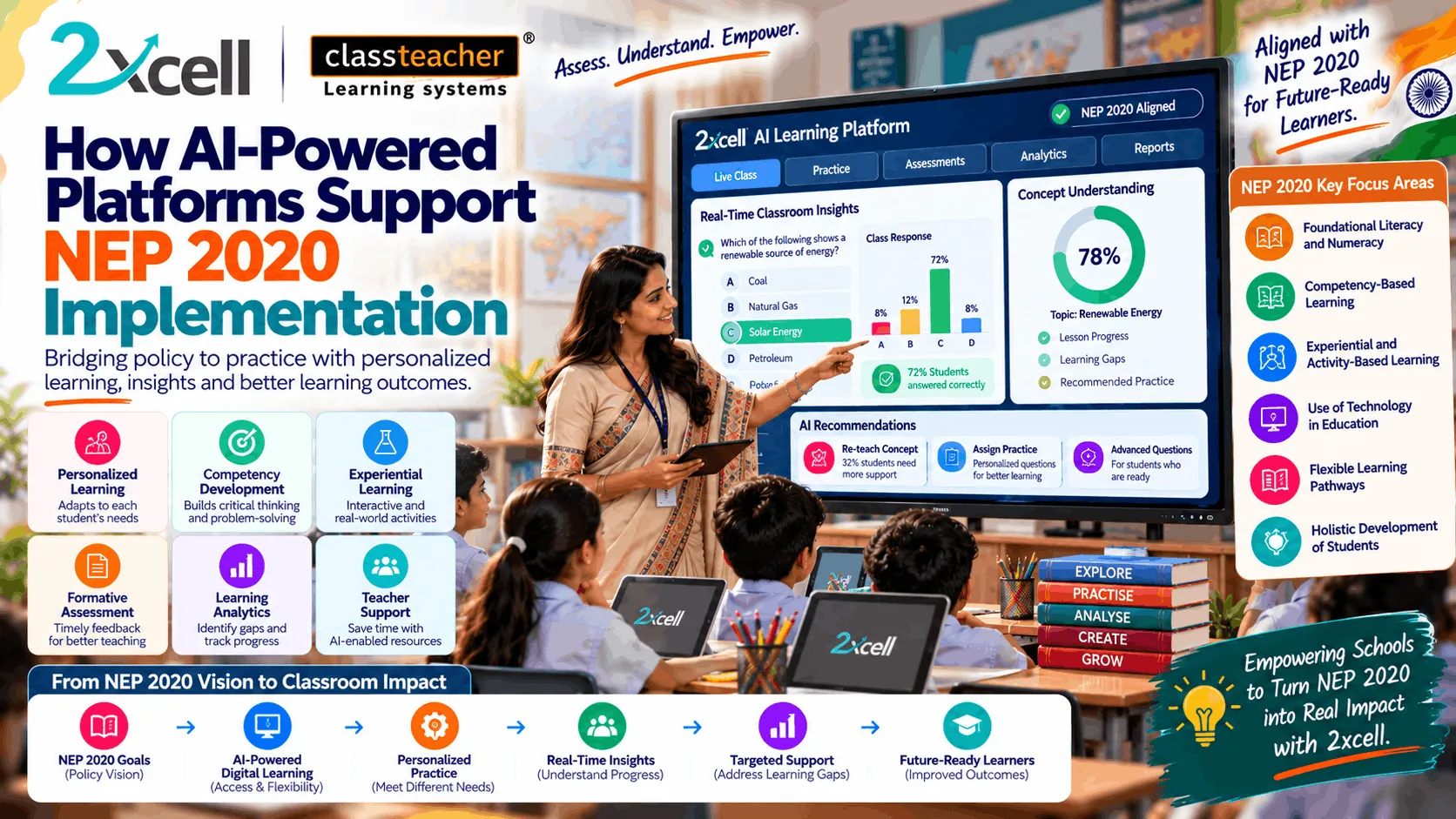
Artificial Intelligence (AI) can support this transition by helping schools connect digital learning resources, personalized practice, assessments, analytics, and academic planning.
Rather than treating technology as a replacement for classroom teaching, schools can use AI-powered platforms to make learning more responsive, support teachers with relevant information, and help students develop skills beyond memorization.
A connected approach can follow:
NEP 2020 Goals → Digital Learning → Competency-Based Practice → Assessment → Learning Insights → Targeted Support
The key is to use technology in ways that support educational objectives while keeping teachers, students, and responsible decision-making at the centre.
Understanding NEP 2020 in the Context of Digital Education
NEP 2020 provides a broader vision for transforming India's education system. It emphasizes foundational literacy and numeracy, competency-based learning, experiential education, flexibility in learning pathways, and the use of technology where appropriate.
For schools, these priorities can translate into practical academic goals, such as:
- Helping students understand concepts rather than simply memorize information.
- Encouraging inquiry, creativity, and problem-solving.
- Connecting classroom knowledge with practical applications.
- Supporting different levels of student readiness.
- Improving assessment practices.
- Strengthening teacher capacity.
- Using educational technology purposefully.
- Monitoring progress and addressing learning gaps.
AI-powered platforms can contribute to some of these objectives by supporting teaching and learning processes. However, technology alone does not ensure NEP 2020 implementation. Curriculum planning, teacher preparation, school leadership, and classroom practices remain essential.
1. Supporting Competency-Based Learning
One important direction of NEP 2020 is moving towards learning that focuses on competencies and the application of knowledge.
Students should not only remember facts but also demonstrate that they can explain concepts, solve problems, and use what they have learned.
AI-enabled learning platforms can support this approach through topic-based practice, application questions, interactive activities, and assessments designed around specific learning objectives.
For example, instead of asking students only to define evaporation, a science activity could ask them to explain how evaporation contributes to the water cycle.
The learning process becomes:
Understand the Concept → Apply Knowledge → Solve a Problem → Demonstrate Competency
Teachers can use the results to identify whether students understand the concept or need additional guidance.
2. Encouraging Experiential and Activity-Based Learning
Experiential learning connects academic concepts with activities, observation, experimentation, and real-world situations.
AI-powered platforms can complement these experiences through interactive simulations, guided activities, digital demonstrations, and problem-solving exercises.
For example, students studying environmental science could explore a simulation showing how changes in rainfall affect water availability.
In mathematics, learners could investigate how changing values affect a graph. In computer science, students could experiment with code and observe the results.
These activities can help students explore relationships rather than relying exclusively on written explanations.
The important distinction is that digital activities should complement practical classroom experiences, not replace experiments, projects, or meaningful interaction with teachers.
3. Making Learning More Personalized
Students enter classrooms with different levels of prior knowledge, learning needs, and academic confidence.
A single explanation or identical practice assignment may not provide the same level of support to every learner.
AI-powered platforms can use available performance information to recommend relevant content, adjust practice difficulty, or suggest additional revision.
For example:
- Student A: Needs foundational explanations and guided questions.
- Student B: Understands the basics and needs application-based practice.
- Student C: Is ready for advanced problem-solving activities.
All three students can work towards the same learning objective while receiving different levels of practice.
This can support the broader goal of making education more responsive to individual learning requirements.
Personalization should remain flexible, and teachers should be able to review recommendations rather than allowing an automated system to make every academic decision.
4. Strengthening Foundational Learning
Foundational literacy and numeracy are essential for students to progress through later stages of education.
If students have difficulty with basic reading, number sense, or mathematical operations, more advanced concepts can become challenging.
AI-enabled learning systems may help teachers identify recurring difficulties through practice results and topic-level assessments.
For example, if a student repeatedly struggles with basic arithmetic, the platform may recommend additional practice before introducing more complex calculations.
Teachers can then provide suitable explanations, activities, or remedial support.
A possible learning cycle is:
Assess Foundational Skills → Identify Gaps → Provide Practice → Review Progress
Such tools can assist with monitoring, but foundational learning also depends on effective instruction, appropriate materials, regular practice, and individual teacher support.
5. Supporting Flexible Learning Pathways
NEP 2020 encourages greater flexibility in education, including opportunities for students to explore different subjects and learning experiences.
Digital platforms can support this flexibility by organizing resources according to subjects, grades, topics, competencies, and difficulty levels.
Students may be able to revisit earlier concepts, explore supplementary resources, or practise specific skills outside scheduled classroom lessons.
Teachers can use these resources to support revision, enrichment, and additional learning opportunities.
For example, a student who has mastered a science concept may explore an advanced activity, while another student can revisit the foundational explanation.
This provides more flexibility without losing sight of the intended academic outcomes.
6. Improving Assessment Practices
Assessment plays an important role in understanding whether students have achieved the intended learning outcomes.
AI-powered platforms can support different stages of assessment through digital quizzes, question banks, automated scoring for suitable question types, and performance summaries.
These tools can help teachers examine:
- Concept-wise understanding.
- Commonly incorrect responses.
- Performance across assessments.
- Areas requiring additional practice.
- Progress towards learning objectives.
For example, a teacher conducting a mathematics assessment may discover that students perform well in basic calculations but struggle with application-based questions.
This information can guide the next lesson.
AI-supported assessment should complement teacher judgement and other forms of evaluation, including projects, classroom discussions, practical work, and written responses that require human review.
7. Using Formative Assessment to Guide Teaching
Formative assessment provides information about student understanding while learning is still taking place.
Instead of waiting until the end of a term, teachers can use short quizzes, classroom polls, exit questions, and digital activities to check comprehension.
AI-powered systems may help organize the resulting information and highlight areas that need attention.
For example, after a history lesson, a teacher can conduct a short assessment to determine whether students understand the causes and consequences of an event.
If responses indicate confusion, the teacher can introduce another explanation, a timeline, or a discussion activity.
The cycle becomes:
Teach → Check Understanding → Interpret Responses → Adapt Instruction → Reassess
This makes assessment more useful as part of everyday teaching rather than treating it only as a method of assigning marks.
8. Helping Teachers Identify Learning Gaps
Learning gaps may remain unnoticed when teachers have access only to overall examination scores.
Topic-level performance data can provide a more detailed view of student understanding.
For instance, a student's mathematics report might indicate:
- Fractions: Needs more practice.
- Algebra: Developing.
- Geometry: Strong.
- Data handling: Strong.
This information can help teachers select appropriate revision activities and provide targeted support.
At the classroom level, similar patterns may reveal that several students are struggling with the same concept.
Teachers can then investigate whether the topic requires another explanation, additional practice, or a different teaching approach.
AI can help highlight patterns, but educators should interpret those patterns in the context of each student's learning experience.
9. Reducing Repetitive Teacher Work
Successful implementation of educational reforms requires teachers to spend time planning lessons, designing activities, evaluating learning, and supporting students.
Certain AI tools can assist with repetitive preparation tasks.
Depending on the platform, teachers may use AI to help draft:
- Practice questions.
- Revision worksheets.
- Lesson activity ideas.
- Differentiated exercises.
- Question banks.
- Study summaries.
- Assessment drafts.
For example, a teacher preparing a lesson on fractions could use an AI tool to draft basic, intermediate, and advanced questions.
The teacher would then check their accuracy, curriculum alignment, difficulty, and suitability before using them.
AI should support teacher preparation rather than remove professional control over educational content.
10. Supporting Teacher Development and Digital Readiness
Technology adoption is effective only when teachers understand how to use it appropriately.
Teachers may require training in digital lesson planning, assessment design, learning analytics, AI-assisted content creation, and responsible use of student data.
AI-powered platforms can provide opportunities to explore new teaching resources and review classroom learning information.
However, platforms cannot replace structured professional development, peer collaboration, mentoring, and practical training.
Schools can support teachers through a continuous development cycle:
Training → Classroom Application → Reflection → Feedback → Improvement
This approach can help teachers become more confident in using technology to support educational objectives.
11. Connecting Learning Resources Across Subjects
NEP 2020 encourages a broader approach to learning, including connections between academic knowledge, practical skills, and real-world problems.
Digital platforms can help schools organize resources across subjects and learning objectives.
For example, an environmental project might connect:
- Science concepts about ecosystems.
- Mathematics involving data and measurement.
- Geography related to natural resources.
- Language skills for preparing a project report.
- Digital skills for presenting findings.
AI tools may assist teachers in generating activity ideas or identifying possible connections between topics.
Teachers should review these suggestions to ensure that the activities are age-appropriate, accurate, and relevant to the curriculum.
12. Encouraging Critical Thinking and Problem-Solving
Education should help students learn how to think, investigate, evaluate information, and solve problems.
AI-powered learning activities can support this objective when they encourage students to reason rather than simply accept an answer.
For example, a digital activity could present a real-world problem and ask students to compare different solutions.
Students might need to examine evidence, explain their choices, or identify weaknesses in a proposed approach.
Teachers can use these activities to encourage discussion and evaluate students' reasoning.
The goal is not to let AI do the thinking for students. It is to use technology to create more opportunities for independent thought and meaningful problem-solving.
13. Making Academic Progress Easier to Monitor
School leaders and teachers need relevant information to understand how students are progressing.
Digital learning platforms can bring together information from assessments, practice activities, and other supported learning processes.
Depending on the system, dashboards may help educators review:
- Assessment results.
- Topic-level performance.
- Practice completion.
- Learning gaps.
- Progress over time.
- Areas requiring intervention.
Such information can support academic planning and follow-up.
Schools should avoid relying on a single score or automated indicator to make important decisions about a student. Academic progress should be understood through multiple sources of evidence and teacher observations.
14. Supporting Inclusive Learning Opportunities
Students may have different educational needs, levels of preparation, language requirements, and access to learning resources.
Digital platforms can offer additional ways to engage with content through videos, written explanations, audio, interactive activities, and practice exercises.
Where suitable accessibility features are available, technology may also help students access learning material in ways that better fit their requirements.
Schools should evaluate whether a platform is usable by students with different needs and whether appropriate support is available.
Digital learning should expand educational opportunities rather than create additional barriers for students who have limited device access, internet connectivity, or digital familiarity.
15. Supporting Multilingual Learning
Language can influence how students access educational content, particularly in classrooms where learners have different linguistic backgrounds.
Digital learning platforms may provide resources in multiple languages, subject to the content and features available.
AI tools can also assist teachers with drafting simplified explanations, vocabulary exercises, and language-support materials.
For example, a teacher could prepare a glossary of important science terms alongside clear explanations in the language used for classroom instruction.
Any AI-generated translation or explanation should be reviewed for accuracy and subject-specific meaning.
Multilingual support can be valuable when it helps students understand concepts without reducing the academic quality of the content.
16. Helping Schools Build a More Connected Learning Environment
Educational technology is most useful when its different components work together.
A connected learning environment may include digital content, classroom activities, practice, assessments, and progress reports.
For example:
Classroom Lesson → Digital Practice → Assessment → Performance Review → Targeted Support
This structure can help teachers connect what happens during instruction with the activities students complete afterward.
Schools should assess whether the platforms they adopt integrate effectively with existing teaching practices and systems.
A collection of disconnected tools may create additional work rather than improve academic coordination.
17. Using AI Responsibly in Education
AI adoption must include appropriate safeguards.
Student information, assessment records, and learning activity data should be handled responsibly. Schools should understand what information a platform collects, how it is used, who can access it, and how it is protected.
They should also review AI-generated educational content for accuracy, bias, age suitability, and curriculum alignment.
Important considerations include:
- Student data privacy and security.
- Transparency about AI-supported decisions.
- Teacher oversight.
- Accuracy of generated content.
- Fairness and accessibility.
- Appropriate use of student performance information.
- Clear procedures for correcting errors.
AI should support educational decisions without replacing human accountability.
18. Measuring Whether Technology Supports NEP 2020 Goals
Buying or introducing an AI platform is not, by itself, evidence that a school is implementing NEP 2020 effectively.
Schools should identify the outcomes they want to improve and measure relevant indicators over time.
Possible indicators include:
Educational objective
What schools can review
Competency-based learning
Performance on application-based questions
Foundational learning
Progress in essential literacy and numeracy skills
Personalized support
Participation in targeted practice and subsequent progress
Formative assessment
Frequency and usefulness of learning checks
Teacher development
Training completion and classroom application
Student engagement
Participation in relevant learning activities
Learning improvement
Changes in assessment performance over time
These measures should be interpreted carefully. Improvements may depend on teaching quality, student circumstances, resources, and other factors, not technology alone.
19. How 2xcell Can Support AI-Enabled Digital Learning
2xcell AI Learning Platform by CLASSTEACHER Learning Systems can be positioned within a connected digital learning approach that brings together relevant learning content, practice, assessments, analytics, personalized learning, and student progress tracking.
These elements can support several activities associated with schools' broader educational objectives.
For example, a school could use digital learning resources to support classroom teaching, practice activities to reinforce concepts, assessments to check understanding, and available analytics to review student performance.
A connected learning cycle can follow:
Learn → Practise → Assess → Analyse → Support → Improve
The usefulness of this approach depends on the platform's actual features, curriculum alignment, implementation quality, and the way teachers use the available information.
2xcell can be explored as part of a school's wider digital learning strategy, alongside teacher development, classroom interaction, academic planning, and responsible technology practices.
20. Building a Practical Roadmap for NEP 2020 Implementation
Schools do not need to introduce every digital tool at once.
A phased approach can help them identify priorities and assess what works in their context.
Step 1: Identify Educational Priorities
Determine which areas require attention, such as foundational learning, competency-based assessment, digital resources, or teacher development.
Step 2: Review Existing Practices
Understand current teaching methods, assessment processes, technology access, and staff readiness.
Step 3: Select Appropriate Tools
Choose platforms based on clear educational needs rather than the number of AI features they offer.
Step 4: Train Teachers
Provide practical guidance on using the technology, reviewing AI outputs, and interpreting learning information.
Step 5: Introduce a Pilot
Begin with selected classes, subjects, or learning objectives before expanding across the school.
Step 6: Evaluate Outcomes
Review student progress, teacher feedback, accessibility, workload, and the usefulness of the available insights.
Step 7: Improve and Expand
Refine implementation based on evidence before introducing the approach more widely.
This creates a more deliberate process:
Plan → Implement → Observe → Evaluate → Improve → Scale
Challenges Schools Should Consider
AI-powered platforms can offer useful support, but schools should evaluate several practical challenges before adoption.
Infrastructure: Reliable devices, connectivity, and technical support may be required.
Teacher Readiness: Staff need sufficient training and time to use the tools effectively.
Content Quality: Educational resources must be accurate and appropriate for the intended curriculum.
Digital Equity: Students should not be disadvantaged because of limited access to devices or connectivity.
Data Protection: Student information must be managed responsibly.
Implementation Costs: Schools should consider licensing, training, maintenance, and ongoing support.
Human Oversight: Teachers must remain involved in interpreting insights and making important academic decisions.
Addressing these issues can help schools make technology adoption more sustainable and educationally meaningful.
The Future of AI and NEP 2020 Implementation
As educational technology develops, schools may increasingly connect digital resources, competency-based assessments, learning analytics, and teacher support into coordinated academic environments.
A future learning process could look like:
NEP-Aligned Learning Objective
↓
Teacher-Led Instruction
↓
Digital or Practical Activity
↓
Competency-Based Assessment
↓
Review of Learning Evidence
↓
Personalized Support
↓
Progress Monitoring
↓
Instructional Improvement
This model can help schools connect educational goals with classroom practice while preserving the importance of human interaction, practical learning, and professional judgement.
The real opportunity lies in using AI purposefully—not adopting technology simply because it is available.
Conclusion
NEP 2020 encourages schools to strengthen conceptual understanding, competency-based learning, experiential education, flexibility, and student development.
AI-powered platforms can support these priorities through digital learning resources, personalized practice, assessment tools, learning analytics, and progress monitoring.
However, successful implementation requires more than technology. Schools also need trained teachers, appropriate curriculum planning, inclusive access, responsible data practices, and clear methods for evaluating educational outcomes.
With 2xcell AI Learning Platform by CLASSTEACHER Learning Systems, schools can explore a connected approach to digital learning, assessment, analytics, personalized practice, and student progress tracking as part of their broader educational strategy.
The objective is to use technology where it adds genuine value: helping teachers make informed decisions, giving students meaningful opportunities to learn, and supporting schools as they work towards their educational goals.
Purposeful Technology. Empowered Teachers. Future-Ready Learners.
2xcell AI Learning Platform
By CLASSTEACHER Learning Systems
Empowering Education with AI & Innovation.