Introduction
Learning becomes more meaningful when students have opportunities to explore ideas beyond textbooks and classroom explanations. Understanding a scientific principle is one thing; applying it through an experiment, building a working model, or solving a practical challenge is another.
Schools today are looking for ways to connect academic knowledge with experiences that encourage curiosity, creativity, collaboration, and problem-solving. A thoughtfully planned Composite Skills Lab can provide an environment where students investigate concepts, experiment with ideas, and develop practical skills through structured activities.
However, establishing a skills lab involves more than arranging equipment in a dedicated room. Schools need to consider curriculum objectives, student age groups, available space, teacher readiness, safety requirements, and long-term implementation goals.
The objective is to create a learning environment where students can move from understanding concepts to exploring how those concepts work in practice.
What Is a Composite Skills Lab?
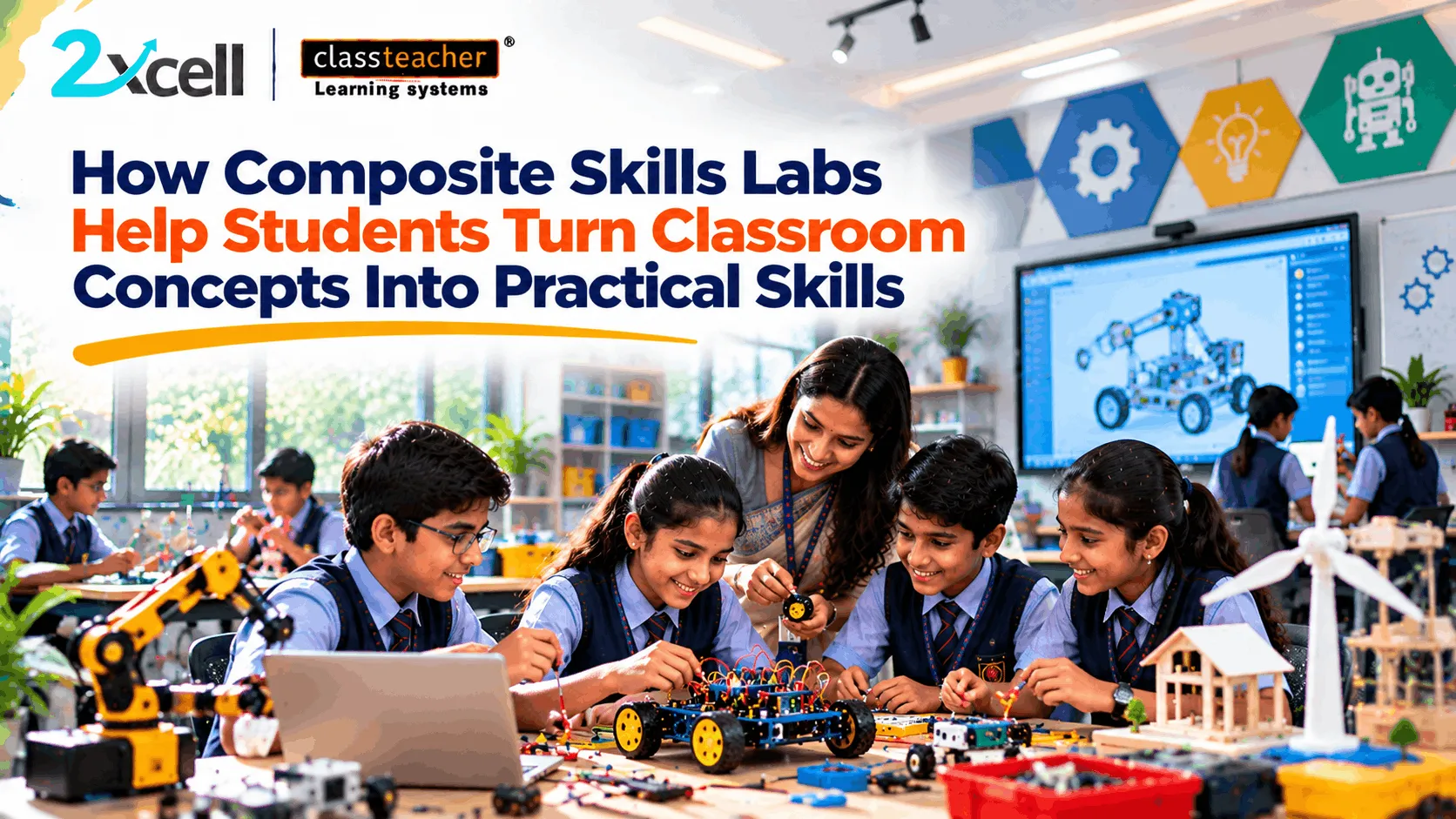
A Composite Skills Lab is a dedicated learning environment designed to bring practical and skill-based educational activities together in a structured setting.
Depending on its design and available resources, it can support activities involving science, technology, engineering, robotics, coding, design, and creative problem-solving.
Instead of studying every concept only through written explanations, students can engage in activities that require them to observe, build, test, investigate, and improve their ideas.
For example, a lesson about simple machines can be extended through model construction, while a coding concept can be explored by developing and testing a basic program.
The specific activities and equipment should reflect the school's curriculum, student requirements, and intended learning outcomes.
1. Connecting Academic Concepts With Practical Experiences
One of the main opportunities offered by a skills lab is the ability to connect theoretical knowledge with practical exploration.
Students may understand a concept during a lesson but need additional opportunities to see how it operates in a real situation.
A practical activity can help bridge this gap.
For example, students learning about renewable energy could investigate how a small solar-powered model works. They could observe its components, discuss how energy is converted, and examine the conditions that affect its performance.
This creates a learning sequence:
Understand → Explore → Experiment → Observe → Apply
The activity gives students an opportunity to connect classroom explanations with observable results.
2. Encouraging Learning Through Experimentation
Experimentation allows students to investigate questions rather than simply memorize answers.
In a skills lab, teachers can introduce challenges that encourage learners to make predictions, test different approaches, and examine the outcomes.
For instance, students building a structure from simple materials might investigate which design supports the greatest weight.
They can compare different structures, record results, identify weaknesses, and modify their designs.
This process encourages students to think about why a particular approach succeeds or fails.
A structured experimentation cycle can follow:
- Identify a question.
- Make a prediction.
- Plan an activity.
- Test the idea.
- Record observations.
- Discuss the results.
- Improve the approach.
The emphasis is on understanding the process, not merely completing the task.
3. Developing Problem-Solving Skills
Practical challenges can help students develop systematic approaches to solving problems.
A skills lab activity might ask learners to design a model, identify a technical issue, or find a way to complete a task using limited resources.
Students need to understand the problem, consider possible solutions, select an approach, and evaluate the result.
For example, a robotics challenge may require students to investigate why a robot is not following the intended path. They can review its construction, examine the programming logic, and test adjustments.
Such activities provide opportunities to practise logical reasoning and learn from mistakes.
The goal is to encourage students to ask not only, "What went wrong?" but also, "What evidence can help us improve it?"
4. Introducing Robotics and Coding Through Practical Projects
Robotics and coding can provide students with opportunities to explore how software, hardware, and logical instructions work together.
Depending on their grade level and prior experience, students may begin with simple programming tasks and gradually progress to more complex projects.
Possible activities include:
- Programming a character or object to follow instructions.
- Building a basic robotic model.
- Testing sensors and movement.
- Identifying and correcting coding errors.
- Designing a solution to a defined challenge.
- Presenting and explaining a completed project.
Students can observe how small changes in instructions affect the output.
This makes coding more than an exercise in writing commands. It becomes a process of designing, testing, and refining solutions.
Schools should select suitable activities and equipment according to student readiness, curriculum requirements, and teacher expertise.
5. Encouraging Creativity and Design Thinking
Creativity grows when students have opportunities to generate ideas and explore different ways to solve a problem.
A Composite Skills Lab can support design-based activities in which students plan, construct, test, and improve their creations.
For example, a class might be asked to design a model that uses materials efficiently or develop a simple solution to a classroom challenge.
Students can sketch possible designs, compare alternatives, create prototypes, and discuss what they would change.
A practical design process can follow:
Imagine → Plan → Build → Test → Refine
This approach encourages students to understand that good solutions often develop through repeated experimentation rather than a single attempt.
It also gives teachers opportunities to observe how students approach open-ended tasks.
6. Building Collaboration and Communication Skills
Many skills-lab activities involve working in groups.
Students may need to share materials, assign responsibilities, discuss ideas, solve disagreements, and present their findings.
These experiences can help learners practise communication and collaboration alongside technical skills.
For example, a group project could involve one student planning the design, another assembling the model, and another recording the results. Students can then review the work together and explain the final outcome.
Teachers should ensure that responsibilities are shared fairly and that every student has opportunities to participate.
A practical project is most valuable when students learn from both the task and the process of working together.
7. Making Learning Relevant Across Subjects
A well-planned skills lab can provide opportunities to connect multiple subjects through a common activity.
For example, designing a small bridge may involve:
Mathematics: Measuring dimensions and comparing quantities.
Science: Exploring forces, balance, and material properties.
Technology: Using digital tools to plan or document the design.
Engineering: Building and testing the structure.
Communication: Presenting findings and explaining improvements.
This interdisciplinary approach helps students see how different concepts can work together to solve a problem.
The activities should remain connected to clear curriculum objectives rather than combining subjects simply for the sake of variety.
8. Supporting Different Grade Levels
A skills lab should be designed around the developmental needs of its students.
Younger learners may benefit from simple construction activities, guided experiments, and basic sequencing tasks. Older students may be ready for coding projects, robotics challenges, design investigations, and more independent problem-solving.
Schools can plan activities that progress in complexity as students develop their skills.
For example:
- Foundational level: Observation, sorting, building, and basic cause-and-effect activities.
- Intermediate level: Guided experiments, simple coding, and structured design challenges.
- Advanced level: Independent projects, robotics programming, data interpretation, and iterative design.
These are illustrative categories rather than fixed grade assignments. Schools should adapt the activities to their curriculum and students' abilities.
9. The Teacher's Role in a Skills Lab
Practical learning still requires strong teaching and careful planning.
Teachers introduce the learning objective, explain procedures, organize resources, guide experimentation, and help students interpret their observations.
Without this guidance, students may complete an activity without fully understanding the concept it was intended to teach.
Teachers can strengthen the experience by:
- Explaining the purpose of each activity.
- Demonstrating equipment use and safety procedures.
- Asking questions that encourage reasoning.
- Allowing students to test their own ideas.
- Helping students understand mistakes.
- Connecting practical observations with academic concepts.
- Reviewing what students learned at the end.
Schools should also provide teachers with suitable training and opportunities to practise using lab resources before introducing new activities to students.
10. Planning the Right Skills Lab for a School
There is no single skills-lab configuration that suits every school.
The appropriate setup depends on the institution's curriculum, available space, student numbers, budget, infrastructure, and learning goals.
Before making an investment, school leaders should consider the following areas.
Curriculum Alignment
Identify the subjects, skills, and learning outcomes the lab is expected to support.
Space and Layout
Determine how students will move between activities, access equipment, work in groups, and receive teacher guidance.
Equipment and Resources
Select resources according to the planned activities, age groups, maintenance requirements, and safety considerations.
Teacher Readiness
Establish what training and ongoing support educators will need to use the lab effectively.
Safety and Supervision
Define procedures for equipment handling, storage, supervision, and maintenance.
Implementation and Evaluation
Plan how the lab will be introduced, how activities will be scheduled, and how the school will review its educational value.
A clear implementation plan can help schools avoid purchasing equipment without a defined purpose.
11. Measuring Learning Beyond Project Completion
Completing a project does not automatically demonstrate that a student has understood the underlying concept.
Schools should consider how they will assess the learning that takes place during practical activities.
Teachers can review:
- Students' understanding of key concepts.
- Their ability to explain a process.
- How they identify and solve problems.
- Their use of evidence during experimentation.
- Their contribution to group work.
- Their ability to improve a design.
- Their reflections on what they learned.
For example, a student who builds a successful model should also be encouraged to explain how it works, which challenges arose, and what changes improved the result.
This allows teachers to assess both the final output and the reasoning behind it.
12. How CLASSTEACHER Learning Systems Can Support Skills-Based Education
Schools exploring practical learning environments can evaluate educational solutions that align with their curriculum and implementation goals.
CLASSTEACHER Learning Systems offers education-focused solutions, including Composite Skills Lab-related learning environments, that schools can consider when planning practical and technology-supported learning experiences.
The 2xcell AI Learning Platform by CLASSTEACHER Learning Systems may also be considered as part of a broader digital learning strategy, depending on the platform's available features and the school's requirements.
When evaluating these solutions, school leaders should consider how the resources support teaching objectives, student activities, teacher preparation, and the assessment of learning outcomes.
The right approach is not simply to introduce more equipment. It is to create a structured environment in which educational resources support purposeful exploration and skill development.
Common Challenges Schools Should Consider
Introducing a skills lab can involve practical and organizational challenges.
Limited space: Plan the layout around the intended activities and the number of students using the lab.
Resource constraints: Prioritize essential equipment and expand the setup as requirements develop.
Teacher training: Provide practical preparation and ongoing support.
Student safety: Establish clear procedures and appropriate supervision.
Equipment maintenance: Plan for storage, servicing, and replacement where necessary.
Curriculum integration: Ensure activities support specific learning objectives.
Assessment: Establish ways to evaluate students' understanding and skill development, not just their completed projects.
Addressing these considerations early can help schools create a more sustainable learning environment.
Conclusion
A Composite Skills Lab can offer students opportunities to move beyond theoretical explanations and engage with concepts through practical activities, experiments, design challenges, robotics, coding, and collaborative projects.
These experiences can support problem-solving, creativity, communication, and the application of academic knowledge.
However, the effectiveness of a skills lab depends on more than the equipment it contains. Curriculum alignment, teacher preparation, suitable activities, student safety, and meaningful assessment are all essential considerations.
For school leaders, the starting point is to identify the skills students need to develop and design an environment that supports those objectives.
With thoughtful planning and appropriate educational resources, schools can create opportunities for students to explore ideas, test possibilities, and learn through experience.
From Classroom Concepts to Practical Exploration — Building Skills Through Meaningful Learning.