Introduction
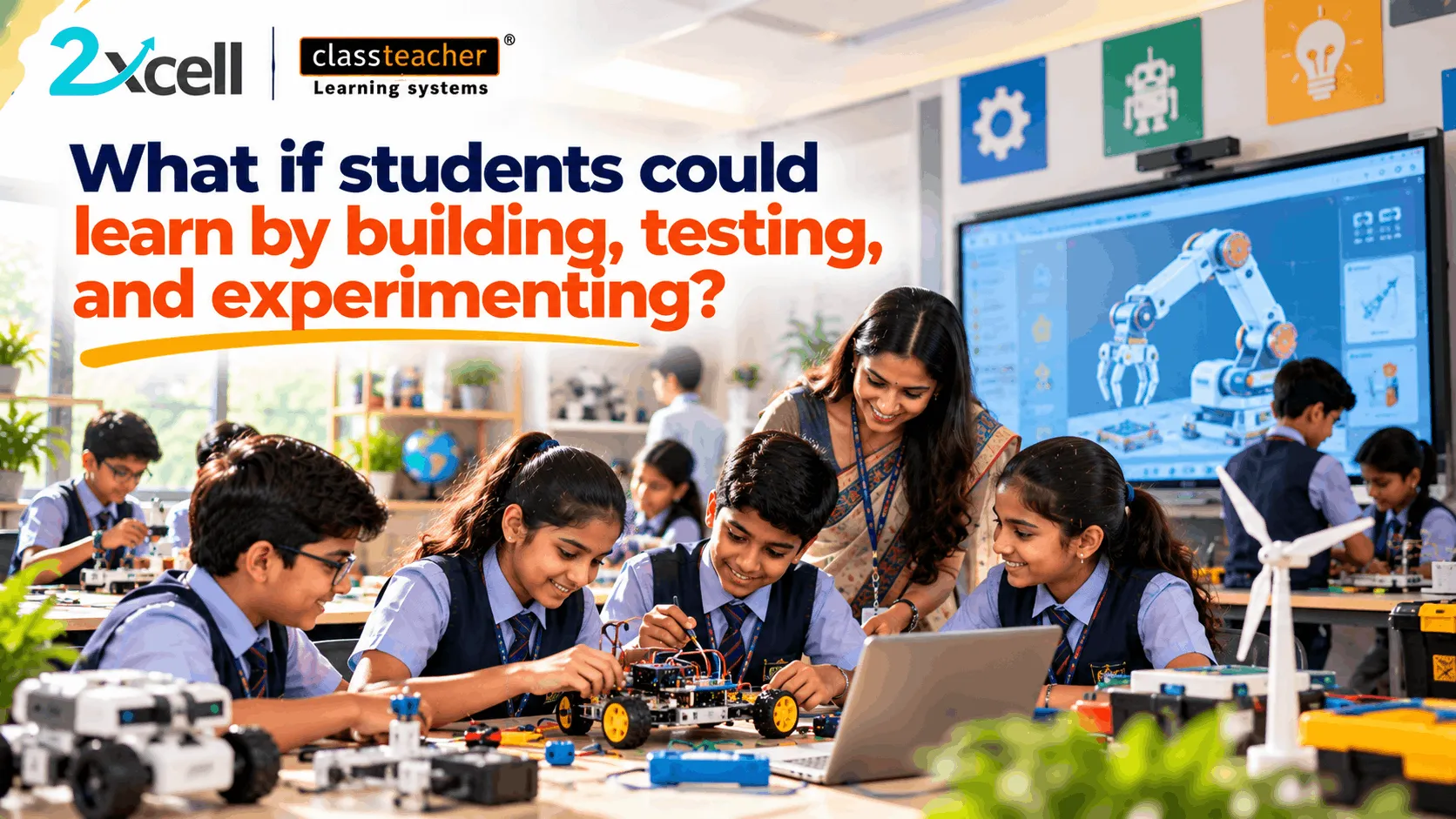
What happens when students move beyond reading about a concept and get the opportunity to experience it themselves?
A science lesson becomes more engaging when students conduct an experiment. Mathematics becomes more practical when learners use calculations to solve real-world problems. Technology becomes more meaningful when students design, build, test, and improve their own creations.
This is the value of hands-on learning. It gives students opportunities to connect classroom knowledge with practical activities, explore different solutions, and learn through direct experience.
Rather than treating learning as the process of receiving information, hands-on education encourages students to participate actively in discovering how things work.
For schools, the opportunity is to create learning environments where curiosity leads to exploration, ideas lead to experiments, and mistakes become opportunities for improvement.
Learn by Doing. Think by Exploring. Grow Through Experience.
What Is Hands-On Learning?
Hands-on learning is an educational approach in which students actively participate in activities that help them understand and apply concepts.
Instead of relying exclusively on lectures, textbooks, or demonstrations, students engage with materials, tools, experiments, models, and practical challenges.
Depending on the subject and age group, activities may include:
- Building simple machines and working models.
- Conducting science experiments.
- Designing and testing robotic systems.
- Creating coding projects.
- Solving real-world mathematical problems.
- Participating in collaborative projects.
- Exploring engineering and design challenges.
- Observing, recording, and analysing experimental results.
The purpose is not simply to keep students busy. Every activity should help them develop an understanding, practise a skill, or apply what they have learned.
1. Practical Activities Connect Theory With Real Life
Students may understand a definition without knowing how the concept works in practice.
Hands-on learning helps bridge this gap by connecting classroom explanations with observable experiences.
For example, students studying force and motion can investigate how changing the surface or slope affects the movement of an object. They can make predictions, perform tests, record observations, and discuss the results.
This creates a connection between scientific principles and everyday experiences.
The learning process becomes:
Understand the Concept → Test the Idea → Observe the Result → Explain the Learning
When students can relate theoretical knowledge to practical situations, they have another way to make sense of what they are studying.
2. Building Projects Encourages Creative Thinking
Creative thinking develops when students have opportunities to generate ideas and explore different possibilities.
A project-based activity can ask students to design a bridge using limited materials, create a simple working model, or develop a solution to a classroom problem.
There may be several possible approaches rather than one predetermined method.
Students can sketch ideas, select materials, test their designs, and make improvements based on what happens.
This encourages them to think beyond memorizing instructions.
For example, if a model fails to support the expected weight, students can investigate the structure, reconsider their design, and test a revised version.
The process helps students understand that creativity involves not only generating ideas but also evaluating and improving them.
3. Experimentation Builds Curiosity
Curiosity encourages students to ask questions and investigate unfamiliar situations.
Practical activities can create opportunities for this kind of exploration.
A teacher might ask students what they think will happen when two materials are combined, how a simple machine changes the direction of a force, or why a particular design performs better than another.
Students can then test their predictions and compare them with the results.
A useful experimentation cycle is:
Question → Prediction → Experiment → Observation → Conclusion
This approach encourages students to look for explanations instead of accepting information without investigation.
Teachers play an important role by asking thoughtful questions, guiding safe experimentation, and helping students connect their observations with the underlying concepts.
4. Learning From Mistakes Develops Problem-Solving Skills
Practical work does not always produce the expected result on the first attempt.
A robot may fail to follow its programmed instructions. A structure may collapse during testing. A coding project may produce an unexpected output.
These situations can become valuable learning opportunities.
Students can examine what happened, identify possible causes, and decide what to change.
The process might look like:
Build → Test → Identify the Problem → Improve → Test Again
This encourages students to approach difficulties systematically.
Instead of seeing every unsuccessful attempt as a failure, students can learn to use evidence and feedback to improve their work.
The teacher's role is to help students understand why something went wrong and how they might approach the challenge differently.
5. Team Projects Strengthen Collaboration
Many practical activities work best when students share ideas and divide responsibilities.
A group building a model, developing a prototype, or conducting an experiment may need students to plan together, manage materials, compare observations, and coordinate different tasks.
These experiences can help students practise:
- Listening to different viewpoints.
- Explaining their ideas clearly.
- Sharing responsibilities.
- Resolving disagreements.
- Giving and receiving feedback.
- Working towards a common goal.
For example, a group designing an energy-efficient house model might assign different responsibilities for research, construction, testing, and presentation.
Each student contributes to the outcome while learning how individual efforts connect with the work of the wider team.
6. Robotics Makes Engineering Concepts Tangible
Robotics activities can introduce students to engineering, logical reasoning, programming, and iterative design.
Students may begin by assembling a simple robot, identifying its components, or understanding how motors and sensors contribute to its operation.
They can then progress to programming movement, testing responses, and improving performance.
For example, a challenge might ask students to design a robot that follows a defined route or avoids an obstacle.
Completing the activity requires students to connect several ideas:
Design → Assemble → Code → Test → Improve
Robotics can also create opportunities to combine mathematics, science, technology, and engineering within a single project.
Activities should be selected according to students' ages, prior experience, available equipment, and learning objectives.
7. Coding Activities Encourage Logical Thinking
Coding provides opportunities for students to translate ideas into instructions that a computer or device can follow.
Students learn to break larger problems into smaller steps, identify errors, and examine how changes in instructions affect outcomes.
For example, a beginner might create a program that moves a character across a screen. More advanced learners could develop a simple game, automate a task, or control a robotics project.
When a program does not work as expected, students can review the instructions, identify the error, and test a correction.
This process supports logical reasoning and systematic problem-solving.
The emphasis should be on understanding the logic behind the program rather than simply copying code from an example.
8. Hands-On Science Encourages Evidence-Based Learning
Science education becomes more practical when students can investigate questions and observe results.
Depending on safety requirements and available resources, activities may involve measuring temperature, examining plant growth, testing the properties of materials, or investigating the movement of objects.
Students can record observations, compare results, and discuss whether the evidence supports their predictions.
For example, an investigation into plant growth could involve observing how different environmental conditions affect development over time.
The activity can introduce students to variables, measurement, observation, and evidence-based conclusions.
Teachers should ensure that experiments are age-appropriate, properly supervised, and conducted using suitable safety procedures.
9. Design Challenges Encourage Innovation
Design challenges give students a problem to solve while allowing them to explore different approaches.
A teacher might ask students to create a paper structure that supports a small object, design packaging that protects a fragile item, or develop a model that uses materials efficiently.
Students first identify the requirements and constraints. They then generate ideas, create a prototype, test it, and make improvements.
A structured design process can follow:
Identify → Imagine → Design → Build → Test → Refine
This approach introduces students to the relationship between creativity, practical limitations, and performance.
It also helps them recognize that a successful solution often emerges through several rounds of testing and improvement.
10. Practical Learning Can Make Mathematics More Meaningful
Mathematical concepts become easier to explore when students can apply them to practical situations.
Activities might include measuring classroom objects, calculating the materials needed for a model, comparing shapes, interpreting experimental data, or planning a project within a defined budget.
For example, students designing a miniature garden could calculate its area, estimate the number of plants required, and compare material costs.
The project connects mathematical calculations with a realistic objective.
Students can see why the concepts matter and how different mathematical skills work together to solve a problem.
11. Teachers Remain Central to Hands-On Learning
Practical learning does not mean removing teachers from the learning process.
Teachers establish the objectives, introduce essential concepts, organize activities, provide guidance, and help students reflect on their experiences.
Without this structure, an activity may be enjoyable without producing the intended learning outcomes.
Effective facilitation can include:
- Explaining the purpose of the activity.
- Demonstrating safe and appropriate procedures.
- Asking questions that encourage reasoning.
- Helping students interpret observations.
- Providing feedback during the activity.
- Connecting practical results with curriculum concepts.
- Assessing what students have understood.
Teachers help transform an activity into a structured educational experience.
12. Digital Technology Can Extend Practical Learning
Digital tools can complement physical activities by helping students design, simulate, document, and analyse their work.
For example, students can use coding environments to test algorithms, digital simulations to explore scientific processes, or presentation software to communicate project findings.
Technology can also help students document each stage of a project through photographs, diagrams, notes, and results.
The most effective approach combines digital resources with clear educational objectives.
A screen should not replace practical exploration when direct experimentation is appropriate. Instead, digital tools should provide additional ways to investigate, understand, or communicate ideas.
13. Assess Skills Through the Learning Process
A final project alone may not reveal everything a student has learned.
Teachers can assess students throughout an activity by observing how they plan, solve problems, collaborate, test ideas, and explain their decisions.
Assessment methods may include:
- Project demonstrations.
- Practical skill checklists.
- Student reflection journals.
- Group presentations.
- Design portfolios.
- Experiment reports.
- Teacher observations.
- Questions about the reasoning behind a solution.
For example, two students may produce similar models but use very different approaches to reach the result.
Understanding their reasoning can help teachers evaluate conceptual knowledge and identify areas requiring additional support.
Assessment should reflect the intended learning objectives rather than focusing exclusively on the final appearance of the project.
14. How Schools Can Introduce Hands-On Learning
Schools do not need to transform every lesson into a large project.
They can introduce practical learning gradually by selecting activities that complement existing curriculum objectives.
Step 1: Identify the Learning Objective
Decide what students should understand or be able to do.
Step 2: Select an Appropriate Activity
Choose an experiment, model, design challenge, coding exercise, or practical task that supports the objective.
Step 3: Prepare Materials and Guidance
Ensure that students have suitable resources, clear instructions, and appropriate safety guidance.
Step 4: Let Students Explore
Give learners opportunities to make predictions, test ideas, and investigate possible solutions.
Step 5: Encourage Reflection
Ask students what happened, why they think it happened, and what they would change.
Step 6: Assess Understanding
Use explanations, demonstrations, questions, or project evidence to evaluate learning.
Step 7: Connect the Experience to Future Learning
Help students identify how the concepts or skills apply to later topics and real-world situations.
This structure allows practical learning to become a purposeful part of classroom teaching.
15. How CLASSTEACHER Learning Systems Can Support Practical Education
Schools looking to expand experiential learning can explore educational resources and technology that support practical, curriculum-connected activities.
CLASSTEACHER Learning Systems offers educational technology solutions, including Composite Skills Lab-related learning environments and digital learning resources, that schools can evaluate according to their requirements.
The 2xcell AI Learning Platform by CLASSTEACHER Learning Systems may also be considered as part of a broader digital learning strategy, depending on the features available and the school's implementation needs.
When selecting solutions, school leaders should consider curriculum alignment, teacher preparation, equipment requirements, student safety, accessibility, and opportunities to measure learning outcomes.
Technology and practical resources are most valuable when they support clear educational objectives and help students apply what they learn.
Common Challenges Schools Should Plan For
Hands-on learning can be highly rewarding, but successful implementation requires preparation.
Limited time: Choose activities with clear objectives and manageable steps.
Resource constraints: Begin with accessible materials and gradually expand as requirements become clearer.
Different ability levels: Offer appropriate guidance and opportunities for students to contribute in different ways.
Safety considerations: Establish clear procedures and provide supervision.
Classroom management: Define responsibilities, organize materials, and explain expectations before activities begin.
Assessment difficulties: Use observation, reflection, demonstrations, and project evidence alongside traditional assessments.
Teacher training: Provide practical professional development and opportunities to share effective activities.
Planning for these challenges helps schools make experiential learning more sustainable.
Conclusion
Hands-on learning gives students opportunities to connect classroom concepts with practical experience. Through building, testing, experimenting, and improving their ideas, learners can explore how knowledge is applied beyond textbooks.
These activities can encourage curiosity, creative thinking, collaboration, logical reasoning, and problem-solving. They can also help teachers observe how students approach challenges and explain their understanding.
However, practical activities are most effective when they are carefully planned, linked to curriculum objectives, supported by teacher guidance, and followed by meaningful reflection.
For schools, the opportunity is to create learning environments where students are not only introduced to ideas but also encouraged to investigate, apply, and develop them.
With thoughtful planning and suitable educational resources from CLASSTEACHER Learning Systems, schools can explore practical learning experiences that connect knowledge with action.
Let Students Build. Let Them Experiment. Let Learning Come to Life.