Introduction
Modern schools generate a large amount of academic information every day.
Assessment results, attendance records, practice activity, assignment performance, classroom participation, learning progress, and student feedback can all provide useful information about how students are learning.
However, simply having data does not make a school data-driven.
The real value comes when teachers and academic leaders know how to interpret relevant information, use it in their decisions, and turn insights into meaningful classroom action.
A data-driven school culture is therefore not about replacing teacher judgement with numbers.
It is about creating a collaborative environment where teachers can use reliable learning information alongside their professional experience to understand students better and improve teaching.
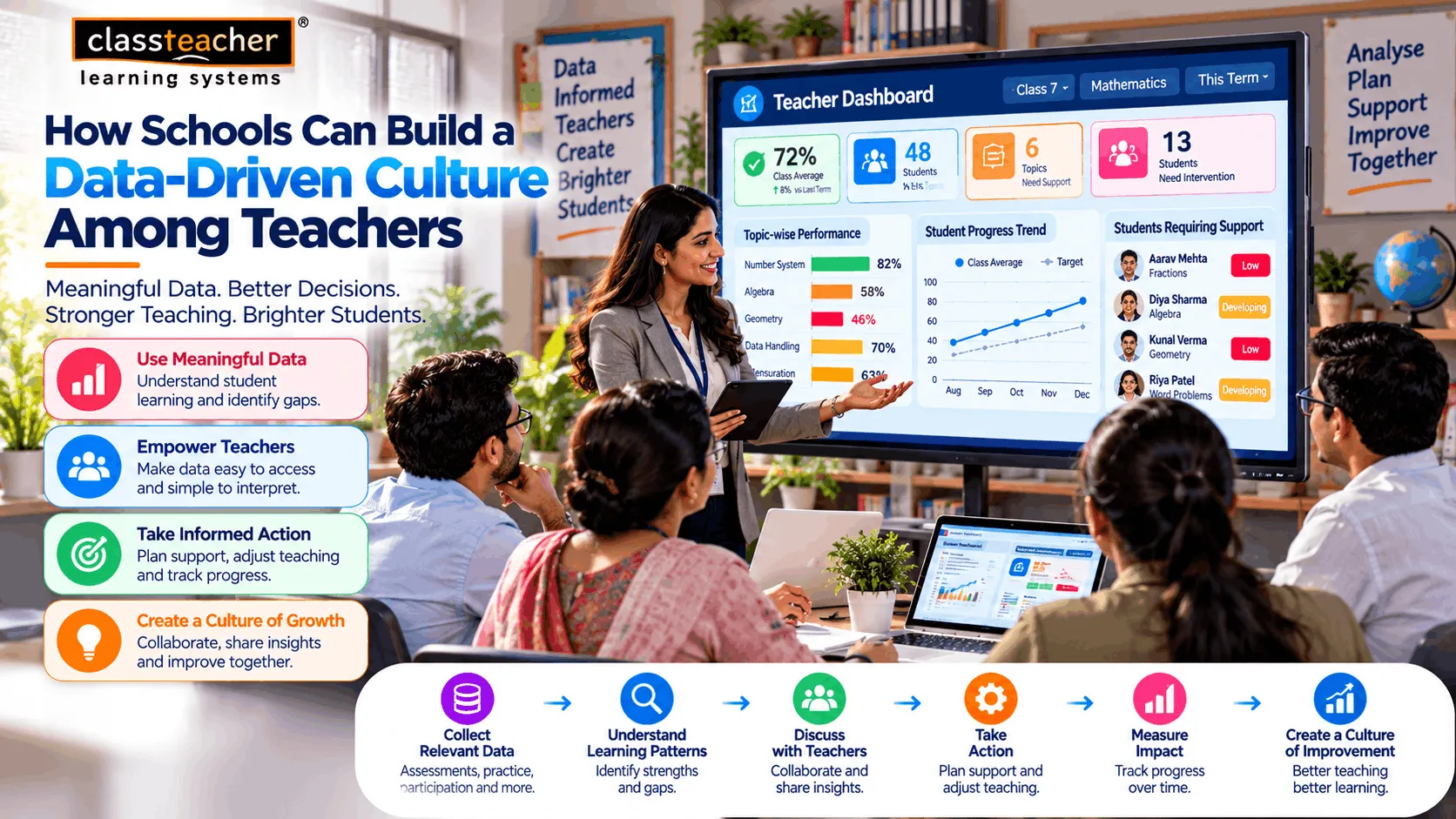
A practical cycle can be:
Collect → Understand → Discuss → Act → Measure → Improve
What Is a Data-Driven Culture in Schools?
A data-driven culture is an environment where educators regularly use meaningful information to support academic decisions.
This can involve data related to:
- Student assessments
- Topic-wise performance
- Practice results
- Learning gaps
- Attendance
- Assignment completion
- Progress over time
- Classroom participation
- Intervention outcomes
The objective is not to collect every possible piece of information.
Instead, schools should focus on data that can help answer practical questions such as:
What are students learning?
Where are they struggling?
Which teaching approaches are working?
What support is required?
What should we change next?
Why Schools Need a Data-Driven Teaching Culture
Teachers make hundreds of academic decisions throughout the year.
They decide:
- Which concept needs more explanation
- Which students require additional practice
- Whether the class is ready for the next topic
- Which resources should be used
- Whether an intervention is working
Relevant data can provide another perspective to support these decisions.
For example, a teacher may believe that most students understand a topic. A short assessment could reveal that a significant group is still struggling with one particular concept.
The data does not replace the teacher's observation.
It adds another layer of evidence.
1. Start With Clear Academic Questions
Schools should not begin by asking:
“What data can we collect?”
A better starting point is:
“What do we need to understand?”
For example:
- Which concepts are students struggling with?
- Are students improving after additional practice?
- Which classes require academic support?
- Are learning outcomes being achieved?
- Which intervention strategies are effective?
Once the question is clear, schools can determine which information is actually useful.
2. Make Data Easy for Teachers to Understand
Complex reports can discourage teachers from using data regularly.
Teachers need information that is:
- Clear
- Relevant
- Timely
- Easy to interpret
- Connected to classroom decisions
Instead of presenting dozens of unrelated numbers, a teacher dashboard could highlight:
Strong Areas
Learning Gaps
Recent Progress
Students Requiring Support
Recommended Focus
This makes data more practical.
3. Connect Data With Classroom Objectives
Data becomes more useful when it is connected to specific learning objectives.
For example, instead of simply showing:
Mathematics Score: 64%
a report could indicate:
- Fractions — Strong
- Algebra — Developing
- Geometry — Needs Practice
- Data Handling — Strong
This gives the teacher a clearer understanding of where additional attention may be required.
The focus shifts from:
Marks → Learning
4. Encourage Teachers to Use Data Regularly
Data-driven teaching should not happen only before report cards or examinations.
Schools can encourage teachers to review relevant information at different stages:
Before Teaching
Understand previous learning.
During Teaching
Use quick checks to identify understanding.
After Teaching
Review assessment and practice results.
Before the Next Topic
Determine whether students are ready to progress.
This creates a continuous feedback loop.
5. Use Short Assessments to Check Understanding
Schools do not need lengthy examinations to collect useful learning information.
Teachers can use:
- Quick quizzes
- Concept checks
- Exit questions
- Topic assessments
- Practice activities
- Short digital tests
For example:
Teach → Quick Check → Analyse → Clarify → Continue
This can help teachers identify misunderstandings while the topic is still fresh.
6. Focus on Trends, Not Isolated Scores
One score provides a snapshot.
Multiple results can reveal a trend.
For example:
Assessment 1: 56%
Assessment 2: 64%
Assessment 3: 71%
This indicates a different situation from:
Assessment 1: 75%
Assessment 2: 66%
Assessment 3: 58%
Looking at performance over time can help teachers identify improvement, stagnation, or decline.
7. Use Data to Identify Learning Gaps
A data-driven culture should help teachers identify specific learning gaps.
For example:
Science
Physics — Strong
Chemistry — Strong
Biology — Developing
Instead of asking the student to revise the entire subject, the teacher can focus additional support on the specific area requiring attention.
This makes intervention more targeted.
8. Encourage Collaborative Data Discussions
Data should not become an individual teacher responsibility.
Schools can create opportunities for teachers to discuss academic information with colleagues.
For example, subject teams can review:
- Common assessment results
- Difficult concepts
- Student progress
- Intervention outcomes
- Effective teaching strategies
A collaborative discussion might reveal that several classes are struggling with the same topic.
The academic team can then decide whether additional resources or instructional support are needed.
9. Turn Data Into Teaching Actions
Collecting data is only useful when it leads to action.
A simple framework is:
Data → Insight → Action → Result
For example:
Data: Students are struggling with fractions.
Insight: They understand basic operations but struggle with word problems.
Action: Introduce additional application-based practice.
Result: Reassess performance after intervention.
This makes data part of the teaching process rather than a reporting exercise.
10. Track Whether Interventions Work
Teachers often provide additional support, but schools may not always measure the outcome.
A data-driven approach can create a cycle:
Identify Gap
↓
Provide Intervention
↓
Practise
↓
Reassess
↓
Compare Results
For example:
Before Support: 52%
After Targeted Practice: 68%
The improvement provides useful evidence about whether the intervention helped.
11. Use Data to Support Personalized Learning
Students in the same classroom may have different learning requirements.
Data can help teachers identify these differences.
Student A
Needs foundational practice.
Student B
Needs regular application questions.
Student C
Is ready for advanced challenges.
The learning objective can remain common while the level of support varies.
This creates:
Common Goal + Personalized Support
12. Help Teachers Move From Intuition to Evidence
Teacher experience is extremely valuable.
However, assumptions can sometimes be incomplete.
A teacher may think a student is performing well because they participate actively in class, while assessment data may show difficulty with independent application.
Similarly, a quiet student may demonstrate strong understanding through assessments.
Data can help teachers combine:
Professional Experience + Evidence
rather than relying exclusively on either one.
13. Make Student Progress Visible
Teachers need to understand how students are progressing over time.
A progress dashboard can help highlight:
- Current performance
- Previous performance
- Topic mastery
- Practice activity
- Assessment results
- Learning gaps
This makes it easier to identify students who are:
Improving
Stable
Declining
Requiring Additional Support
14. Encourage Teachers to Share Best Practices
Data can help schools identify teaching approaches that appear to be producing positive outcomes.
For example, one teacher may use a particular activity that results in strong student performance.
The school can encourage teachers to share:
- Lesson strategies
- Activities
- Digital resources
- Assessment methods
- Practice approaches
The objective is not to force every teacher to teach identically.
It is to create opportunities for successful practices to spread across the school.
15. Use Data for Academic Planning
School leaders can use aggregated academic information to support planning.
Relevant information can help identify:
- Subjects requiring additional resources
- Grades needing academic intervention
- Common learning gaps
- Teacher training requirements
- Curriculum pacing issues
- Assessment patterns
This can make academic planning more evidence-based.
16. Build a Culture Where Data Is Not Used for Blame
This is one of the most important aspects of building a data-driven culture.
Teachers may hesitate to use data if they believe every performance indicator will be used to criticize them.
Schools should position data as a tool for:
Understanding → Supporting → Improving
rather than:
Ranking → Blaming → Penalizing
The purpose should be continuous academic improvement.
17. Train Teachers to Interpret Data
Having dashboards is not enough.
Teachers may need support in understanding:
- What different metrics mean
- Which trends matter
- How to identify meaningful patterns
- How to interpret assessment results
- How to connect data with intervention
Professional development can help teachers become more confident with academic data.
18. Avoid Data Overload
More information does not automatically mean better decisions.
A dashboard with hundreds of metrics may become difficult to use.
Schools should prioritize information that helps answer practical questions.
For example:
What is the student struggling with?
What has improved?
What requires attention?
What should the teacher do next?
Simple and focused information can often be more useful than excessive reporting.
19. Protect Student Data
A data-driven culture must also be a responsible data culture.
Schools should consider:
- Data privacy
- Secure authentication
- Appropriate access controls
- Responsible data sharing
- Protection of academic records
- Secure storage
- Appropriate data retention
Teachers should only have access to information relevant to their responsibilities.
Students and families should also understand how their learning information is being used where appropriate.
20. How 2xcell Can Support a Data-Driven School Culture
2xcell AI Learning Platform by CLASSTEACHER Learning Systems can support a connected digital learning environment involving:
- Digital learning content
- Practice
- Assessments
- Analytics
- Personalized learning
- Student progress tracking
A connected academic cycle can follow:
Learn → Practise → Assess → Analyse → Support → Improve
Relevant learning information can help teachers understand student performance, identify learning gaps, monitor progress, and determine where additional support may be useful.
The objective is not simply to give teachers more data.
It is to help connect learning information with meaningful classroom action.
Create Teacher-Friendly Data Dashboards
An effective teacher dashboard can focus on a small number of useful indicators.
Student Performance
How is the student performing?
Topic Mastery
Which concepts are understood?
Learning Gaps
Where is additional support needed?
Practice
Is the student getting enough opportunities to practise?
Progress
Is performance improving over time?
Intervention
Has additional support produced improvement?
This makes academic data easier to translate into decisions.
Use Data During Teacher-Parent Communication
Data can also improve conversations between teachers and parents.
Instead of simply discussing examination marks, teachers can explain:
- Areas of strength
- Specific learning gaps
- Progress over time
- Practice requirements
- Intervention provided
- Recommended next steps
For example:
“Your child is performing well in algebra but needs additional practice with geometry.”
This is more actionable than simply saying:
“The mathematics score is low.”
Build a School-Wide Data Cycle
A strong data-driven culture can operate at multiple levels.
Teacher Level
Student and classroom insights.
Department Level
Subject and grade-level patterns.
School Leadership Level
Overall academic trends.
Management Level
Long-term academic planning and improvement.
This creates:
Classroom Data → Department Insights → School Action → Continuous Improvement
How Schools Can Start Building a Data-Driven Culture
Schools do not need to transform everything at once.
Step 1: Define Key Academic Questions
Identify what teachers and leaders need to understand.
Step 2: Select Relevant Data
Focus on information connected to those questions.
Step 3: Create Simple Reports
Present insights in a teacher-friendly format.
Step 4: Train Teachers
Help educators understand and interpret the information.
Step 5: Discuss Findings
Create collaborative academic review sessions.
Step 6: Take Action
Connect insights with teaching strategies or interventions.
Step 7: Measure Results
Check whether the action produced improvement.
Step 8: Refine the Process
Continue improving how the school uses data.
The cycle becomes:
Question → Data → Insight → Action → Result → Improvement
Common Mistakes Schools Should Avoid
Collecting Data Without a Purpose
Data should answer meaningful academic questions.
Focusing Only on Marks
Learning involves more than examination scores.
Creating Too Many Reports
Excessive reporting can reduce teacher engagement.
Using Data to Blame Teachers
Data should support improvement, not fear.
Ignoring Teacher Context
Numbers need professional interpretation.
Failing to Act on Insights
Data without action provides limited value.
Ignoring Data Privacy
Student information must be handled responsibly.
The Future of Data-Driven Teaching
As AI, learning analytics, digital assessment, and personalized learning develop, schools may increasingly connect different sources of academic information.
A future model could look like:
Student Learning
↓
Practice & Assessment
↓
Learning Data
↓
AI-Assisted Analysis
↓
Teacher Insight
↓
Targeted Action
↓
Progress Measurement
↓
Academic Improvement
This can help schools move from periodic academic reporting towards continuous improvement.
Conclusion
Building a data-driven culture among teachers is not simply about introducing dashboards or collecting more information.
It requires a shift in how schools approach academic decision-making.
Teachers need access to relevant, understandable, and actionable information that can complement their professional experience.
When schools create a culture where teachers regularly analyse learning patterns, discuss insights, implement targeted interventions, and measure outcomes, data can become a practical part of everyday teaching.
With 2xcell AI Learning Platform by CLASSTEACHER Learning Systems, schools can explore a connected approach to digital learning, practice, assessment, analytics, personalized learning, and student progress tracking.
The goal is not:
More Data.
It is:
Better Insights → Better Decisions → Better Teaching → Better Student Outcomes.
2xcell AI Learning Platform
By CLASSTEACHER Learning Systems
Empowering Education with AI & Innovation.