Introduction
Technology has become an important part of modern school education. Schools are investing in digital classrooms, learning platforms, smart assessment tools, AI-powered systems, interactive displays, digital content, and analytics solutions.
But purchasing technology is only the beginning.
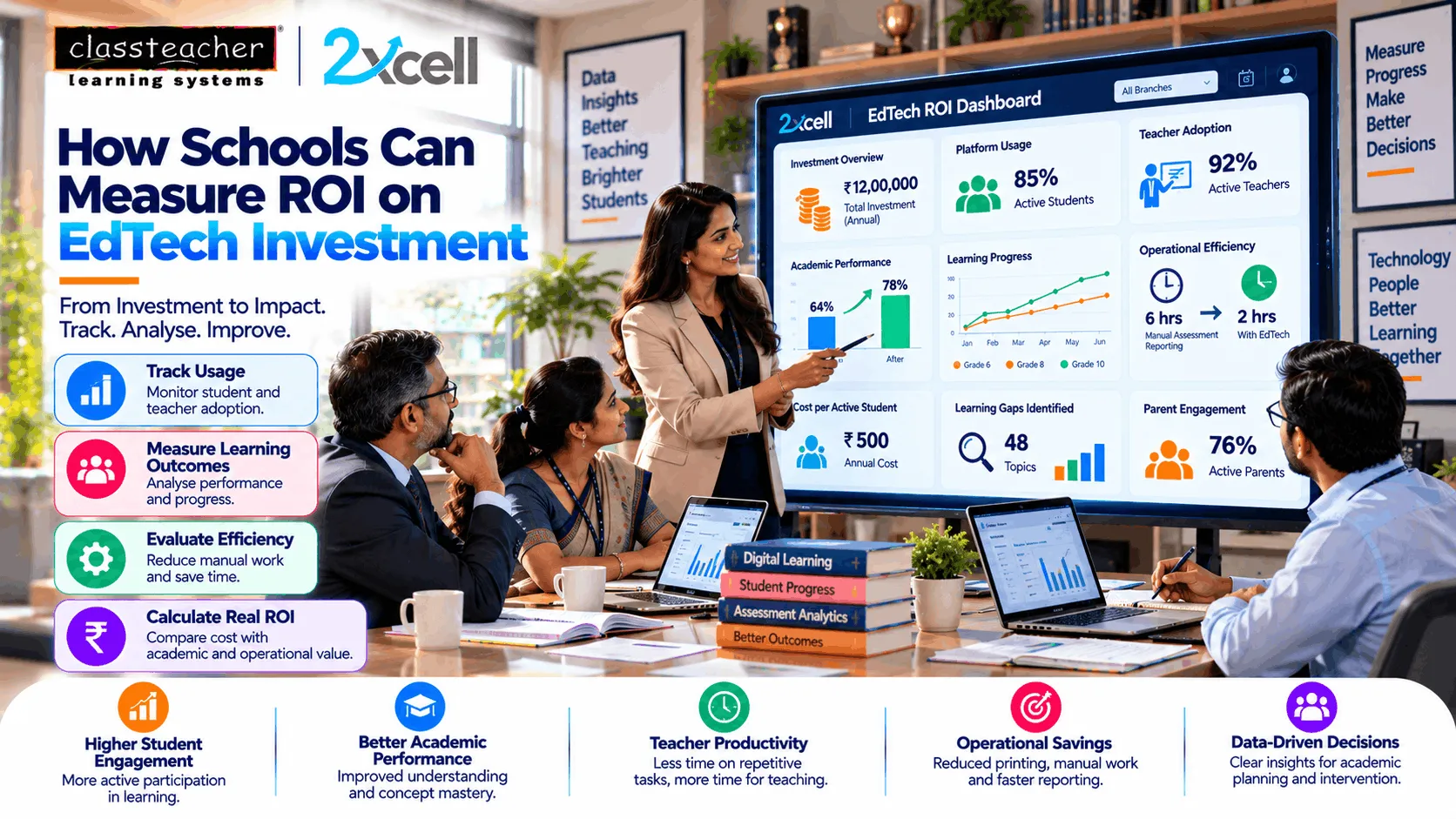
School leaders also need to understand whether these investments are producing meaningful educational and operational value.
This leads to an important question:
How can a school measure the Return on Investment (ROI) of its EdTech investment?
ROI in education should not be measured only through financial savings. Schools can also examine improvements in student learning, teacher productivity, engagement, assessment efficiency, resource utilization, and academic decision-making.
A broader evaluation can follow:
Investment → Usage → Outcomes → Impact → ROI
What Does ROI Mean in EdTech?
Return on Investment refers to the value an organization receives compared with the resources invested.
A basic financial ROI calculation can be represented as:
ROI = (Gain from Investment − Cost of Investment) ÷ Cost of Investment × 100
However, EdTech creates different types of value.
For schools, ROI may include:
- Improved academic performance
- Better student engagement
- Reduced administrative workload
- More efficient assessments
- Better teacher productivity
- Increased resource utilization
- Improved parent communication
- Faster academic intervention
- Better learning visibility
Therefore, schools should evaluate both financial and educational outcomes.
1. Start by Defining the Purpose of the Investment
Before measuring ROI, schools should identify why the technology was purchased.
For example, a school may invest in an EdTech platform to:
- Improve student learning
- Support personalized education
- Reduce teacher workload
- Improve assessment processes
- Strengthen digital learning
- Monitor student progress
- Improve classroom engagement
- Provide better academic analytics
Without a clearly defined purpose, it becomes difficult to determine whether the investment has been successful.
The first question should be:
What problem was the technology expected to solve?
2. Calculate the Total Cost of the EdTech Investment
The purchase price is not always the complete cost.
Schools may need to consider:
- Software subscription
- Hardware
- Installation
- Licensing
- Training
- Technical support
- Maintenance
- Content development
- Infrastructure
- Integration costs
- Renewal charges
For example, a digital learning platform may require teacher training and technical setup in addition to the annual subscription.
Understanding the complete investment provides a more accurate basis for ROI measurement.
3. Measure How Frequently the Technology Is Used
A technology solution cannot create much value if it is rarely used.
Schools can monitor indicators such as:
- Number of active teachers
- Number of active students
- Lessons using digital resources
- Assessments conducted
- Practice activities completed
- Login frequency
- Digital content usage
- Platform engagement
For example:
500 Students Registered → 420 Active → 350 Regular Users
This provides more useful information than simply knowing that 500 students have accounts.
4. Track Teacher Adoption
Teacher adoption is one of the most important indicators of EdTech utilization.
A school can measure:
- Number of teachers using the platform
- Frequency of usage
- Digital lessons created
- Assessments conducted
- Resources accessed
- Reports reviewed
- Digital activities assigned
If a school has 100 teachers but only 20 regularly use the technology, the school may need to investigate training, usability, or implementation challenges.
5. Measure Student Engagement
Schools can also examine whether technology is changing how students participate in learning.
Possible indicators include:
- Practice completion
- Assessment participation
- Digital activity completion
- Learning resource usage
- Quiz participation
- Revision activity
- Time spent on relevant learning activities
However, engagement should not be measured only by screen time.
The more important question is:
Is the technology encouraging meaningful learning activity?
6. Compare Academic Performance Over Time
Academic performance can provide one part of the ROI picture.
Schools can compare relevant performance indicators before and after implementation.
For example:
Before EdTech Implementation: 64% average
After Implementation: 72% average
However, schools should be careful about attributing every improvement directly to technology.
Other factors may also influence results, including:
- Teacher changes
- Curriculum changes
- Student demographics
- Additional academic support
- Assessment differences
- Changes in teaching methods
Therefore, academic performance should be evaluated alongside other indicators.
7. Measure Learning Progress, Not Just Final Scores
A final examination score provides only one snapshot.
Digital learning platforms can provide information about progress across multiple activities.
For example:
Initial Assessment → Practice → Reassessment → Improvement
Schools can examine whether students are:
- Improving over time
- Mastering difficult concepts
- Reducing repeated mistakes
- Completing targeted practice
- Progressing towards learning objectives
This provides a broader view of educational impact.
8. Measure Learning Gap Identification
One potential benefit of digital analytics is the ability to identify learning gaps earlier.
For example, a platform may highlight that many students are struggling with a particular topic.
The school can then provide:
Learning Gap → Targeted Practice → Teacher Support → Reassessment
ROI can be considered not only in terms of improved scores, but also in how effectively the school identifies and responds to learning needs.
9. Measure Teacher Time Savings
Technology can create operational value by reducing repetitive work.
Teachers may traditionally spend considerable time preparing:
- Worksheets
- Question papers
- Answer checking
- Performance reports
- Student records
- Revision material
Digital systems can automate or simplify some of these activities.
For example:
Manual Assessment Reporting: 6 Hours
versus
Digital Reporting: 2 Hours
The four-hour difference represents potential time savings that can be redirected towards teaching, feedback, planning, or student support.
10. Measure Assessment Efficiency
Assessment is another area where schools can evaluate ROI.
Schools can track:
- Time required to create assessments
- Time required for evaluation
- Report generation time
- Assessment participation
- Feedback turnaround time
- Number of assessments conducted
If digital assessment reduces administrative effort while maintaining academic quality, it can contribute to operational ROI.
11. Evaluate the Quality of Feedback
Fast feedback can help students understand where they need improvement.
Schools can measure:
- Feedback turnaround time
- Number of students receiving feedback
- Topic-level feedback
- Practice recommendations
- Teacher intervention based on results
The value is not simply that feedback is delivered faster.
The important question is:
Does the feedback help students improve?
12. Measure Parent Engagement
Some EdTech solutions provide parents with greater visibility into student progress.
Schools can examine:
- Parent portal usage
- Progress report views
- Communication activity
- Parent participation
- Access to academic updates
If technology improves communication between schools and families, this can represent an additional form of educational value.
13. Measure Student Retention and Participation Carefully
For some schools, technology may be part of a broader strategy to improve student experience.
Schools can monitor changes in:
- Student participation
- Attendance
- Course completion
- Learning activity
- Engagement
However, these indicators should not automatically be attributed to EdTech alone.
Schools should consider other factors that may have influenced the results.
14. Compare Different EdTech Tools
Schools may use several technology solutions simultaneously.
For example:
- Learning Management System
- Smart Classroom
- Digital Content
- Assessment Platform
- AI Learning Platform
- Interactive Panels
ROI analysis can help school leadership understand which tools are being actively used and which require improvement.
The objective should not simply be to remove tools with lower usage.
Instead, schools can ask:
Why is usage low?
Possible reasons may include:
- Lack of training
- Poor integration
- Limited content
- Technical issues
- Teacher resistance
- Student accessibility
- Workflow complexity
15. Create a Balanced EdTech ROI Dashboard
School leaders can create a dashboard containing multiple indicators.
Financial
- Investment cost
- Annual operating cost
- Savings
- Cost per student
Academic
- Assessment performance
- Learning progress
- Concept mastery
- Learning gaps
Teacher
- Platform adoption
- Time saved
- Digital activity creation
- Assessment usage
Student
- Participation
- Practice completion
- Progress
- Engagement
Operational
- Reporting efficiency
- Assessment turnaround
- Resource utilization
This creates a broader picture of EdTech impact.
16. Calculate Cost Per Active Student
One useful metric is the cost per active learner.
For example:
Annual EdTech Cost = ₹10,00,000
Active Students = 2,000
Cost per Active Student = ₹500
Schools can then compare this cost with the educational and operational value being generated.
This does not provide the complete ROI by itself, but it can help with investment planning.
17. Measure Cost Savings From Digital Processes
Digital systems may reduce the need for certain physical and administrative resources.
Potential areas include:
- Printing
- Paper-based assessments
- Manual record keeping
- Physical worksheets
- Report preparation
- Repetitive administrative tasks
For example:
Previous Printing Cost → Current Digital Cost → Annual Saving
These savings can be included in the overall ROI analysis.
18. Evaluate Whether the Technology Supports Teachers
An EdTech platform should not create additional complexity without providing meaningful value.
Schools can ask teachers:
- Does the platform save time?
- Is it easy to use?
- Does it support lesson planning?
- Does it improve assessment?
- Does it provide useful insights?
- Does it help identify learning gaps?
Teacher feedback can reveal value that may not be visible in financial reports.
19. Measure Implementation Success Over Multiple Periods
EdTech ROI should not always be measured immediately after deployment.
Schools can evaluate results across different stages.
First 3 Months
Focus on adoption and implementation.
6 Months
Review usage, engagement, and operational improvements.
12 Months
Evaluate academic trends, teacher productivity, and overall value.
This allows schools to distinguish between initial implementation challenges and longer-term outcomes.
20. How 2xcell Can Support EdTech ROI Measurement
2xcell AI Learning Platform by CLASSTEACHER Learning Systems can support a connected digital learning environment involving:
- Digital learning content
- Practice
- Assessments
- Analytics
- Personalized learning
- Student progress tracking
A school can use relevant platform information to monitor areas such as:
Usage → Practice → Assessment → Performance → Learning Gaps → Progress
This can help schools understand how digital learning resources are being used and how student learning is progressing.
The objective is to connect technology usage with measurable educational outcomes, rather than evaluating EdTech only by the number of features it provides.
A Practical EdTech ROI Framework for Schools
Schools can use a simple five-stage framework.
Step 1: Define the Goal
What problem should the technology solve?
Step 2: Record the Investment
What is the complete cost?
Step 3: Measure Usage
Who is using the technology and how frequently?
Step 4: Measure Outcomes
What changed in learning, teaching, or operations?
Step 5: Compare Cost With Value
Did the outcomes justify the investment?
This creates:
Goal → Investment → Usage → Outcome → ROI
Example of an EdTech ROI Evaluation
Consider a school that invests in a digital learning platform.
Investment
Annual technology cost: ₹8 lakh
Usage
- 90% teacher registration
- 75% active student participation
- Regular digital assessments
Operational Impact
- Reduced manual assessment work
- Faster report generation
- Less printing
Academic Indicators
- Improved practice completion
- Better visibility into learning gaps
- More targeted intervention
The school can then combine financial savings and measurable educational outcomes to evaluate the overall value of the investment.
ROI Should Not Be Reduced to Marks Alone
A common mistake is to evaluate EdTech only through examination results.
Education produces several forms of value.
For example:
Student Learning
Teacher Productivity
Operational Efficiency
Parent Engagement
Better Academic Decision-Making
Together, these can provide a more complete picture of EdTech ROI.
Common Mistakes When Measuring EdTech ROI
Measuring Only Purchase Cost
The initial price does not represent the complete investment.
Counting Users Instead of Usage
Registration does not necessarily mean meaningful adoption.
Focusing Only on Test Scores
Academic performance is important but not the only outcome.
Ignoring Teacher Feedback
Teachers directly experience the technology in daily workflows.
Measuring Too Early
Some benefits require time to become visible.
Ignoring Implementation Quality
Poor training or weak adoption can affect outcomes.
Treating All Technology as Equal
Different tools may solve different problems and should be evaluated against their intended purpose.
The Future of EdTech ROI Measurement
As AI and learning analytics become more integrated into school technology, ROI measurement may become increasingly data-driven.
A future school dashboard could connect:
Investment
↓
Technology Usage
↓
Teacher Adoption
↓
Student Engagement
↓
Assessment
↓
Learning Analytics
↓
Intervention
↓
Academic Progress
↓
Operational Value
This can help school leaders move from simply asking:
“How much did we spend?”
to:
“What measurable value did the investment create?”
Conclusion
Measuring the ROI of EdTech investment requires more than comparing the purchase price with immediate financial savings.
Schools should examine the complete picture, including technology adoption, teacher productivity, student engagement, academic progress, assessment efficiency, learning gap identification, operational savings, and parent communication.
A successful EdTech investment should ultimately contribute to meaningful educational or operational outcomes.
With 2xcell AI Learning Platform by CLASSTEACHER Learning Systems, schools can explore a connected approach to digital learning, assessment, analytics, personalized learning, and student progress tracking.
The most useful question is not simply:
“Did we invest in technology?”
It is:
“What changed because we invested in technology?”
That shift—from technology spending to measurable outcomes—can help schools make more informed decisions about their digital education strategy.
2xcell AI Learning Platform
By CLASSTEACHER Learning Systems
Empowering Education with AI & Innovation.