Introduction
Planning the next academic term involves much more than preparing a timetable and deciding which chapters to teach. Schools must understand what students have learned, where academic difficulties remain, how teachers are managing their workload, and which resources will be required in the coming months.
Without reliable information, planning can depend heavily on assumptions or general observations. These may overlook important differences between classes, subjects, and individual students.
Data-backed academic planning helps schools use information from assessments, attendance records, classroom activities, teacher feedback, and learning platforms to make more informed decisions.
For example, if students across several classes struggle with the same mathematics concept, school leaders can plan additional revision sessions, teaching resources, or targeted support before the next term begins.
The objective is not to collect as much data as possible. It is to identify useful information and turn it into practical academic action.
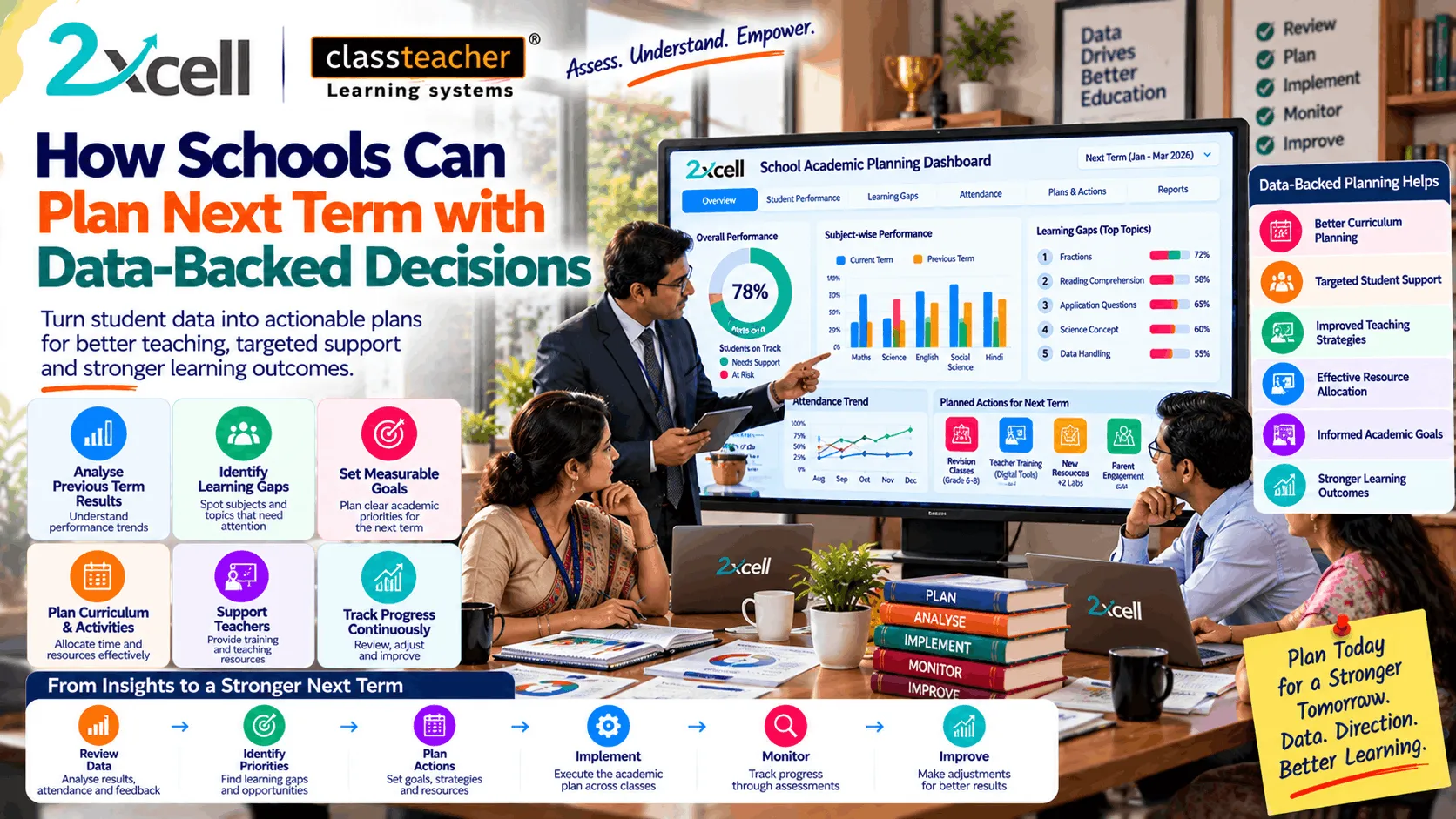
A structured planning cycle can follow:
Review → Identify → Prioritize → Plan → Implement → Measure → Improve
What Are Data-Backed Decisions in School Planning?
Data-backed decisions are choices informed by relevant evidence rather than assumptions alone.
In an academic setting, this may involve reviewing:
- Student assessment results.
- Subject-wise and topic-wise performance.
- Attendance and participation patterns.
- Curriculum completion.
- Learning gaps.
- Homework and practice outcomes.
- Teacher observations.
- Parent feedback.
- Availability of teaching resources.
- Previous term's academic goals.
For example, if assessment results show that students understand basic concepts but struggle to apply them in unfamiliar questions, the next term's plan can include more application-based activities.
Data does not make every decision automatically. It gives school leaders and teachers a clearer starting point for deciding what should happen next.
Why Planning the Next Term Requires Better Academic Insights
Every new term brings different academic priorities. Some classes may need foundational revision, while others may be ready for more advanced concepts.
Schools may face challenges such as:
- Incomplete curriculum coverage.
- Uneven performance between sections.
- Students requiring additional support.
- Limited teacher preparation time.
- Inefficient allocation of learning resources.
- Repeated difficulties in particular subjects.
- Unclear priorities for academic improvement.
A review of the previous term can help schools distinguish between problems that require immediate attention and areas where existing practices are working well.
Instead of repeating the same plan every term, schools can make adjustments based on what the evidence reveals.
1. Review the Previous Term Before Setting New Goals
The first step is to understand what happened during the term that has just ended.
School leaders and academic coordinators can review academic results alongside curriculum completion, student participation, teacher feedback, and the effectiveness of previous interventions.
Questions worth asking include:
- Were the planned learning objectives achieved?
- Which subjects showed strong progress?
- Which topics created persistent difficulties?
- Did students receive support when they needed it?
- Were assessments completed according to the academic plan?
- Which teaching practices worked well?
- What should be changed next term?
For example, a class may have completed the mathematics syllabus on schedule but performed poorly in application-based questions. This suggests that the next term's plan may need more problem-solving practice rather than simply faster syllabus completion.
The purpose of the review is to understand the reasons behind outcomes, not merely record them.
2. Identify Learning Gaps at the Topic Level
Overall marks can hide important differences in student understanding.
Two students may receive similar scores but struggle with completely different concepts. A class may perform well in one chapter and poorly in another.
Topic-level analysis helps schools identify these differences.
For example:
Illustrative mathematics review
Fractions
Requires additional practice
Priority
Basic calculations
Generally understood
Maintain
Word problems
Needs application-based learning
Plan support
This type of review can help teachers plan revision, additional examples, guided practice, and follow-up assessments around specific learning needs.
3. Set Measurable Academic Goals for the Upcoming Term
Once the previous term has been reviewed, schools can establish clear priorities for the next one.
Broad goals such as “improve mathematics” or “increase student engagement” may be difficult to evaluate unless they are translated into observable outcomes.
A more useful goal might be to improve students' accuracy in a particular topic, increase completion of assigned practice, or ensure that identified learning gaps receive follow-up support.
Effective goals should be:
- Specific: Identify the subject, skill, or outcome.
- Measurable: Decide how progress will be checked.
- Relevant: Connect the goal to an actual academic need.
- Time-bound: Establish when progress will be reviewed.
- Practical: Consider available time, staff, and resources.
For example, a school could set a goal to reassess a selected group of students after four weeks of targeted mathematics practice.
The target should be based on the school's baseline data and realistic expectations, rather than an arbitrary number.
4. Use Assessment Results to Plan the First Few Weeks
The beginning of a new term is an opportunity to address previous learning gaps before introducing more complex concepts.
Assessment results can help teachers decide which topics need a short revision period and which can be introduced according to the regular academic schedule.
Schools can prepare a term-opening plan that includes:
- Short diagnostic assessments.
- Revision of prerequisite concepts.
- Subject-specific practice.
- Individual or group support.
- Follow-up checks to measure improvement.
For example, if students need a stronger understanding of fractions before starting ratios, teachers can schedule a focused revision activity in the first week.
This reduces the risk of moving forward while important foundational concepts remain unclear.
5. Prioritize Students Who Need Additional Academic Support
Academic planning should account for differences in student progress.
Some students may need additional explanations, while others may benefit from more challenging activities. A uniform plan may not address these needs effectively.
Schools can use assessment trends, classroom observations, and learning activity records to identify students who may require additional attention.
A support plan could include:
Identify Need → Select Support → Provide Practice → Review Progress
Teachers should interpret the available information carefully. A low score may reflect a learning gap, but it could also be influenced by attendance, language barriers, assessment conditions, or other circumstances.
The purpose of identification is to offer appropriate support—not to label students or make decisions based on a single result.
6. Align Curriculum Coverage with Actual Student Understanding
Completing the syllabus is an important planning responsibility, but syllabus completion alone does not confirm that students have understood the material.
Schools should review two connected factors:
- How much of the planned curriculum was covered?
- How well did students understand the concepts taught?
If a class has completed a topic but many students struggle to apply it, the next term's plan may need additional practice or a revised teaching approach.
Academic coordinators can work with teachers to identify essential learning objectives, plan suitable pacing, and allow time for revision where necessary.
This creates a better balance between curriculum requirements and meaningful learning.
7. Compare Class and Section Performance Carefully
Schools often have multiple sections within the same grade. Reviewing performance across sections can reveal patterns that deserve further investigation.
For example, one section may perform well in comprehension but struggle with written responses, while another may show the opposite pattern.
Such differences can prompt academic teams to examine:
- Teaching approaches.
- Time allocated to practice.
- Assessment difficulty.
- Classroom participation.
- Availability of learning resources.
- Student attendance and preparation.
Comparisons should be used to understand differences and share effective practices—not to rank teachers without considering classroom context.
When common learning objectives and assessment standards are used appropriately, schools can make more informed decisions about academic support.
8. Plan Teacher Training Around Identified Needs
Teacher development is more effective when it responds to actual classroom requirements.
Instead of arranging training only because a particular topic is popular, school leaders can combine teacher feedback, classroom observations, assessment patterns, and curriculum requirements to identify useful development areas.
For example, the review may indicate a need for training in:
- Competency-based assessment.
- Interactive classroom techniques.
- Differentiated instruction.
- Digital learning tools.
- Question-paper design.
- Learning-gap identification.
- AI-assisted lesson preparation.
Teachers can also share approaches that have worked well in their classrooms.
The next term's professional development plan should connect training with practical classroom application and follow-up review.
9. Use Attendance and Participation Data Responsibly
Attendance and participation can provide useful context when schools review academic performance.
A student who misses several lessons may have fewer opportunities to understand new concepts or complete classroom activities.
However, attendance data should not be interpreted in isolation.
Schools can review attendance patterns alongside academic progress, teacher observations, and relevant family communication to understand where support may be needed.
Planning actions could include:
- Following up on repeated absences.
- Helping students catch up on missed lessons.
- Sharing appropriate revision material.
- Communicating with parents where necessary.
- Reviewing participation barriers.
Student information should be handled sensitively, and schools should investigate individual circumstances before deciding on interventions.
10. Allocate Resources According to Academic Priorities
Data-backed planning can help schools decide where teaching materials, equipment, and academic support are most needed.
For example, if science assessments show that students struggle to understand a particular process, the school might consider demonstrations, visual resources, practical activities, or suitable digital simulations.
Resource planning can cover:
- Subject-specific learning materials.
- Laboratory equipment.
- Digital content.
- Practice worksheets.
- Assessment tools.
- Remedial teaching resources.
- Teacher training.
- Classroom technology.
The objective is to connect spending and resource allocation with identifiable educational needs.
Schools should also consider cost, accessibility, maintenance, teacher readiness, and expected educational value before making new investments.
11. Use Digital Assessments to Gather Timely Information
Digital assessment tools can help schools organize responses and review results more efficiently, depending on the system's features.
They may support quizzes, objective tests, question-wise analysis, and structured performance reports.
For example, after a short classroom quiz, a teacher may discover that most students selected the same incorrect answer. This can indicate that the class needs another explanation before the topic is considered complete.
Classteacher's Smart Audience Response System (SRS) is designed to support classroom assessments and the collection of student responses through its response-device ecosystem.
Such tools can contribute to term planning by making assessment information easier to review and use.
The important consideration is not whether an assessment is digital or paper-based. It is whether the results help teachers make useful decisions about learning.
12. Create a Clear Academic Calendar
A term plan should translate academic priorities into a realistic schedule.
Schools can combine curriculum requirements, assessment dates, revision periods, school events, and teacher development activities into a coordinated academic calendar.
Useful planning elements include:
- Curriculum milestones.
- Unit assessments.
- Revision weeks.
- Project deadlines.
- Parent-teacher meetings.
- Teacher training.
- Academic review meetings.
- Follow-up assessments.
Historical information can help identify periods when workloads become unusually high or when students need additional preparation time.
The calendar should also allow reasonable flexibility for unexpected school closures, changes in academic pace, or learning needs that emerge during the term.
13. Use Previous Assessment Patterns to Improve Question Design
Assessment quality influences the decisions made from assessment results.
If a test focuses mainly on memorization, it may provide limited information about students' ability to apply knowledge or solve unfamiliar problems.
Schools can review previous question papers to understand whether assessments cover the intended learning objectives.
Academic teams can consider the balance between:
- Recall and understanding.
- Application-based questions.
- Problem-solving.
- Reasoning.
- Competency-based tasks.
- Subject-specific skills.
For example, if students repeatedly perform well on definitions but struggle with real-world applications, the next term's assessment plan could include more questions requiring interpretation and practical reasoning.
Assessment design should remain aligned with the curriculum, grade level, and intended learning outcomes.
14. Monitor Progress Throughout the Term
Data-backed planning should not end when the academic calendar is finalized.
Schools need periodic opportunities to check whether the planned actions are working.
A monthly or unit-level review may examine:
- Curriculum progress.
- Student assessment outcomes.
- Completion of planned interventions.
- Attendance patterns.
- Teacher feedback.
- Areas requiring additional resources.
If an intervention is not producing the expected improvement, the school can investigate the reasons and revise its approach.
A useful monitoring cycle is:
Plan → Implement → Review → Adjust → Review Again
This allows academic planning to remain responsive rather than becoming a fixed document that is rarely updated.
15. Connect Parent Communication with Academic Planning
Parents can provide valuable context about a student's learning experience, while schools can help families understand academic expectations and areas requiring attention.
Information from parent-teacher meetings and appropriate communication channels can contribute to planning decisions.
For example, parents may report that students are struggling to complete homework because the instructions are unclear or the workload is difficult to manage.
Schools can review such feedback alongside academic information before deciding whether changes are needed.
Useful communication can cover:
- Progress towards learning objectives.
- Upcoming assessments.
- Areas for revision.
- Recommended practice.
- Attendance concerns.
- Support strategies.
The objective is to create a constructive partnership between school and family while respecting student privacy.
16. Use Learning Analytics to Identify Emerging Patterns
When schools use digital learning platforms, they may have access to information about practice completion, assessment performance, topic progress, and resource usage.
Learning analytics can help organize this information into patterns that may otherwise be difficult to notice.
For example, a school might discover that students frequently access a resource but continue to struggle with the related assessment questions.
This may prompt teachers to review the resource, provide a different explanation, or introduce more guided practice.
Analytics should be treated as a source of insight rather than an automatic explanation of student behaviour. Teachers and academic leaders must interpret the findings within the context of classroom learning.
17. Establish Clear Responsibilities for Academic Planning
A data-backed plan works best when everyone understands their responsibilities.
Different school roles may require different information and actions.
Teachers review student understanding, plan lessons, and provide classroom support.
Academic coordinators monitor curriculum coverage, coordinate assessments, and identify recurring subject-level concerns.
Principals and school leaders establish priorities, allocate resources, and review overall progress.
Parents support relevant learning routines and communicate concerns when needed.
Clear responsibilities reduce the risk of academic information being collected without anyone acting on it.
Schools should also decide who will review progress, how often meetings will take place, and how agreed actions will be documented.
18. How 2xcell Can Support Data-Informed Academic Planning
The 2xcell AI Learning Platform by CLASSTEACHER Learning Systems can form part of a school's digital learning strategy by connecting relevant learning activities and academic information.
Depending on the features used, a connected learning environment can involve:
- Digital learning content.
- Student practice.
- Assessments.
- Learning analytics.
- Personalized learning.
- Student progress tracking.
These elements can support a learning cycle such as:
Learn → Practise → Assess → Analyse → Support → Improve
For example, schools can use relevant assessment and progress information to identify concepts that may require further practice and incorporate suitable follow-up activities into their academic plans.
The platform should be evaluated against the school's specific requirements, including curriculum alignment, reporting capabilities, usability, data privacy, and integration with existing academic processes.
Technology can help organize learning information, but teachers and school leaders remain responsible for interpreting that information and making appropriate academic decisions.
19. Common Mistakes Schools Should Avoid
Data-backed planning can become less effective when information is misunderstood or collected without a clear purpose.
Schools should avoid the following mistakes.
Relying only on overall marks: Total scores may hide topic-level difficulties.
Using outdated information: Old results may not accurately represent current student understanding.
Setting unrealistic targets: Goals should reflect baseline performance, resources, and the time available.
Collecting too much data: Every metric should have a clear purpose.
Ignoring teacher feedback: Classroom observations can explain patterns that numbers alone cannot.
Treating correlations as causes: A pattern may indicate a concern without explaining why it occurred.
Failing to follow up: Identifying a learning gap is useful only when an appropriate response is considered.
Overlooking privacy: Student records should be accessed and used responsibly.
Avoiding these mistakes helps schools focus on meaningful evidence and practical improvement.
20. A Practical Framework for Planning the Next Term
Schools can use a simple seven-step framework to convert academic information into an actionable term plan.
Step 1: Gather Relevant Information
Collect the previous term's assessment results, curriculum progress, attendance information, teacher observations, and other relevant academic records.
Step 2: Identify Priorities
Determine which learning gaps, subjects, grades, or operational issues require attention.
Step 3: Set Measurable Goals
Define what improvement should look like and how it will be evaluated.
Step 4: Plan Actions
Decide which teaching strategies, learning resources, assessments, or training activities will support each goal.
Step 5: Assign Responsibilities
Identify who will implement each action and when it should happen.
Step 6: Monitor Progress
Review results at planned intervals and identify where adjustments are needed.
Step 7: Evaluate and Improve
At the end of the term, compare outcomes with the original goals and use the findings to guide the next planning cycle.
The complete process becomes:
Review Evidence → Set Priorities → Plan Actions → Assign Ownership → Monitor Results → Improve
This framework helps schools connect academic review with day-to-day teaching and long-term improvement.
The Future of Data-Backed School Planning
As digital assessments, learning platforms, and analytics tools develop, schools may have more opportunities to connect academic planning with ongoing student progress.
A future planning process could combine curriculum information, assessment outcomes, teacher feedback, and learning activity data to help academic teams identify priorities more efficiently.
AI may assist with organizing information, identifying patterns, and suggesting resources where appropriate. However, these suggestions require review, and schools should avoid relying on automated outputs without considering their accuracy and context.
The strongest approach will combine reliable information with professional judgement, practical classroom experience, and regular evaluation.
Conclusion
Planning the next academic term is an opportunity for schools to build on previous progress, address unresolved learning gaps, and establish clearer priorities.
Data-backed decisions can help schools understand student performance, improve assessment planning, allocate resources more effectively, and organize targeted academic support.
However, data alone does not improve education. Its value depends on how accurately it is interpreted and whether the resulting decisions lead to meaningful action.
By combining assessment information, teacher observations, curriculum planning, and suitable digital tools, schools can create a more informed and responsive academic planning process.
With 2xcell AI Learning Platform by CLASSTEACHER Learning Systems, schools can explore a connected approach to digital content, practice, assessment, analytics, personalized learning, and student progress tracking as part of their broader academic strategy.
The goal is to move beyond planning based only on assumptions and towards a process that regularly reviews evidence, responds to student needs, and improves teaching and learning over time.
Plan with Evidence. Act with Purpose. Improve Every Term.
2xcell AI Learning Platform
By CLASSTEACHER Learning Systems
Empowering Education with AI & Innovation.