Introduction
The world of work is changing rapidly.
Artificial Intelligence is becoming part of industries ranging from healthcare and finance to manufacturing, education, media, technology, and scientific research. As AI becomes more widely used, students entering the workforce will need more than traditional academic knowledge.
They will need to understand how technology works, how to use AI responsibly, how to solve unfamiliar problems, and how to combine technical knowledge with creativity and human skills.
This creates an important responsibility for schools:
How can education prepare students for careers that may look very different from today's jobs?
The answer is not simply teaching students how to use AI tools.
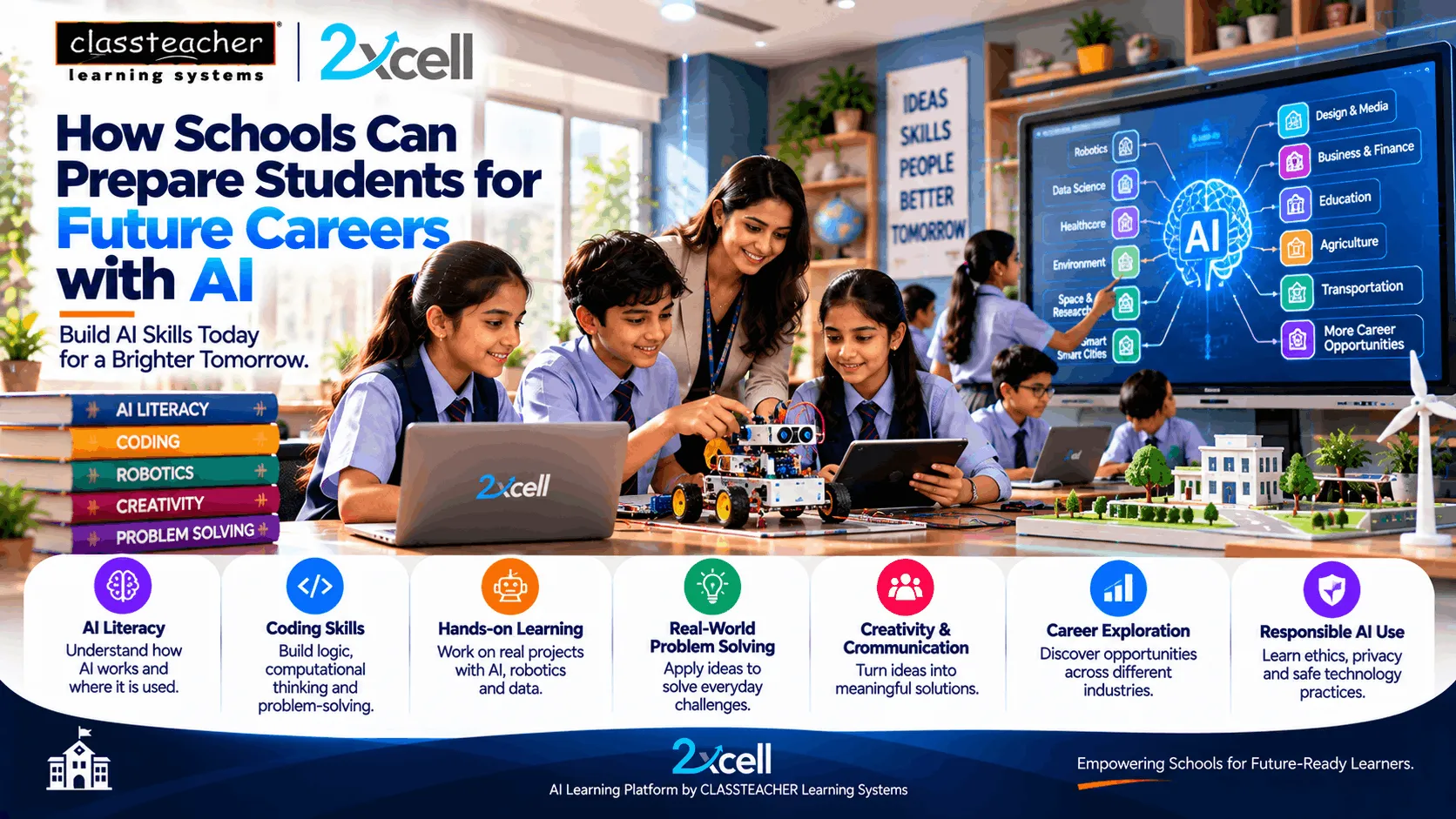
Schools can build future readiness by combining AI education, practical learning, problem-solving, digital skills, creativity, communication, and responsible technology use.
The journey can begin with:
Learn → Explore → Build → Apply → Reflect → Innovate
Why AI Career Readiness Matters
Students currently sitting in classrooms will enter a workforce where AI may be integrated into everyday tasks.
AI can already support activities such as:
- Data analysis
- Content creation
- Software development
- Research
- Customer service
- Design
- Business analysis
- Automation
- Scientific discovery
- Decision support
This means students need to understand not only what AI is, but also how it can be applied to real-world problems.
Schools can help students develop the ability to work with technology rather than simply consume it.
1. Introduce Students to AI Concepts Early
AI education does not need to begin with advanced programming.
Schools can introduce age-appropriate concepts such as:
- What is Artificial Intelligence?
- How do machines learn?
- What is data?
- How do recommendation systems work?
- What is computer vision?
- What is natural language processing?
- Where is AI used in everyday life?
Younger students can explore AI through simple activities and examples.
Older students can gradually move towards more technical concepts.
The objective is to build familiarity before students reach higher education or employment.
2. Connect AI Learning With Real-World Problems
Students learn differently when they understand why a technology matters.
Instead of teaching AI only through definitions, schools can introduce real-world challenges.
For example:
Problem: How can a school reduce food waste?
Students could explore:
Data Collection → Analysis → AI Idea → Prototype → Testing → Improvement
Another project could ask:
How could AI help identify traffic patterns near a school?
Students can explore data, formulate questions, and think about possible technology-based solutions.
This transforms AI from an abstract subject into a problem-solving tool.
3. Combine AI With Coding Education
Coding provides students with a foundation for understanding how digital systems work.
Students can progress from:
Basic Programming → Logic → Algorithms → Data → AI Concepts
Coding can help develop:
- Logical thinking
- Problem-solving
- Computational thinking
- Attention to detail
- Structured reasoning
The objective is not necessarily to make every student a software developer.
It is to help students understand the logic behind the technologies they increasingly encounter.
4. Give Students Hands-On AI Experiences
Reading about AI is different from building or experimenting with it.
Schools can introduce practical activities such as:
- Simple AI models
- Image classification experiments
- Chatbot projects
- Data analysis activities
- Voice-based applications
- Robotics projects
- AI-powered prototypes
- Interactive simulations
Hands-on learning can help students understand how ideas become working solutions.
A useful classroom cycle is:
Concept → Experiment → Build → Test → Improve
5. Use Robotics to Connect AI With the Physical World
Robotics can provide a practical way for students to understand technology.
Students can learn how:
Sensors + Code + Data + Algorithms = Intelligent Behaviour
A robotics project might involve building a system that detects an object, follows a path, responds to an instruction, or performs a defined task.
Students can then experiment with different solutions.
This encourages them to understand that technology involves testing and iteration.
6. Develop Data Literacy
AI depends heavily on data.
Students therefore need to understand basic data concepts.
Schools can introduce:
- Data collection
- Data organization
- Data visualization
- Patterns
- Trends
- Data quality
- Bias in data
- Basic statistics
- Responsible data use
For example, students could analyse classroom data and create visualizations before discussing what the patterns actually mean.
This helps develop analytical thinking.
7. Teach Students How to Work With AI
Future career preparation should include practical AI interaction.
Students can learn how to:
- Write clear instructions
- Ask effective questions
- Evaluate AI-generated information
- Compare different outputs
- Identify errors
- Improve prompts
- Use AI for brainstorming
- Use AI as a learning assistant
The important lesson is:
AI Output ≠ Automatically Correct Information
Students need to learn how to question, verify, and improve AI-generated results.
8. Teach Responsible AI Use
Future-ready education should include responsible technology use.
Students should understand issues such as:
- Privacy
- Data protection
- Bias
- Copyright
- Misinformation
- Digital identity
- Responsible AI usage
- Human oversight
For example, if an AI system provides an incorrect answer, students should be able to identify why verification is necessary.
This helps develop responsible technology users rather than passive technology consumers.
9. Strengthen Problem-Solving Skills
AI may automate certain tasks, but the ability to identify meaningful problems remains important.
Schools can encourage students to ask:
What problem are we trying to solve?
Who experiences this problem?
What information do we need?
What possible solutions exist?
How can we test the solution?
This type of thinking can be developed through projects, experiments, challenges, and collaborative activities.
10. Encourage Creativity Alongside Technology
Career readiness is not only about technical skills.
Creativity remains important because students may need to imagine new products, services, solutions, and experiences.
AI can assist with generating ideas, but students still need to decide:
- Which idea is useful?
- Who will benefit?
- What makes it different?
- How can it be improved?
- Is it practical?
Schools can combine creative activities with technology to help students explore this process.
11. Develop Communication Skills
Future careers will require students to explain ideas clearly.
A technically strong project can still fail if its creator cannot communicate:
- The problem
- The solution
- The process
- The results
- The limitations
- The next steps
Schools can ask students to present their AI and technology projects to classmates.
This develops:
Research + Technology + Communication
12. Build Collaboration Through AI Projects
Many technology projects require teamwork.
Students can work in groups where different members handle:
- Research
- Coding
- Data
- Design
- Testing
- Presentation
This can help students understand how real-world projects involve multiple roles.
It also encourages collaboration, accountability, and peer learning.
13. Introduce Career Exploration Through AI
Schools can help students understand how AI is connected to different career areas.
AI-related work can intersect with fields such as:
Technology
Software development, AI engineering, data science and cybersecurity.
Healthcare
Medical imaging, research, diagnostics support and healthcare analytics.
Business
Data analysis, automation, customer insights and decision support.
Design and Media
Creative technology, digital production and content workflows.
Science
Research, modelling, simulation and data analysis.
Education
Adaptive learning, digital content and learning analytics.
The purpose is not to tell students which career to choose.
It is to help them understand the range of possibilities.
14. Connect Classroom Learning With Industry Problems
Students can gain valuable experience when academic concepts are connected to practical challenges.
Schools can introduce projects inspired by areas such as:
- Smart cities
- Sustainable energy
- Healthcare
- Agriculture
- Transportation
- Environmental monitoring
- Education
- Financial literacy
Students can investigate problems and develop technology-based ideas.
This creates a bridge between:
Classroom Knowledge → Practical Application
15. Build AI Learning Progressively Across Grades
AI education does not need to look the same for every age group.
A possible progression could be:
Primary Grades
Digital awareness, simple logic, patterns, technology exploration and creative problem-solving.
Middle School
Coding fundamentals, data concepts, robotics, computational thinking and introductory AI activities.
Secondary School
AI concepts, data analysis, machine learning fundamentals, programming and project-based applications.
Senior Secondary
Advanced projects, AI applications, research, data science, programming and career exploration.
The exact curriculum should depend on the school's academic framework and student readiness.
16. Use Project-Based Learning
Projects can bring multiple skills together.
For example:
Project: Smart School Energy Monitor
Students can:
Research → Collect Data → Analyse → Design → Build → Test → Present
This single project can involve:
- Mathematics
- Science
- Coding
- Data analysis
- AI concepts
- Communication
- Collaboration
Project-based learning can therefore provide a practical environment for developing multiple future-ready skills.
17. Teach Students to Evaluate AI Results
One of the most important future skills may be knowing when not to trust an AI output immediately.
Students can learn to ask:
- Is the information accurate?
- What evidence supports it?
- Could there be bias?
- Is anything missing?
- Can the information be verified?
- Is the answer appropriate for the situation?
This develops critical thinking alongside AI literacy.
18. Use AI as a Learning Assistant
AI can also be used within the learning process itself.
Depending on the platform and school policies, students may use AI to:
- Explore concepts
- Generate practice questions
- Receive explanations
- Brainstorm ideas
- Review drafts
- Explore alternative solutions
- Practise problem-solving
However, students should remain active participants.
The objective should be:
AI Helps → Student Thinks → Student Verifies → Student Learns
rather than simply copying AI-generated answers.
19. Prepare Teachers Alongside Students
Students cannot receive effective AI education if teachers are not supported.
Schools can provide professional development covering:
- AI fundamentals
- AI tools for education
- Prompting
- Digital safety
- Responsible AI use
- AI-supported lesson planning
- AI-assisted assessment
- Classroom applications
Teacher development should be continuous because AI technologies are evolving rapidly.
20. Measure Skills Beyond Examination Scores
Future career readiness involves more than academic marks.
Schools can also observe:
- Problem-solving
- Creativity
- Collaboration
- Communication
- Digital literacy
- Critical thinking
- Project execution
- Research ability
- Technology application
Projects, presentations, practical activities, portfolios, and competency-based assessments can provide additional evidence of student development.
AI Career Readiness Is Not About Replacing Traditional Education
Preparing students for AI-driven careers does not mean abandoning fundamental academic learning.
Students still need:
- Mathematics
- Science
- Languages
- Reading
- Writing
- Research skills
- Social understanding
- Critical thinking
These foundations can help students use advanced technology effectively.
The goal is to connect foundational knowledge with modern technology.
Strong Fundamentals + Digital Skills + AI Literacy = Future Readiness
How 2xcell Can Support AI-Ready Learning
2xcell AI Learning Platform by CLASSTEACHER Learning Systems can support a connected digital learning environment involving learning content, practice, assessment, analytics, and personalized learning.
A future-ready learning journey can connect:
Learn → Practise → Apply → Assess → Analyse → Improve
Schools can use digital learning environments to support students as they explore concepts, practise skills, complete assessments, and receive learning support.
When AI learning is combined with coding, robotics, digital content, assessments, and analytics, schools can create broader opportunities for students to develop technology-related skills.
The goal is not simply to introduce AI tools.
It is to create learning experiences that help students understand, experiment, solve problems, and apply knowledge.
What Schools Should Consider When Building AI Readiness
Before introducing AI programs, schools can consider several questions.
Curriculum Alignment
How does AI education connect with existing academic goals?
Student Age
What level of AI concepts is appropriate for each grade?
Practical Learning
Are students actually building and experimenting?
Teacher Training
Are educators prepared to guide AI-related activities?
Responsible Use
Are students learning about privacy, bias, verification, and ethical use?
Infrastructure
Does the school have the necessary digital resources?
Assessment
How will AI-related skills and competencies be evaluated?
Long-Term Planning
Can the program evolve as technology changes?
The Future Skills Schools Can Develop
A future-ready student may need a combination of technical and human capabilities.
Digital Skills
Understanding modern digital tools and platforms.
AI Literacy
Understanding what AI can and cannot do.
Computational Thinking
Breaking complex problems into manageable steps.
Data Literacy
Understanding and interpreting information.
Critical Thinking
Questioning information and evaluating evidence.
Creativity
Generating original ideas and solutions.
Communication
Explaining concepts and presenting solutions.
Collaboration
Working effectively with others.
Adaptability
Learning new technologies and approaches as they emerge.
These skills can complement traditional academic knowledge.
The Future of Career Preparation in Schools
Career preparation is gradually becoming more connected to technology, but schools do not need to predict exactly which jobs will exist in the future.
Instead, they can help students become adaptable learners.
A student who knows how to:
Learn → Experiment → Solve → Communicate → Adapt
may be better prepared to learn new tools as technology changes.
This is particularly important in a field like AI, where technologies and applications can evolve quickly.
Conclusion
Preparing students for future careers with AI is not simply about teaching them how to use the latest AI application.
It is about developing a broader combination of AI literacy, digital skills, coding, data understanding, creativity, critical thinking, communication, collaboration, and practical problem-solving.
Schools can introduce these capabilities through age-appropriate AI education, robotics, coding, project-based learning, digital content, practical activities, and responsible technology use.
Teachers remain central to this process because technology provides tools, while educators provide guidance, context, and mentorship.
With 2xcell AI Learning Platform by CLASSTEACHER Learning Systems, schools can explore connected digital learning that brings together AI-enabled learning, practice, assessment, analytics, and personalized education.
The future-ready classroom is not simply preparing students for today's jobs.
It is helping them develop the ability to learn, adapt, create, and solve problems in a changing world.
Learn AI. Build Skills. Solve Problems. Shape the Future.
2xcell AI Learning Platform
By CLASSTEACHER Learning Systems
Empowering Education with AI & Innovation.