Introduction
Student dropout is one of the most important challenges schools must address to ensure that learners receive consistent educational opportunities. A student may leave school for several reasons, including academic difficulties, irregular attendance, financial challenges, limited engagement, family circumstances, or a lack of appropriate support.
In many cases, the signs of disengagement may appear before a student actually leaves school. Attendance may gradually decline, assessment scores may fall, classroom participation may decrease, or assignments may remain incomplete.
When schools rely only on annual examinations or end-of-term reports, these changes may go unnoticed until the situation becomes more difficult to address.
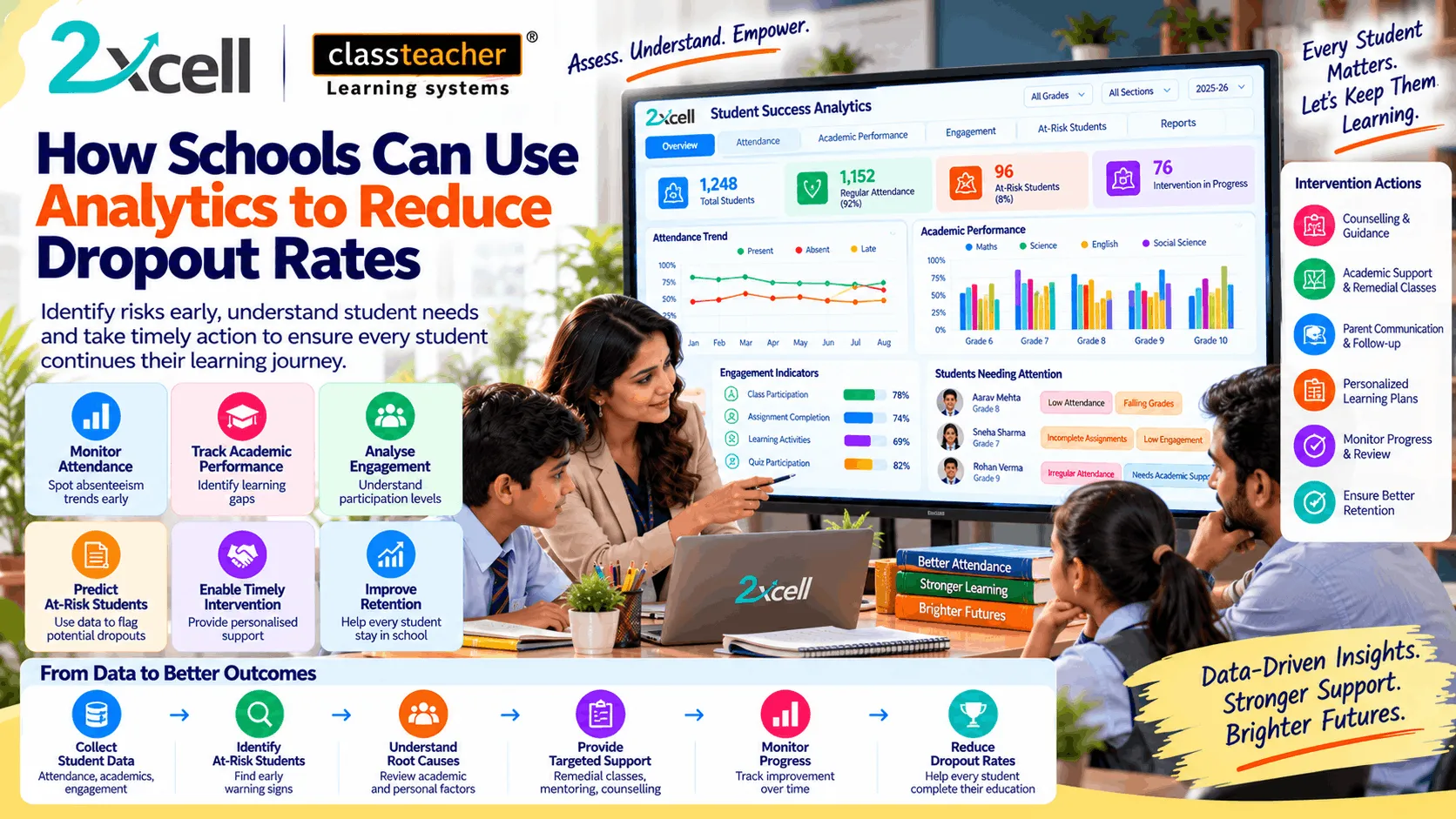
Educational analytics can help schools identify these warning signs, understand student needs, and plan timely interventions.
By bringing together relevant academic and attendance information, schools can move from reacting to dropout incidents towards identifying students who may need additional support.
The approach can follow a structured cycle:
Collect Data → Identify Patterns → Review Student Needs → Provide Support → Monitor Progress
The purpose is not to predict a student's future with certainty. It is to help educators recognize possible difficulties early and respond with appropriate guidance.
What Is Educational Analytics?
Educational analytics involves collecting and analysing relevant information about students' learning experiences, attendance, participation, and academic performance.
Schools can use this information to understand patterns that may affect student progress.
Depending on the systems available, relevant indicators may include:
- Attendance and absenteeism trends
- Assessment results
- Subject-wise academic performance
- Assignment completion
- Classroom participation
- Changes in academic progress
- Learning activity records
- Previous academic difficulties
- Student support and intervention records
- Engagement with digital learning resources
When these indicators are reviewed together, schools may gain a more complete understanding of students who could benefit from additional attention.
However, no single indicator should automatically classify a student as likely to drop out. Data should guide further investigation and supportive conversations.
Why Schools Need an Early-Warning Approach
A student rarely experiences every academic or personal difficulty at the same time. Challenges may develop gradually, making it important for schools to review changes rather than rely on isolated results.
For example, consider a student whose attendance has decreased over several weeks. At the same time, mathematics scores are falling and assignments are becoming less frequent.
Individually, each indicator may have several explanations. Together, they may suggest that the student needs a conversation with a teacher, counsellor, or parent.
An early-warning approach helps schools ask three important questions:
- What has changed in the student's academic journey?
- What circumstances may explain that change?
- What support could help the student continue learning?
This creates an opportunity to respond before disengagement becomes more serious.
1. Analyse Attendance Patterns to Identify Emerging Concerns
Attendance is one of the most useful indicators schools can monitor.
Repeated absences, frequent late arrivals, or a sudden change in attendance may indicate that a student is experiencing difficulties.
Analytics can help schools identify patterns such as:
- Increasing absences over several weeks
- Frequent absences on particular days
- Repeated late arrivals
- Declining attendance across a term
- Changes following an academic or personal event
For example, a student who previously attended regularly may begin missing several classes each week.
Rather than waiting until the end of the term, the school can review the pattern and contact the family to understand the situation.
Possible reasons may include transportation problems, health concerns, family responsibilities, bullying, or difficulties adjusting to school.
Attendance analytics should initiate supportive follow-up, not automatic punishment.
2. Track Academic Performance Over Time
A single examination result cannot fully explain a student's academic situation.
A learner may perform poorly because of a difficult topic, temporary circumstances, or gaps in foundational knowledge. Repeated declines across several assessments may provide a stronger reason for further review.
Schools can analyse:
- Changes in examination scores
- Subject-wise performance
- Repeated difficulty with foundational concepts
- Unsuccessful assessment attempts
- Progress across different grading periods
For example:
Example: Monitoring Academic Progress
Assessment 1
72%
Assessment 2
59%
Assessment 3
46%
Illustrative data only. A declining trend may prompt a teacher review, additional practice, or a discussion with the student.
When declining performance is identified early, teachers can investigate learning gaps and offer remedial instruction, mentoring, or other appropriate support.
3. Combine Multiple Indicators for a Better Understanding
Dropout risk should not be assessed through one measurement alone.
A student may have low attendance but strong academic performance. Another may attend regularly but struggle with coursework and feel disconnected from school.
Analytics becomes more useful when schools review several relevant indicators together.
Indicator
What schools can investigate
Attendance
Are absences becoming more frequent?
Academic performance
Are scores declining across assessments?
Assignments
Is the student completing less work?
Participation
Has classroom engagement changed?
Learning activity
Is the student struggling to keep up with coursework?
Previous support
Has the student benefited from earlier interventions?
The purpose is to identify situations that deserve attention, not to create a permanent label for a student.
4. Identify Students Who May Need Academic Intervention
Academic difficulties can affect motivation, confidence, and a student's willingness to continue with school.
Analytics can help teachers identify students who may need additional help with particular subjects or concepts.
For example, a student may repeatedly struggle with algebra while performing well in other subjects.
Instead of treating the problem as general academic weakness, the school can provide focused mathematics support.
Interventions may include:
- Small-group teaching
- Additional concept explanations
- Subject-specific practice
- Remedial classes
- Peer-assisted learning
- Teacher mentoring
- Regular progress reviews
By addressing academic challenges directly, schools can help students experience improvement and regain confidence in their ability to learn.
5. Monitor Assignment Completion and Learning Participation
Incomplete assignments may indicate that a student is struggling to understand the material, managing time poorly, or experiencing difficulties outside school.
A sudden increase in missing work may be particularly important when it occurs alongside declining attendance or assessment performance.
Schools can monitor:
- Assignment submission rates
- Missed deadlines
- Repeated incomplete activities
- Participation in classroom tasks
- Completion of revision work
- Engagement with assigned digital resources
Teachers should then speak with the student to understand the reasons behind the pattern.
The response might involve study-planning guidance, additional instruction, family communication, or a review of the student's workload.
6. Use Analytics to Understand Student Engagement
Academic performance is important, but it does not always reveal how connected a student feels to school.
Changes in participation may help educators identify students who are becoming disengaged.
Schools can review available information about:
- Classroom participation
- Involvement in projects
- Participation in group activities
- Completion of learning tasks
- Engagement with school programmes
Digital engagement data must be interpreted carefully. A student who uses a learning platform less frequently may have limited internet access or may complete work offline.
Teachers should consider the student's circumstances before drawing conclusions.
7. Develop an Early-Warning Dashboard
A centralized dashboard can help school leaders and teachers review relevant student information without manually comparing multiple spreadsheets.
Depending on the school's technology, a dashboard may present:
- Attendance summaries
- Academic progress
- Subject-wise performance
- Assignment completion
- Changes in engagement
- Follow-up status
- Intervention history
For example, a dashboard may highlight a student whose attendance has declined while several academic indicators have also worsened.
The teacher can review the underlying information, discuss the situation with the student, and decide whether additional support is required.
An effective dashboard should make important information easier to understand rather than overwhelm staff with excessive charts and alerts.
8. Use AI to Surface Patterns That Deserve Attention
AI-supported analytics can help schools analyse larger sets of academic and attendance information to identify patterns that may be difficult to notice manually.
Depending on the system and data quality, AI may help:
- Flag unusual attendance changes
- Identify repeated academic difficulties
- Highlight combinations of concerning indicators
- Organize students for follow-up review
- Summarize changes across reporting periods
- Suggest areas for further investigation
For example, an analytics system might flag a student whose attendance and assessment performance have both declined.
That signal should lead to human review, not an automatic decision about the student's future.
AI cannot reliably determine every underlying cause of disengagement from school records alone. Family circumstances, emotional wellbeing, financial barriers, and other personal factors may require direct communication and professional support.
9. Personalize Support According to Student Needs
Students may face different challenges, so a single intervention will not work for everyone.
Analytics can help schools organize support according to the needs identified during teacher review.
Student A: Academic Difficulty
Possible response: subject-specific tutoring, additional practice, and regular assessment reviews.
Student B: Attendance Concerns
Possible response: a supportive family conversation and help addressing barriers to attendance.
Student C: Reduced Engagement
Possible response: teacher mentoring, classroom inclusion, and a review of the student's learning experience.
Personalized intervention makes school support more relevant and gives educators a clearer way to review whether their actions are helping.
10. Strengthen Teacher and Counsellor Collaboration
Teachers often notice changes in student behaviour before those changes appear in formal reports.
Counsellors may understand emotional, social, or family-related challenges that are not visible in academic data.
Analytics can bring relevant observations together, helping these professionals coordinate their response.
A collaborative process may include:
- A teacher notices a concerning pattern.
- The school reviews relevant attendance and academic records.
- The student is approached respectfully.
- A counsellor or appropriate staff member provides additional support.
- The school agrees on an intervention plan.
- Progress is reviewed at suitable intervals.
Access to sensitive information should be limited to authorized staff who need it for student support.
11. Involve Parents Through Timely Communication
Parents may not always know that attendance, academic performance, or assignment completion has changed significantly.
Timely communication can help schools and families understand the situation before it becomes more difficult to address.
Schools can use progress reports, parent-teacher meetings, secure messaging, and individual discussions to share relevant concerns.
A constructive conversation should focus on:
- What the school has observed
- What the student may be experiencing
- What support is available
- What the family can reasonably help with
- When progress will be reviewed
The aim is to create a partnership between school and home rather than assign blame.
12. Address Non-Academic Barriers to School Continuation
Not every dropout concern can be resolved through academic intervention.
Students may face barriers such as financial hardship, transportation difficulties, caregiving responsibilities, bullying, safety concerns, or limited access to digital resources.
Analytics may help schools identify when a student needs further discussion, but the underlying problem often requires human support.
Depending on the circumstances, schools may explore:
- Counselling services
- Scholarship or financial assistance information
- Safe reporting channels
- Mentoring programmes
- Transportation support where available
- Flexible academic support
- Referral to appropriate school or community services
A responsible dropout-prevention strategy recognizes that students need both academic opportunities and an environment in which continuing education is possible.
13. Track Interventions to Understand What Is Working
Identifying a student who needs support is only the first step.
Schools also need to understand whether the intervention has helped.
For each case, educators can record:
- The concern identified
- The intervention provided
- The date support began
- The student's response
- Changes in attendance or academic performance
- The next follow-up date
For example, after a student receives additional mathematics support, teachers can review subsequent assessment results and classroom participation.
If the student improves, the school can continue or adjust the support as appropriate. If the difficulty remains, staff can investigate other possible causes.
This creates a cycle of continuous improvement:
Identify → Support → Monitor → Review → Adjust
14. Measure Dropout-Prevention Outcomes
Schools should evaluate whether their interventions are producing meaningful improvements.
Useful measures may include:
Metric
Why it matters
Attendance rate
Shows whether regular attendance is improving
Chronic absenteeism
Helps track persistent attendance problems
Student retention rate
Measures the proportion of students continuing their education
Grade progression
Shows whether students are advancing academically
Course completion
Helps identify unfinished academic requirements
Intervention follow-up
Indicates whether planned support was delivered
Re-engagement
Helps assess whether previously disengaged students are participating again
Schools should compare these indicators across appropriate time periods and student groups.
They should also account for differences in student circumstances and avoid assuming that any improvement was caused by analytics alone.
The ultimate objective is to improve student continuation and learning, not merely to produce better dashboard figures.
15. Protect Student Privacy and Use Data Responsibly
Dropout-prevention analytics involves sensitive student information. Schools must ensure that monitoring supports students without stigmatizing them.
Important considerations include:
- Collect only relevant information.
- Restrict access to authorized personnel.
- Protect student records through appropriate security controls.
- Explain how information is used.
- Review AI-generated alerts before taking action.
- Check for potential bias in analytical methods.
- Allow staff to correct inaccurate records.
- Follow applicable privacy and child-protection requirements.
Students should not be denied opportunities, disciplined, or treated unfairly simply because an algorithm flags them for review.
Analytics should open the door to support, not close doors for students.
16. How 2xcell Can Support Data-Informed Academic Monitoring
2xcell AI Learning Platform by CLASSTEACHER Learning Systems can support a connected digital learning environment involving learning content, practice, assessments, analytics, personalized learning, and student progress tracking.
Within an appropriate school implementation, connected learning information can help educators review academic progress and identify areas where additional learning support may be useful.
A learning-support cycle can follow:
Learn → Practise → Assess → Analyse → Support → Review
For schools exploring analytics-based academic monitoring, relevant progress information may contribute to conversations about student performance and learning gaps.
However, dropout prevention requires more than an academic learning platform. Schools also need attendance monitoring, appropriate student-support processes, family communication, and trained staff who can respond to the reasons a student may be disengaging.
The objective is to connect useful educational information with timely, thoughtful action.
How Schools Can Begin Implementing Analytics for Dropout Prevention
Schools do not need to introduce a complicated system immediately. They can begin with a practical and structured approach.
Step 1: Identify the Main Warning Indicators
Decide which attendance, academic, and engagement indicators are relevant to the school's context.
Step 2: Improve Data Quality
Ensure that attendance records, assessments, and student information are accurate and consistently maintained.
Step 3: Define an Early-Warning Process
Set clear criteria for when a student should receive a teacher review or supportive follow-up.
Step 4: Assign Responsibility
Clarify who reviews alerts, contacts families, coordinates support, and records outcomes.
Step 5: Create Individual Support Plans
Choose interventions according to each student's circumstances rather than applying the same response to everyone.
Step 6: Review Progress Regularly
Monitor whether attendance, engagement, academic progress, or other relevant indicators improve.
Step 7: Improve the Process
Use the results to refine the school's support system and identify areas where additional resources are needed.
The Future of Analytics in Dropout Prevention
As educational technology develops, schools may gain better ways to connect attendance, assessment, learning activity, and student-support records.
A future early-support framework could look like this:
Attendance & Academic Records
Pattern Identification
Teacher or Counsellor Review
Personalized Support Plan
Progress Monitoring
Intervention Review
The effectiveness of this approach depends on data quality, staff capacity, appropriate interventions, and the school's ability to address the underlying causes of student disengagement.
Technology can help schools notice patterns, but people must interpret those patterns and provide meaningful support.
Conclusion
Reducing student dropout rates requires schools to recognize difficulties early and respond with appropriate support. Attendance trends, declining academic performance, incomplete assignments, and reduced engagement can provide useful signals when reviewed in context.
Educational analytics can help schools organize these signals, identify students who may need attention, coordinate interventions, and monitor progress over time.
However, analytics alone cannot prevent every dropout. Effective prevention also requires teacher involvement, student counselling, family collaboration, responsible data practices, and practical solutions to academic and non-academic barriers.
With 2xcell AI Learning Platform by CLASSTEACHER Learning Systems, schools can explore a connected approach to digital learning, assessment, analytics, personalized learning, and student progress tracking as part of a broader student-support strategy.
The goal is to move beyond identifying problems after they occur and towards recognizing when students may need help to continue their education.
Identify Early. Support Thoughtfully. Help Every Student Continue Learning.
2xcell AI Learning Platform
By CLASSTEACHER Learning Systems
Empowering Education with AI & Innovation.