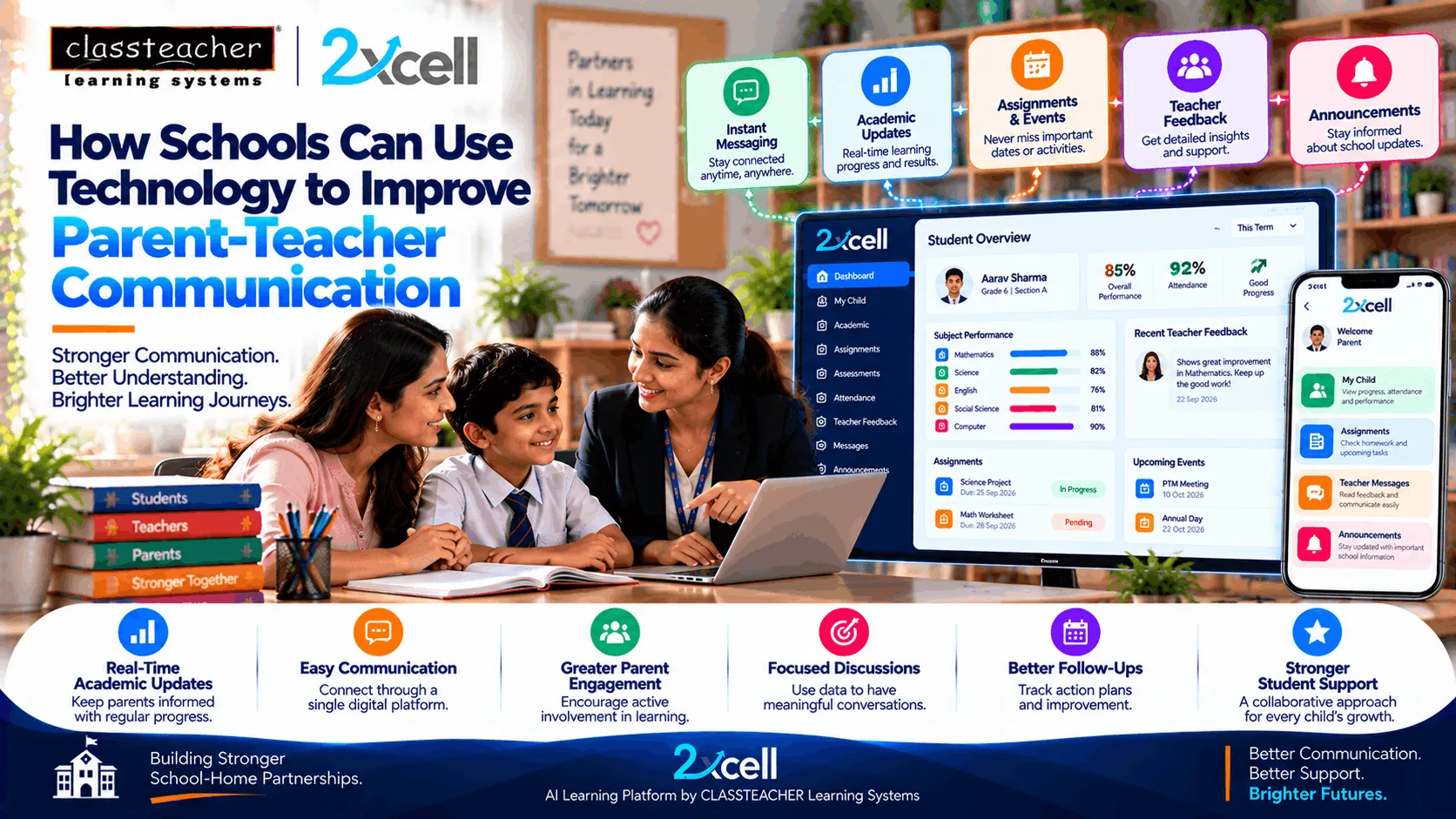
Introduction
Strong communication between parents and teachers plays an important role in supporting student learning.
Traditionally, parent-teacher communication has depended on school diaries, phone calls, periodic meetings, notices, emails, and report cards. These methods continue to have value, but modern schools now have access to digital tools that can make communication more organized, timely, and connected to the student's learning journey.
Technology can help schools bring together academic updates, attendance information, assessments, announcements, progress reports, and teacher feedback in a more accessible environment.
The objective is not to replace personal communication.
It is to strengthen it:
Inform → Understand → Discuss → Support → Follow Up
Why Parent-Teacher Communication Matters
Parents and teachers see different sides of a student's educational experience.
Teachers observe:
- Classroom participation
- Academic performance
- Learning difficulties
- Assignments
- Behaviour during learning activities
- Progress across subjects
Parents may observe:
- Study routines at home
- Areas of interest
- Homework habits
- Questions about school
- Changes in learning behaviour
- The child's response to academic challenges
When these perspectives are connected, both sides can gain a broader understanding of the student's learning journey.
Technology can help create that connection.
1. Digital Platforms Can Make Communication More Accessible
Parents and teachers may not always be available at the same time for a phone call or physical meeting.
A digital communication platform can provide access to relevant school information through one organized environment.
Depending on the school's system, parents may be able to view:
- Academic updates
- Attendance
- Assignments
- Assessment results
- Learning activities
- Teacher messages
- School announcements
This can reduce dependence on scattered communication channels.
2. Parents Can Receive Academic Updates More Regularly
Waiting for a term-end report card can leave parents with limited information about ongoing progress.
Digital systems can provide more frequent updates about relevant academic activities.
For example:
Assessment Completed → Result Available → Teacher Review → Parent Visibility
This can help parents understand progress during the learning process rather than only after a major examination.
3. Teachers Can Share More Specific Feedback
A short message such as "Needs improvement" does not always tell parents what action is required.
Digital communication can support more specific feedback.
For example:
Subject: Mathematics
Area: Fractions
Observation: Requires additional practice
Suggested Action: Complete topic-based practice
This gives parents a clearer understanding of where support may be useful.
4. Technology Can Connect Parent Communication With Student Performance
Communication becomes more useful when it is connected to meaningful learning information.
For example:
Assessment Data → Learning Insight → Teacher Feedback → Parent Discussion
Instead of discussing marks alone, teachers and parents can discuss:
- Strong areas
- Difficult topics
- Improvement
- Practice requirements
- Learning goals
This can make conversations more focused.
5. Digital Progress Reports Can Show Learning Trends
A single score provides a snapshot.
Progress over several assessments can provide more context.
For example:
Assessment 1: 61%
Practice: Additional revision
Assessment 2: 68%
Targeted Practice: Completed
Assessment 3: 76%
A digital progress report can help parents see the direction of learning rather than focusing only on one result.
6. Parents Can Understand Learning Gaps More Clearly
Overall marks may not reveal specific areas where students need support.
A digital academic report could show:
Science
- Biology — Strong
- Physics — Developing
- Chemistry — Additional Practice
This allows parents and teachers to have a more focused discussion.
Instead of saying:
"Science needs improvement."
the conversation can become:
"Let's provide additional support in this particular topic."
7. Technology Can Make Parent-Teacher Meetings More Productive
Digital information can help parents and teachers prepare before a meeting.
Teachers can review:
- Recent assessments
- Student progress
- Practice activity
- Attendance
- Learning gaps
- Previous interventions
Parents can review relevant information and prepare questions.
The meeting can then focus more on:
What is happening? → Why? → What support is needed? → What happens next?
8. Digital Messaging Can Support Timely Communication
Some situations require communication before the next scheduled parent-teacher meeting.
Digital messaging can help schools communicate relevant information about:
- Assignments
- Assessments
- Attendance
- Events
- Academic activities
- Important reminders
This can make communication more timely.
However, schools should establish clear communication guidelines so that digital messaging remains organized and appropriate.
9. Parents Can Track Assignments and Learning Activities
Students may occasionally forget to communicate homework or assignment requirements at home.
A digital platform can provide parents with visibility into relevant activities.
For example:
Assignment: Science Project
Due Date: Friday
Status: In Progress
This allows parents to support students without having to depend entirely on information being communicated verbally.
10. Attendance Information Can Improve Communication
Attendance is another important part of school communication.
Digital systems can provide parents with relevant attendance information, such as:
- Attendance records
- Absence notifications
- Attendance trends
- Important school attendance updates
If unusual attendance patterns appear, schools can communicate with parents earlier.
11. Technology Can Help Parents Understand Teacher Recommendations
Teachers may recommend:
- Additional practice
- Revision
- Reading
- Remedial support
- Advanced activities
- Individual guidance
Digital communication can help record these recommendations and make them easier for parents to understand.
For example:
Learning Gap → Teacher Recommendation → Parent Awareness → Home Support → Progress Review
This creates continuity between school and home.
12. Parents Can Follow Whether Support Is Working
Communication should not stop after a recommendation is made.
Suppose a teacher identifies difficulty in mathematics.
The process could be:
Identify Gap → Additional Practice → Reassessment → Review Progress → Parent Update
This helps parents understand whether the intervention is producing improvement or whether additional support may be needed.
13. AI-Powered Insights Can Add Context to Communication
AI can help analyze relevant learning information and identify patterns.
For example, an AI-enabled learning platform may highlight:
- Repeated mistakes
- Topic-level difficulties
- Changes in performance
- Practice requirements
- Learning progress
These insights can give teachers additional information to discuss with parents.
The appropriate relationship is:
AI Identifies Patterns → Teacher Interprets Them → Parent Receives Context
AI should support communication rather than independently make conclusions about a child.
14. Digital Communication Can Support Personalized Parent Updates
Not every parent needs the same type of information.
One parent may want to focus on academic performance.
Another may be more interested in attendance.
Another may want to understand learning activities and practice.
Digital platforms can organize relevant information so communication becomes more focused.
Useful categories may include:
- Academic Progress
- Attendance
- Practice
- Assessments
- Teacher Feedback
- Learning Goals
15. Technology Can Help Reduce Communication Gaps
In a large school, teachers may be responsible for communicating with many parents.
Digital systems can help organize communication records and academic information.
This can reduce situations where important information is scattered across:
- Paper diaries
- Messages
- Spreadsheets
- Emails
- Phone conversations
A more connected system can make it easier to maintain a consistent communication trail.
16. Parent Communication Can Become More Two-Way
Effective communication should not only involve schools sending information.
Parents should also have appropriate opportunities to respond.
Digital platforms can support:
- Queries
- Feedback
- Meeting requests
- Acknowledgements
- Follow-up discussions
This can create a two-way communication model:
School Shares → Parent Understands → Parent Responds → Teacher Follows Up
17. Digital Portals Can Keep Important Information in One Place
Parents may currently use different channels for different school activities.
A connected parent portal can potentially bring together:
- Announcements
- Attendance
- Assessments
- Assignments
- Progress reports
- Teacher communication
- Learning resources
Having information in one place can make school communication easier to navigate.
18. Technology Can Support Communication Beyond Report Cards
A report card usually summarizes performance over a defined period.
Digital learning systems can provide more continuous information.
For example:
Learning Activity → Practice → Assessment → Feedback → Progress
This can help parents understand what is happening between major examinations.
The emphasis shifts from:
"What was the final score?"
to:
"How is the student progressing?"
19. Teachers Can Use Data to Prepare Better Conversations
Before speaking with parents, teachers can review relevant information and identify the most important points.
A structured conversation may include:
Strengths
What is the student doing well?
Areas for Attention
Which concepts require additional support?
Progress
What has changed recently?
Action
What can the school and family do next?
This makes parent-teacher communication more focused and constructive.
20. How 2xcell Can Support Parent-Teacher Communication
2xcell AI Learning Platform by CLASSTEACHER Learning Systems can support a connected digital learning environment involving:
- Digital learning content
- Practice
- Assessments
- Analytics
- Personalized learning
- Student progress tracking
A connected learning cycle can follow:
Learn → Practise → Assess → Analyse → Communicate → Support → Improve
Relevant learning information can help schools provide greater visibility into student progress while supporting communication between teachers and parents.
For example, schools can use learning information to discuss:
- Student strengths
- Learning gaps
- Assessment performance
- Practice requirements
- Progress over time
- Recommended support
The goal is to make communication more meaningful by connecting it with the student's learning journey.
What Schools Should Consider When Choosing Communication Technology
Technology should be selected according to the school's actual communication requirements.
Ease of Use
Can parents and teachers access the system easily?
Centralized Information
Can important academic and communication information be accessed from one place?
Timely Updates
Can schools share relevant information without unnecessary delays?
Academic Integration
Can communication connect with assessments, learning activities, and progress?
Teacher Control
Can teachers decide what information should be shared?
Parent Accessibility
Can parents understand the information without technical expertise?
Data Privacy
Are student and family records handled securely?
Scalability
Can the system support the school's growing communication needs?
Avoiding Information Overload
More messages do not necessarily mean better communication.
Parents may become overwhelmed if they receive too many:
- Notifications
- Alerts
- Reports
- Messages
- Performance updates
Schools can prioritize important information.
A useful communication dashboard could highlight:
Today's Important Updates
Recent Academic Progress
Areas Requiring Attention
Upcoming Assessments
Teacher Recommendations
This can make communication more practical.
Technology Should Strengthen Human Communication
Digital platforms can make information easier to share, but they should not eliminate meaningful conversations.
Some situations require direct interaction between parents and teachers.
Teachers can provide context that a dashboard cannot.
Parents can provide information about the student's experience outside school.
Therefore:
Technology Provides Information → Teacher Adds Context → Parent Provides Perspective → Joint Support
This creates a more complete approach to student support.
The Future of Parent-Teacher Communication
As AI, digital learning, analytics, and school communication platforms continue to develop, parent-teacher communication may become increasingly connected with student learning data.
A future communication ecosystem could look like:
Student Learning
↓
Digital Activity
↓
Assessment
↓
Learning Analytics
↓
Teacher Review
↓
Parent Communication
↓
Support Plan
↓
Progress Tracking
This can help create a continuous connection between classroom learning and home support.
Conclusion
Technology can help schools make parent-teacher communication more timely, organized, and connected to student learning.
Digital platforms can provide parents with better visibility into assessments, assignments, attendance, learning progress, strengths, and areas requiring attention.
For teachers, technology can help organize information and prepare more focused conversations with families.
However, effective communication is not simply about sending more information.
It is about providing the right information, at the right time, with the right context.
With 2xcell AI Learning Platform by CLASSTEACHER Learning Systems, schools can explore a connected approach to digital learning, assessment, analytics, personalized learning, and student progress tracking.
The goal is simple:
Better Information. Better Conversations. Better Student Support.
2xcell AI Learning Platform
By CLASSTEACHER Learning Systems
Empowering Education with AI & Innovation.