Introduction
Classroom assessment plays an important role in understanding whether students have understood what they are being taught. However, conducting tests manually can take considerable time.
Teachers may need to prepare question papers, distribute them, collect responses, check answer sheets, calculate results, and then identify students who need additional support.
A Smart Audience Response System (SRS) can make this process more efficient by allowing students to respond digitally and helping teachers access assessment information quickly.
Instead of assessment ending with a score, the process can become:
Ask → Respond → Capture → Analyse → Understand → Support
This can help teachers spend less time on repetitive assessment work and more time on teaching and remediation.
What Is a Smart Audience Response System?
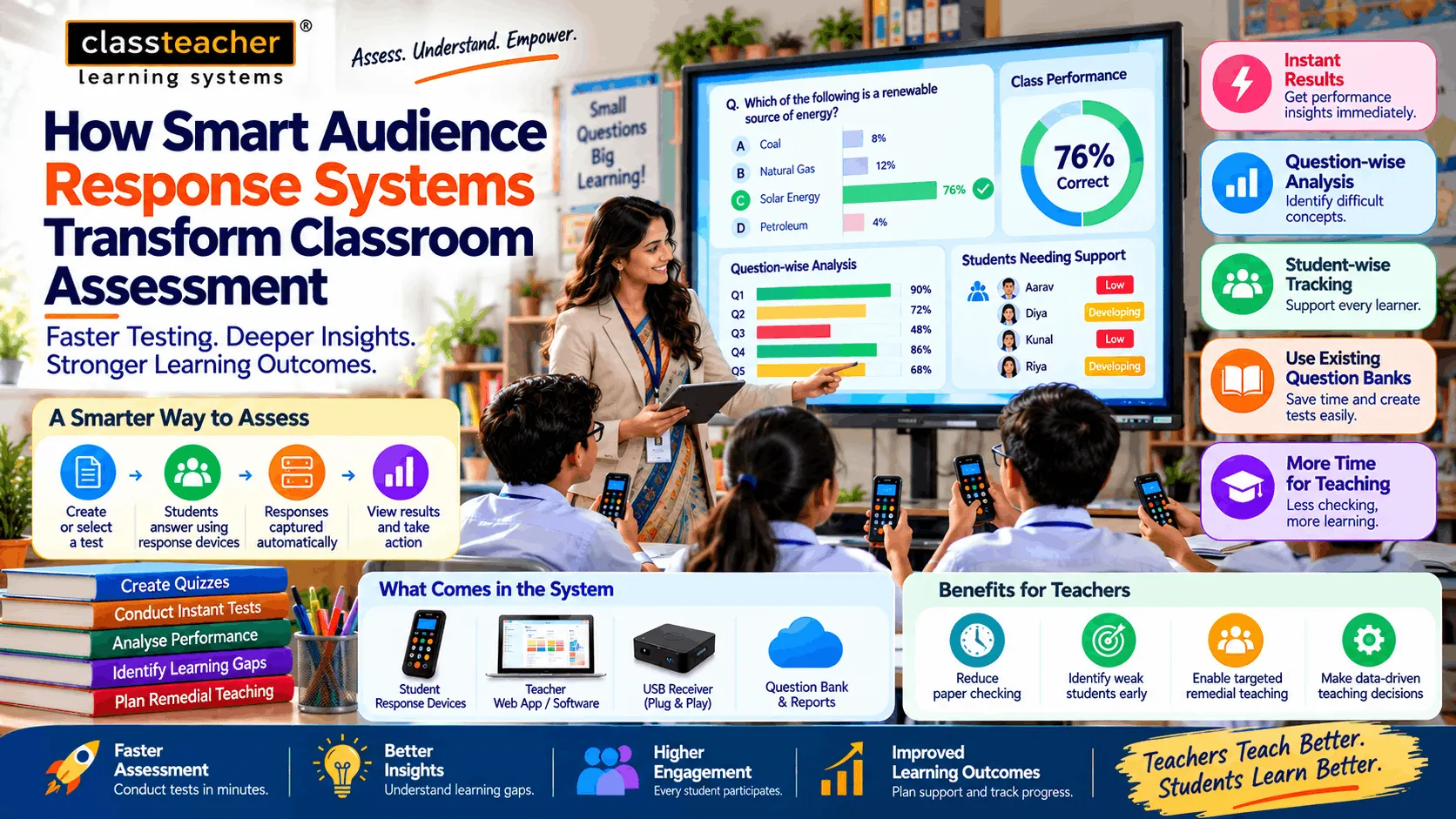
A Smart Audience Response System is a classroom assessment solution that allows students to answer questions using dedicated response devices while teachers manage assessments through connected software.
A typical system can include:
- Student response devices
- Teacher web application or software
- USB receiver
- Question bank
- Assessment reports
- Performance analysis
Teachers can create or select an assessment, students can submit their answers, and the responses can be captured electronically.
This creates a more connected assessment environment.
The Challenge With Traditional Objective Testing
Objective tests are useful for checking student understanding, but manually evaluating them can create additional work for teachers.
A traditional process may look like:
Create Test → Print → Distribute → Collect → Check → Record → Report
When teachers conduct multiple tests across several classes, this process can consume valuable time.
There is also a delay between students completing the test and teachers receiving meaningful performance information.
A smart response system can shorten this assessment cycle.
1. Teachers Can Create Assessments According to the Syllabus
Teachers can prepare quizzes and objective tests around their existing academic requirements.
Questions can be organized according to:
- Subject
- Chapter
- Topic
- Learning objective
- Assessment requirement
This allows teachers to conduct assessments that are connected with classroom teaching rather than using unrelated questions.
2. Existing Question Banks Can Make Assessment Easier
Teachers do not always need to create every question from the beginning.
A structured question bank can provide access to previously created questions that can be selected for different classroom assessments.
This can be useful for:
- Chapter tests
- Revision quizzes
- Practice assessments
- Concept checks
- Classroom activities
It can also reduce repetitive preparation work.
3. Students Can Answer Through Response Devices
Instead of writing answers on paper for every objective test, students can submit responses through dedicated response devices.
The teacher displays the question, students select their answers, and the system captures the responses.
The classroom process becomes:
Question → Student Response → Digital Capture
This makes objective assessment more interactive.
4. Results Can Be Captured Automatically
One of the key advantages of a digital response system is automatic response capture.
Teachers do not need to manually transfer every response into a separate record.
The system can collect student responses and organize the information for analysis.
This can reduce repetitive administrative work.
5. Teachers Can Access Results Faster
In traditional testing, teachers may need time to evaluate answer sheets before understanding how the class performed.
With a smart response system, assessment information can become available much faster.
This allows teachers to move more quickly from:
Testing
to
Understanding
and then to:
Academic Action
6. Question-Wise Analysis Can Reveal Difficult Concepts
A total score does not always explain what students have understood.
Question-wise analysis can provide more detailed information.
For example:

If one question has significantly lower performance, the teacher can investigate the concept associated with that question.
This can make classroom assessment more meaningful.
7. Student-Wise Tracking Provides Individual Insights
Every student may have different learning requirements.
Student-wise reports can help teachers identify:
- Strong performers
- Students requiring additional practice
- Students repeatedly making mistakes
- Students showing improvement
- Students who may need remedial support
This provides a more detailed picture than a single class average.
8. Teachers Can Identify Weak Areas Earlier
Regular classroom assessment can help identify academic difficulties before they become larger problems.
For example:
Low Performance
↓
Identify Difficult Concept
↓
Additional Explanation
↓
Practice
↓
Follow-Up Assessment
This gives teachers an opportunity to intervene during the learning process instead of waiting until a major examination.
9. Instant Insights Can Support Remedial Teaching
The real value of assessment comes from what teachers do with the results.
Suppose a large number of students answer a question incorrectly.
The teacher can:
- Explain the concept again
- Provide examples
- Conduct a discussion
- Give additional practice
- Use another teaching method
The process becomes:
Assessment → Insight → Remedial Teaching
This connects testing directly with learning improvement.
10. Assessment Can Become More Interactive
A smart response system can turn objective questions into classroom interaction.
Instead of simply asking students to complete a test silently, teachers can use questions as discussion points.
For example:
Teacher Displays Question
↓
Students Submit Responses
↓
Class Results Appear
↓
Teacher Discusses the Concept
This allows assessment and classroom teaching to work together.
11. Every Student Can Participate
In a traditional classroom discussion, only some students may raise their hands or answer aloud.
A response system allows the teacher to collect answers from the class more broadly.
This can help teachers understand whether the lesson has been understood across the classroom rather than relying on responses from only a few students.
12. Teachers Can Reduce Time Spent on Manual Correction
Objective assessments often involve repetitive checking.
When responses are digitally captured and results are generated through the system, teachers can reduce some of this manual effort.
The time saved can be redirected towards:
- Student support
- Lesson planning
- Remedial teaching
- Classroom interaction
- Academic planning
The objective is:
Less Administrative Work → More Teaching Focus
13. Performance Can Be Tracked Across Sections
Schools may have multiple sections studying the same subject or grade.
Structured assessment reports can help teachers and academic teams compare performance across sections.
For example:
Section A → 78%
Section B → 71%
Section C → 84%
Such information can help identify whether a particular section requires additional academic support.
14. Schools Can Build a Continuous Assessment Process
Assessment does not need to happen only after completing an entire chapter.
Teachers can use short objective tests at different stages.
A continuous assessment cycle could be:
Teach → Check → Analyse → Explain → Practise → Check Again
This provides more regular information about student understanding.
15. Data Can Support Better Academic Decisions
Teachers already rely on their classroom experience.
Assessment data can complement that experience by providing measurable evidence.
For example, a teacher may believe that students have understood a topic because they participated actively.
A quick assessment can provide additional evidence about whether students can actually answer questions independently.
The combination becomes:
Teacher Observation + Assessment Data = Stronger Academic Insight
16. Reports Can Support School-Level Planning
Assessment information can also be useful beyond the individual classroom.
School leaders and academic coordinators may need to understand:
- Overall performance
- Section-wise results
- Subject-level patterns
- Common learning difficulties
- Student progress
- Areas requiring intervention
Structured digital reports can make this information easier to review.
17. Assessment Can Support Data-Driven Teaching
A smart response system can contribute to a broader data-driven teaching approach.
The cycle can be:
Student Responses
↓
Performance Data
↓
Teacher Analysis
↓
Academic Decision
↓
Instructional Support
↓
Improved Performance
This shifts assessment from being only a measurement tool to becoming part of the teaching process.
18. Teachers Can Use Assessment for Feedback
Feedback is more useful when students receive it close to the learning activity.
After an assessment, teachers can discuss:
- Correct answers
- Common mistakes
- Difficult concepts
- Alternative approaches
- Areas requiring revision
Students can then use the feedback to improve their understanding.
The cycle becomes:
Answer → Feedback → Correct → Understand
19. Smart Assessment Can Support Different Subjects
A response system can be used for objective assessments across various subjects.
Mathematics
Formulas, calculations, concepts, and problem-solving questions.
Science
Processes, definitions, applications, and concept-based questions.
Social Science
History, geography, civics, and curriculum-based quizzes.
Languages
Grammar, vocabulary, comprehension, and language concepts.
General Knowledge
Quick classroom quizzes and knowledge checks.
The questions and assessment format can be adapted according to the subject.
20. How Classteacher SRS Supports Smart Assessment
The Classteacher Smart Audience Response System (SRS) brings together several components to support classroom assessment.
The system can include:
- Student response devices
- Teacher web app/software
- USB receiver
- Question bank
- Automated results
- Question-wise analysis
- Student-wise performance tracking
- Assessment reports
A typical workflow can be:
Create / Select a Test
↓
Students Answer Using Response Devices
↓
Responses Captured Automatically
↓
Results Generated
↓
Teacher Reviews Performance
↓
Feedback & Remedial Teaching
This connects classroom testing with meaningful academic action.
From Test Scores to Learning Insights
A traditional assessment approach may focus mainly on:
How many marks did the student get?
A smarter approach can ask:
- Which questions were difficult?
- Which concepts were misunderstood?
- Which students need additional support?
- Which areas were understood well?
- Did performance improve after intervention?
This changes the purpose of assessment from simply measuring performance to understanding learning.
How Schools Can Implement Smart Response-Based Assessment
Schools can introduce the system gradually.
Step 1: Identify Assessment Requirements
Determine which grades, subjects, and assessments can benefit from digital response technology.
Step 2: Prepare Question Banks
Organize objective questions according to curriculum requirements.
Step 3: Train Teachers
Help teachers understand the assessment software and response devices.
Step 4: Start With Short Assessments
Begin with quizzes and chapter-level concept checks.
Step 5: Analyse Results
Review question-wise and student-wise performance.
Step 6: Take Academic Action
Provide additional explanation or practice where required.
Step 7: Reassess
Conduct another assessment to check whether understanding has improved.
Common Mistakes Schools Should Avoid
Using Technology Without a Purpose
The system should solve an actual assessment requirement.
Focusing Only on Scores
Teachers should examine the underlying concepts and patterns.
Testing Without Follow-Up
Assessment should lead to feedback, revision, or intervention when required.
Overusing Assessments
Students should not feel that every classroom interaction is a test.
Ignoring Teacher Judgement
Technology should support teachers, not replace their professional understanding.
The Future of Classroom Assessment
As schools adopt more digital learning technologies, assessment can become increasingly connected with analytics, personalized practice, and student progress tracking.
A future classroom assessment cycle could look like:
Teach
↓
Interactive Question
↓
Student Response
↓
Instant Analysis
↓
Learning Gap
↓
Targeted Practice
↓
Teacher Support
↓
Reassessment
↓
Progress
This creates a continuous connection between assessment and learning.
Conclusion
Effective assessment is not only about finding out how many questions students answered correctly.
It is about understanding what students know, where they are struggling, and what teachers can do next.
Smart Audience Response Systems can help schools make objective assessments faster, more interactive, and easier to analyse.
By capturing responses digitally, generating reports, providing question-wise and student-wise insights, and supporting continuous assessment, an SRS can help teachers spend less time on repetitive checking and more time on teaching and student support.
The Classteacher Smart Audience Response System provides a connected approach involving response devices, teacher software, question banks, automated results, performance tracking, and academic reporting.
The goal is simple:
Assess Faster. Understand Better. Teach Smarter.
Classteacher Smart Audience Response System
Teachers Teach Better. Students Learn Better.
Real-Time Assessment. Real Progress.