Introduction
Every classroom contains students who learn at different speeds and demonstrate different levels of understanding. A single examination score can show how a student performed, but it may not explain why the student achieved that result or what should happen next.
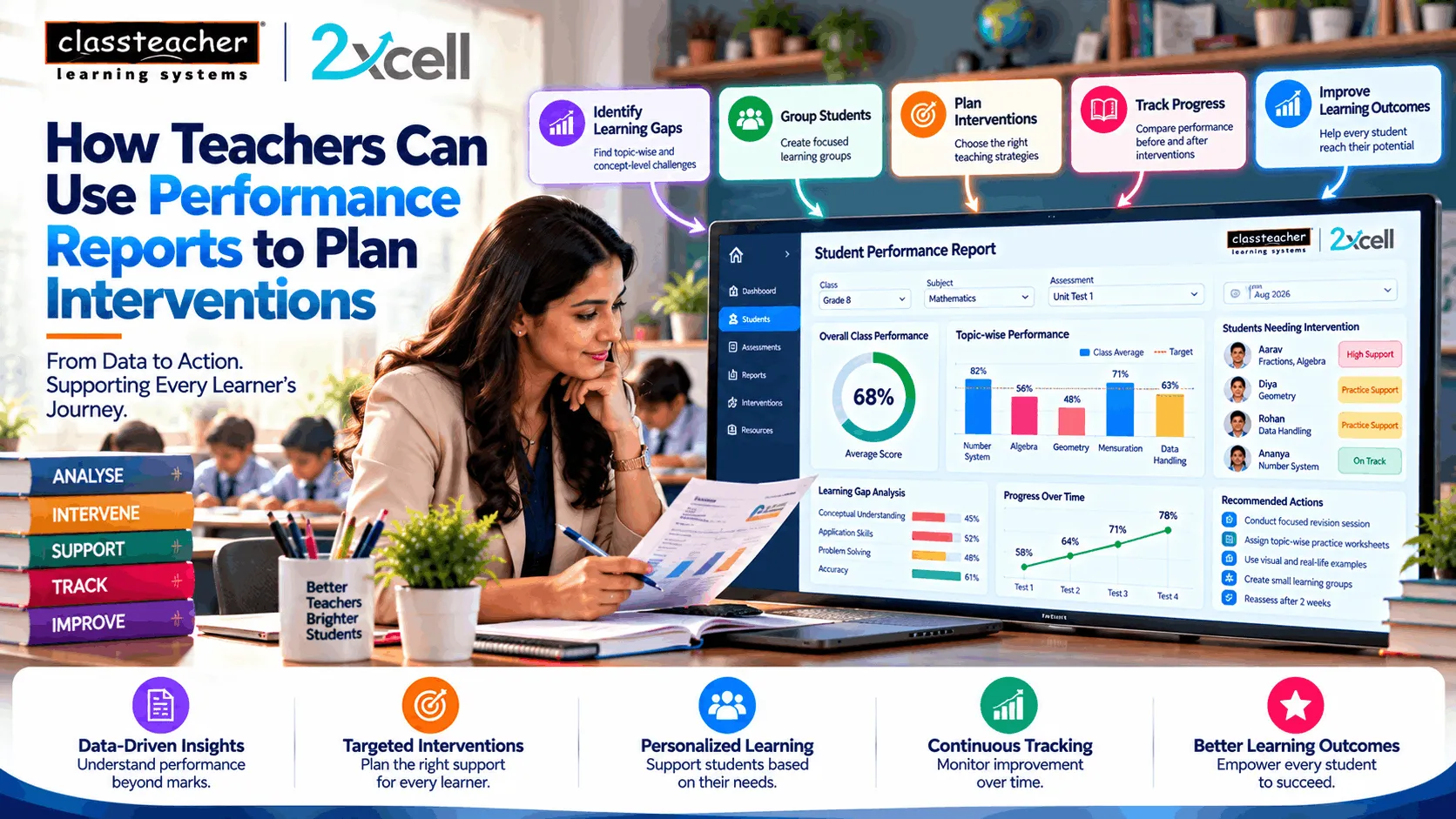
Performance reports can help teachers move beyond marks and look at patterns in student learning. When reports include information such as topic-wise performance, assessment results, practice activity, progress trends, and areas of difficulty, teachers can use these insights to plan more focused academic interventions.
The purpose of performance reporting is therefore not simply to document results. It is to help teachers answer an important question:
What should we do next to help this student improve?
What Is a Performance Report?
A performance report is a structured summary of a student's or class's learning performance.
Depending on the digital platform being used, a report may include:
- Assessment scores
- Topic-wise performance
- Question-level results
- Practice activity
- Concept mastery
- Repeated mistakes
- Progress over time
- Learning gaps
- Areas requiring revision
- Improvement after intervention
A useful performance report should turn raw learning information into insights that teachers can understand and act upon.
For example, instead of simply showing:
Mathematics – 62%
a detailed report might show:
Fractions – 45%
Decimals – 72%
Algebra – 68%
Geometry – 79%
This gives the teacher a clearer starting point for intervention planning.
Why Performance Reports Matter for Intervention Planning
Intervention is most useful when it addresses a specific learning requirement.
If a student is struggling with mathematics, giving the same revision material to everyone may not address the actual problem.
Performance reports can help teachers identify:
- Which concept is difficult?
- How frequently is the student making mistakes?
- Is the difficulty limited to one topic?
- Has the student's performance changed over time?
- Does the student require additional practice?
- Is the student ready for more advanced work?
This allows intervention to become more targeted.
1. Start by Identifying the Learning Gap
The first step is to understand exactly where the student is facing difficulty.
Teachers can review topic-wise and assessment-level information to identify areas where performance is consistently below the expected level.
For example:
Science Performance
- Human Body – 82%
- Matter – 76%
- Force & Motion – 51%
- Energy – 79%
Rather than revising the entire Science syllabus, the teacher can focus initially on Force & Motion.
This saves time and makes the intervention more relevant.
2. Look Beyond the Overall Score
An overall percentage can sometimes hide important differences between topics.
Consider two students who both score 70%.
Student A may have strong conceptual understanding but make mistakes in application-based questions.
Student B may understand application questions but struggle with basic concepts.
Although their overall scores are identical, they may require completely different support.
Performance reports can help teachers examine the details behind the final score.
This changes the conversation from:
"The student scored 70%."
to:
"Which parts of the subject does the student understand, and where is additional support required?"
3. Identify Repeated Mistakes
One incorrect answer does not necessarily indicate a learning gap.
Repeated mistakes can provide stronger evidence that a concept needs attention.
For example, a student may repeatedly:
- Apply the wrong mathematical formula
- Confuse scientific terms
- Make grammatical errors
- Misinterpret questions
- Struggle with multi-step problems
A performance report can help teachers identify these recurring patterns.
Once the pattern is identified, the teacher can design an intervention specifically around that difficulty.
4. Group Students With Similar Learning Needs
Intervention does not always have to be conducted individually.
If several students demonstrate difficulty with the same concept, teachers can create a small learning group.
For example:
Group A – Foundation Support
Students who require concept explanation and guided practice.
Group B – Practice Support
Students who understand the concept but need additional application.
Group C – Advanced Learning
Students who have already demonstrated mastery and are ready for challenging problems.
This allows teachers to use classroom time more effectively while still responding to different learning needs.
5. Use Reports to Decide the Type of Intervention
Not every learning gap requires the same response.
A teacher can select an intervention according to the identified need.
Conceptual Difficulty
Use:
- Alternative explanations
- Visual examples
- Demonstrations
- Concept maps
- Teacher-led discussion
Practice Difficulty
Use:
- Additional questions
- Worksheets
- Guided exercises
- Topic-wise quizzes
Application Difficulty
Use:
- Case studies
- Real-world problems
- Higher-order questions
- Project-based activities
Revision Requirement
Use:
- Summary resources
- Short quizzes
- Revision exercises
- Previous question practice
The report identifies the area; the teacher decides the appropriate response.
6. Compare Performance Before and After Intervention
An intervention should not end when the additional activity is completed.
Teachers should check whether it actually helped.
A simple process can be:
Initial Assessment → Identify Gap → Intervention → Reassessment → Compare Results
For example:
Initial Performance: 48%
Targeted Practice: Completed
Reassessment: 67%
The improvement provides useful information about the student's response to the intervention.
If performance remains unchanged, the teacher may need to try another approach.
7. Track Progress Over Multiple Assessments
One assessment provides a snapshot.
Multiple reports can show a student's development over time.
Teachers can compare:
- Test 1
- Practice Assessment
- Revision Test
- Unit Assessment
- Term Assessment
This can reveal whether the student's performance is:
Improving → Stable → Declining → Fluctuating
Such trends can help teachers decide whether existing support is sufficient or whether additional intervention is needed.
8. Identify Students Who May Need Early Support
Performance reports can also help teachers notice potential concerns before they become larger academic problems.
For example, a student may show:
- Gradually declining scores
- Repeated mistakes
- Low practice completion
- Weak performance across related topics
- Limited improvement after revision
None of these signals should automatically be treated as a final judgement about the student.
Instead, they can encourage the teacher to investigate further and determine whether additional academic support would be useful.
9. Use Class-Level Reports for Group Interventions
Performance reports are useful not only for individual students.
Class-level reports can reveal broader patterns.
Suppose a large percentage of students perform poorly on the same topic.
The teacher may decide to conduct a classroom-wide intervention.
This could involve:
- Re-teaching the concept
- Using a different explanation
- Introducing practical examples
- Conducting guided practice
- Running a short assessment
- Reviewing the new results
This allows the teacher to address a common learning requirement efficiently.
10. Personalize Practice Based on Report Insights
Students who require additional support may benefit from targeted practice rather than repeating the entire syllabus.
For example:
Weak Topic → Targeted Questions → Feedback → Additional Practice → Reassessment
Students who demonstrate strong understanding can meanwhile receive more challenging activities.
This creates a differentiated learning experience without changing the overall curriculum objectives.
11. Use Performance Reports During Parent-Teacher Discussions
Performance reports can also make academic discussions with parents more specific.
Instead of discussing only examination marks, teachers can discuss:
- Areas of strength
- Topics requiring attention
- Progress over time
- Completed interventions
- Areas of improvement
- Suggested next steps
This can make parent-teacher conversations more focused on the student's learning journey.
12. Use Reports for Better Lesson Planning
Performance data can influence what happens in the next lesson.
For example:
Report Insight: Students are struggling with fractions.
↓
Teacher Decision: Revisit the concept.
↓
Classroom Activity: Visual explanation + guided examples.
↓
Practice: Topic-specific questions.
↓
Assessment: Short formative test.
↓
Report: Review improvement.
This creates a feedback loop between assessment and teaching.
Performance Reports Should Support Teachers, Not Replace Them
Technology can organize large amounts of academic information, but teachers provide the context needed to understand that information.
For example, a report may show that a student's performance has declined.
However, the report may not explain whether the reason is:
- A conceptual misunderstanding
- Lack of practice
- Difficulty with the question format
- A change in learning environment
- Need for additional explanation
- Another classroom factor
Teachers can investigate the situation and decide the appropriate response.
The ideal model is:
Performance Data → Teacher Interpretation → Intervention → Reassessment
How AI Can Support Performance Reports
Artificial Intelligence can make performance reporting more dynamic by helping analyse large amounts of learning information.
Depending on the system, AI-enabled analytics may assist with:
- Identifying performance patterns
- Highlighting frequently missed concepts
- Tracking progress
- Organizing student data
- Recommending relevant practice
- Identifying areas for teacher attention
- Comparing performance across assessments
However, AI-generated insights should be reviewed by educators before important academic decisions are made.
Technology can highlight a pattern, while teachers provide the educational context.
How 2xcell Can Support Intervention Planning
2xcell AI Learning Platform by CLASSTEACHER Learning Systems is designed to support a connected digital learning environment involving learning content, practice, assessments, personalized learning, and analytics.
A connected learning cycle can be represented as:
Learn → Practise → Assess → Analyse → Support → Improve
Performance information can help teachers understand where students may need additional support and provide opportunities for more targeted learning activities.
Rather than treating assessment as the final stage of learning, schools can use assessment information as an input for the next teaching decision.
Benefits of Performance-Based Intervention Planning
For Teachers
- Better visibility into student performance
- More focused intervention planning
- Easier progress monitoring
- Topic-specific insights
- More informed lesson planning
For Students
- Targeted practice
- Timely academic support
- Clearer learning goals
- Opportunities to improve specific skills
- Progress tracking
For School Leaders
- Class-level performance insights
- Identification of common learning gaps
- Intervention monitoring
- Academic trend analysis
- More structured academic planning
Creating an Effective Intervention Cycle
Schools can establish a simple process for using performance reports.
Step 1: Collect
Gather relevant assessment and learning information.
Step 2: Analyse
Identify patterns, gaps, and progress trends.
Step 3: Prioritize
Determine which areas require attention first.
Step 4: Intervene
Provide appropriate academic support.
Step 5: Reassess
Measure student performance after intervention.
Step 6: Adjust
Continue, modify, or replace the intervention based on the results.
This creates a continuous improvement cycle rather than a one-time response.
Avoiding Over-Reliance on Reports
Performance reports should not become another source of administrative workload.
Teachers do not need hundreds of metrics to make every decision.
A useful report should make important information easy to understand.
For example:
Student: Requires Support
Subject: Mathematics
Topic: Fractions
Observed Issue: Application-based questions
Action: Targeted practice
Next Step: Reassessment
Simple, actionable information can be more useful than a dashboard filled with unnecessary data.
The Future of Intervention Planning
As AI, digital assessments, learning analytics, and personalized learning continue to develop, performance reports can become increasingly connected to classroom action.
A future intervention cycle may look like:
Assessment
↓
Performance Analysis
↓
Learning Gap Identification
↓
Teacher Review
↓
Targeted Intervention
↓
Personalized Practice
↓
Reassessment
↓
Progress Tracking
This approach can help schools create a more responsive academic environment where assessment information contributes directly to teaching decisions.
Conclusion
Performance reports can transform assessment information into practical insights for teachers.
Instead of looking only at final scores, educators can examine topic-wise performance, repeated mistakes, progress trends, and areas requiring additional support. These insights can help teachers plan interventions that are more focused and relevant to individual or group learning needs.
The most important step is not generating a report.
It is using the report to decide what should happen next.
With 2xcell AI Learning Platform by CLASSTEACHER Learning Systems, schools can explore a connected approach to digital learning, assessment, analytics, personalized practice, and academic support.
Analyse. Intervene. Reassess. Improve.
2xcell AI Learning Platform
By CLASSTEACHER Learning Systems
Empowering Education with AI & Innovation.