Introduction
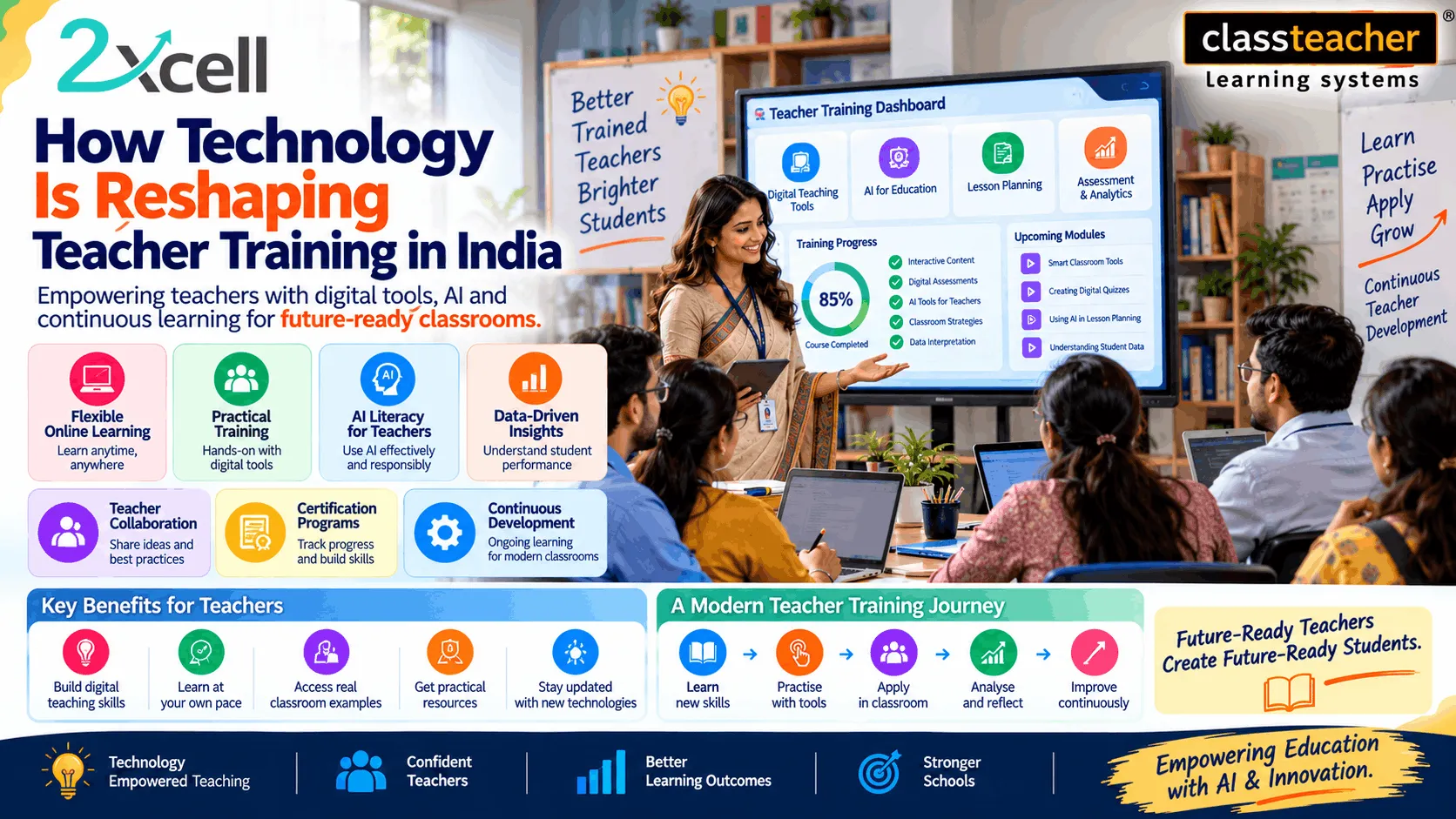
Teacher training in India is undergoing an important transformation.
For many years, professional development for teachers was largely associated with workshops, seminars, printed resources, classroom observations, and periodic training programmes. These methods continue to have value, but the growth of digital technology is creating new possibilities for how teachers learn, practise, collaborate, and improve.
Today's teachers are expected to work in classrooms influenced by digital content, smart boards, online assessments, AI tools, learning analytics, hybrid learning, and changing student expectations.
As a result, teacher training can no longer focus only on subject knowledge or traditional teaching methods.
Modern professional development increasingly needs to address:
- Digital teaching tools
- Technology-enabled lesson planning
- Data interpretation
- Digital assessment
- AI awareness
- Personalized learning
- Classroom engagement
- Online and blended learning
- Digital safety
- Continuous professional development
The shift can be described as:
Train → Practise → Apply → Analyse → Improve → Continue Learning
What Is Technology-Enabled Teacher Training?
Technology-enabled teacher training uses digital platforms, online resources, simulations, collaborative tools, analytics, and other technology-supported methods to develop teachers' professional capabilities.
Instead of relying entirely on occasional workshops, teachers can access learning opportunities throughout the year.
These may include:
- Online training programmes
- Recorded training sessions
- Interactive courses
- Digital teaching resources
- Virtual demonstrations
- Assessment tools
- AI-assisted planning tools
- Peer collaboration
- Performance insights
- Digital certification programmes
The objective is to make professional development more accessible, practical, and continuous.
Why Teacher Training Needs to Evolve
The classroom environment is changing quickly.
Teachers may now be expected to use:
- Interactive displays
- Digital learning platforms
- Online assessments
- Educational applications
- AI-powered tools
- Digital content
- Learning analytics
- Hybrid teaching methods
Knowing that these technologies exist is not enough.
Teachers need confidence in understanding when, why, and how to use them effectively.
Technology therefore needs to become part of teacher development itself.
1. Online Learning Makes Training More Accessible
Traditional training programmes may require teachers to travel to a particular location at a fixed time.
Digital training can reduce some of these limitations.
Teachers can access learning material through:
- Online courses
- Recorded sessions
- Digital modules
- Webinars
- Virtual workshops
- Learning portals
This can make professional development easier to access across different locations.
For schools with teachers in multiple cities or branches, digital training can also provide a more connected learning environment.
2. Teachers Can Learn at Their Own Pace
Not every teacher requires the same amount of time to understand a new technology.
One teacher may quickly learn how to create a digital assessment, while another may need additional demonstrations and practice.
Digital training allows teachers to:
- Pause lessons
- Revisit modules
- Repeat demonstrations
- Review instructions
- Practise new tools
- Learn in smaller sessions
This creates a more flexible professional learning experience.
3. Technology Can Make Training More Practical
Teacher training becomes more valuable when teachers can actually practise what they learn.
For example, instead of simply explaining how digital assessments work, a training programme can allow teachers to:
Create a Quiz → Conduct an Assessment → Review Results → Interpret Data
Similarly, AI training can involve practical activities such as:
Understand AI → Explore a Tool → Create a Classroom Resource → Review Output → Improve the Resource
This connects professional development with classroom application.
4. Digital Tools Can Support Continuous Professional Development
Teacher development does not have to happen only once or twice a year.
Digital platforms can provide ongoing access to learning resources.
A teacher may complete one module this week and another several weeks later.
This creates a continuous development cycle:
Learn → Apply → Reflect → Learn Again
Such an approach can make professional development part of a teacher's regular workflow.
5. Technology Can Improve Digital Teaching Skills
Teachers increasingly need to understand how technology can support classroom instruction.
Training can cover areas such as:
- Interactive presentations
- Digital content
- Online collaboration
- Smart classroom tools
- Digital assessments
- Educational videos
- Interactive activities
- Learning management systems
The objective should not be to make teachers use technology everywhere.
Instead, teachers should understand where technology genuinely adds educational value.
6. AI Is Creating a New Area of Teacher Training
Artificial Intelligence is becoming an important part of education.
Teachers may use AI-supported tools for:
- Lesson planning
- Activity ideas
- Question generation
- Content creation
- Differentiated learning
- Feedback
- Assessment support
- Resource organization
However, effective AI use requires more than knowing how to type a prompt.
Teachers also need to understand:
- Accuracy
- Context
- Verification
- Bias
- Student privacy
- Responsible use
- Appropriate classroom application
AI literacy can therefore become an important component of modern teacher training.
7. Technology Can Support Data Literacy for Teachers
Schools increasingly generate information through assessments, digital activities, and learning platforms.
Teachers need to understand what this information means.
Training can help teachers interpret:
- Assessment scores
- Topic-level performance
- Learning gaps
- Progress trends
- Practice activity
- Student participation
The objective is not to turn every teacher into a data scientist.
It is to help teachers use relevant information to make better instructional decisions.
The process becomes:
Data → Interpretation → Action → Review
8. Digital Training Can Demonstrate New Teaching Methods
Some teaching techniques can be difficult to understand through theoretical explanations alone.
Technology can demonstrate them through:
- Classroom videos
- Simulated lessons
- Interactive examples
- Recorded demonstrations
- Digital case studies
Teachers can observe how a particular approach works in practice before trying it themselves.
This can make professional development more connected to real classroom situations.
9. Virtual Collaboration Can Connect Teachers
Professional learning does not have to happen individually.
Technology can connect teachers through digital communities where they can exchange:
- Lesson ideas
- Teaching resources
- Classroom activities
- Assessment strategies
- Technology experiences
- Challenges
- Solutions
This can help create a culture where teachers learn from one another.
The model becomes:
Individual Learning + Peer Collaboration = Shared Professional Growth
10. Technology Can Support Training Across Multiple School Branches
Multi-branch schools often face the challenge of maintaining consistency in teacher development.
A centralized digital training environment can provide common learning resources across campuses.
For example:
Central Training Framework
↓
Digital Training Modules
↓
Branch-Level Application
↓
Teacher Feedback
↓
Progress Review
This can help school groups create common professional-development standards while still allowing individual branches to address local requirements.
11. Digital Assessments Can Measure Training Outcomes
Teacher training should not end when the training session ends.
Schools may want to understand whether teachers have actually developed the intended skills.
Digital assessments can help evaluate:
- Knowledge
- Technology understanding
- Course completion
- Practical application
- Training progress
For example:
Training → Practice → Assessment → Feedback → Further Support
This makes professional development more measurable.
12. Technology Can Personalize Teacher Learning
Just as students have different learning needs, teachers can have different professional-development requirements.
A new teacher may need foundational training in digital classroom tools.
An experienced teacher may want advanced training in:
- AI
- Learning analytics
- Digital assessment
- Personalized education
Technology can help organize different learning pathways.
For example:
Beginner
Digital classroom fundamentals.
Intermediate
Interactive learning and digital assessment.
Advanced
AI, analytics, personalization, and technology integration.
This makes teacher development more flexible.
13. Technology Can Reduce the Gap Between Training and Classroom Application
One common challenge in professional development is the gap between learning a technique during training and actually applying it later.
A teacher may attend a workshop, understand the concept, and then return to a busy classroom.
Digital follow-up can help maintain continuity.
For example:
Training Session → Classroom Application → Reflection → Feedback → Follow-Up Resource
This makes training an ongoing process rather than a one-time event.
14. Teachers Can Build Digital Resource Libraries
Technology allows teachers to create and organize reusable resources.
These can include:
- Lesson plans
- Worksheets
- Quizzes
- Presentations
- Videos
- Activities
- Revision material
- Assessment questions
Over time, teachers can develop a professional digital resource library.
This can save preparation time and encourage resource sharing within schools.
15. Technology Can Support Better Lesson Planning
Lesson planning is an important part of teaching.
Digital tools can help teachers organize:
Learning Objective → Content → Activity → Practice → Assessment
AI-powered tools can also assist with generating initial ideas or structuring resources, which teachers can then review and modify according to their curriculum and students.
The teacher remains responsible for deciding whether the material is accurate, appropriate, and useful.
16. Technology Can Improve Training Feedback
Feedback is valuable for teachers just as it is for students.
After completing a training module, teachers can receive feedback through:
- Digital assessments
- Practical tasks
- Self-reflection
- Peer reviews
- Trainer comments
- Progress dashboards
This can help teachers understand what they have mastered and where additional development may be useful.
17. Digital Training Can Support Rural and Remote Schools
India's education ecosystem includes schools operating in very different geographic and infrastructure environments.
Where suitable connectivity and devices are available, digital training can help bring professional-development resources to teachers who may otherwise have fewer opportunities to attend centralized programmes.
This can support wider access to:
- Expert sessions
- Digital resources
- Training modules
- Demonstrations
- Professional communities
Technology cannot eliminate every infrastructure challenge, but it can create additional pathways for teacher development.
18. Technology Can Help Teachers Understand Personalized Learning
Personalized learning is becoming increasingly relevant in modern classrooms.
Teachers need to understand how students can receive different levels of:
- Practice
- Revision
- Explanation
- Content
- Assessment
- Feedback
Training can help teachers understand how technology can support these differences without removing the teacher's role.
The model becomes:
Common Learning Goal → Different Support Pathways
19. Teacher Training Can Include Digital Safety and Responsible Technology Use
As teachers and students use more digital platforms, responsible technology use becomes increasingly important.
Teacher training can address:
- Student data privacy
- Secure account practices
- Responsible AI usage
- Digital citizenship
- Online safety
- Appropriate content sharing
- Ethical use of technology
Technology training should therefore include not only what tools can do, but also how they should be used responsibly.
20. How 2xcell Can Support Technology-Enabled Learning
2xcell AI Learning Platform by CLASSTEACHER Learning Systems can support a connected digital learning environment involving:
- Digital learning content
- Practice
- Assessment
- Analytics
- Personalized learning
- Student progress tracking
For teachers, such a connected environment can provide opportunities to understand how digital content, assessment, analytics, and personalized learning can work together.
A possible learning cycle is:
Learn → Practise → Assess → Analyse → Support → Improve
This approach can help schools move towards a more connected digital learning ecosystem while keeping teachers at the centre of educational decision-making.
Technology Should Support Teachers, Not Replace Them
Technology can provide tools, information, and recommendations.
But effective education still depends heavily on teachers' professional judgement.
Teachers understand:
- Classroom behaviour
- Student needs
- Learning difficulties
- Social context
- Curriculum requirements
- Individual differences
Therefore, the relationship should be:
Technology Provides Support → Teacher Applies Expertise → Students Receive Better Learning Experiences
The purpose of teacher technology training should be to strengthen this relationship.
What Schools Should Consider When Planning Technology-Based Teacher Training
Before introducing a digital professional-development programme, schools can consider several factors.
Relevance
Does the training address actual classroom requirements?
Practical Application
Can teachers practise what they learn?
Curriculum Alignment
Does technology support the school's academic framework?
Teacher Control
Can teachers adapt digital resources according to their students?
Accessibility
Can teachers access training conveniently?
Progress Tracking
Can schools understand training participation and development?
Continuous Learning
Is there support after the initial training?
Data Responsibility
Are teacher and student records handled appropriately?
Technical Support
Can teachers receive help when they face technology-related difficulties?
Building a Modern Teacher Training Framework
Schools can gradually develop technology-supported professional development through a structured process.
Step 1: Identify Training Needs
Understand what teachers currently know and where support is required.
Step 2: Define Learning Objectives
Decide what teachers should be able to do after the training.
Step 3: Provide Digital Training
Use suitable courses, demonstrations, workshops, and resources.
Step 4: Encourage Practical Application
Give teachers opportunities to use the tools in realistic classroom situations.
Step 5: Collect Feedback
Understand what worked and where teachers need additional help.
Step 6: Measure Progress
Use assessments, practical tasks, or other relevant indicators.
Step 7: Continue Support
Provide follow-up resources and advanced learning opportunities.
This creates:
Identify → Train → Practise → Apply → Review → Improve
The Future of Teacher Training in India
Teacher professional development is likely to become increasingly connected with AI, digital content, analytics, virtual collaboration, and personalized learning.
A future teacher-learning ecosystem could look like:
Training Need
↓
Personalized Digital Course
↓
Interactive Practice
↓
Classroom Application
↓
Performance Feedback
↓
Additional Support
↓
Advanced Learning
This could move professional development from occasional training events towards a more continuous learning journey.
However, technology should remain a means to improve teaching—not the objective itself.
Conclusion
Technology is reshaping teacher training in India by making professional development more accessible, practical, measurable, and continuous.
Digital platforms can help teachers learn new tools, practise modern teaching methods, understand learning data, explore AI, collaborate with peers, and connect training with classroom application.
The most effective approach is not to replace traditional teacher development with technology.
It is to combine teacher expertise with technology-enabled professional learning.
With 2xcell AI Learning Platform by CLASSTEACHER Learning Systems, schools can explore a connected approach to digital learning, assessment, analytics, personalized learning, and student progress tracking.
The future of teacher training is not simply about learning more technology.
It is about helping teachers use technology more confidently, responsibly, and meaningfully to improve learning outcomes.
Learn Better. Teach Smarter. Grow Continuously.
2xcell AI Learning Platform
By CLASSTEACHER Learning Systems
Empowering Education with AI & Innovation.