Introduction
Keeping students motivated is an important part of effective education.
A student may understand a subject but still lose interest when learning becomes repetitive. Another student may be curious about a topic but struggle to remain engaged when the learning material does not connect with their interests or level of understanding.
Digital learning has introduced new ways for schools to make education more interactive, flexible, and responsive.
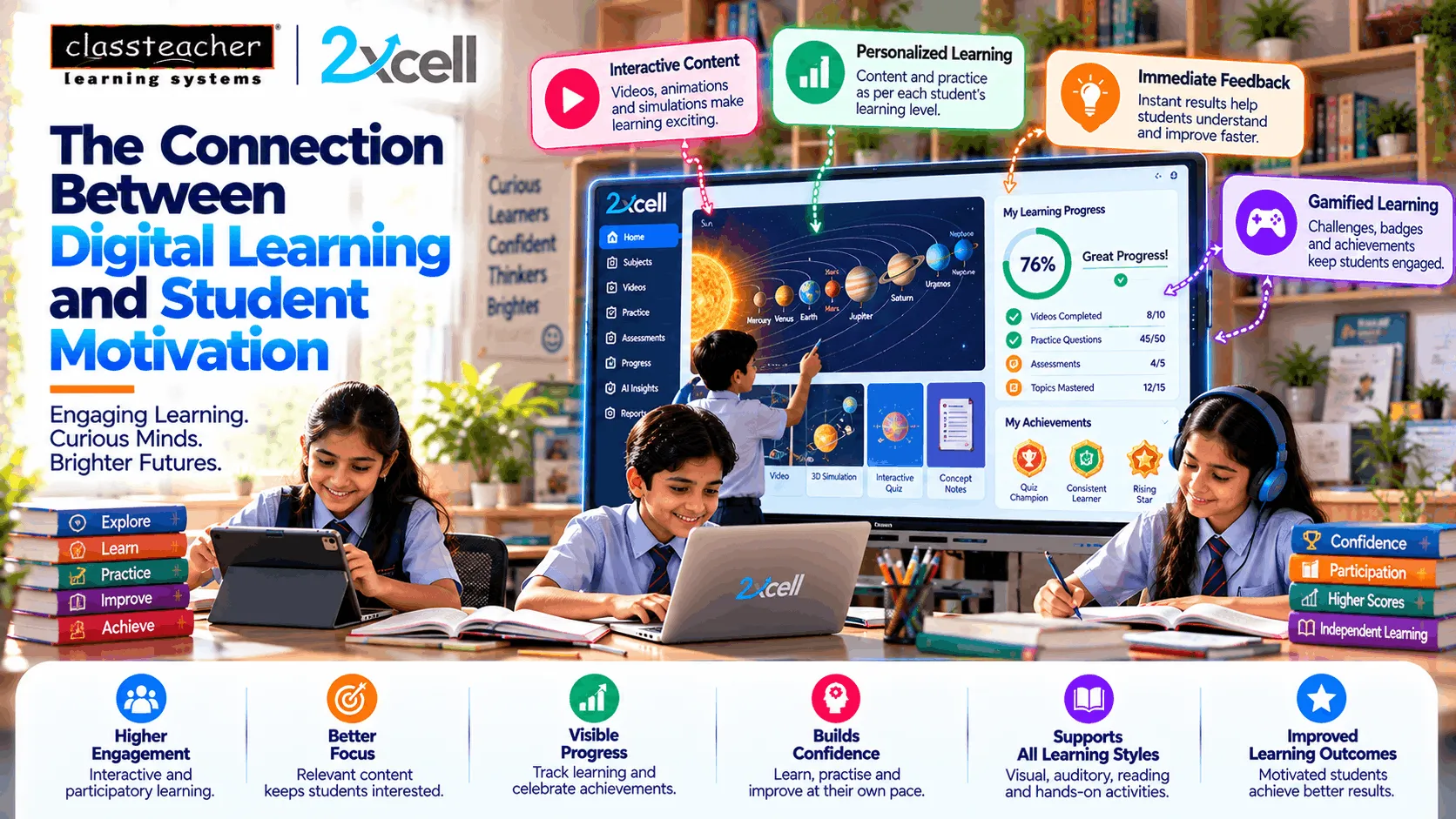
Videos, interactive activities, digital assessments, personalized practice, simulations, learning analytics, and AI-powered recommendations can give students more opportunities to participate actively in their learning.
However, technology itself does not automatically create motivation.
The real connection comes from how digital learning is designed and how it helps students experience progress, participation, relevance, and achievement.
A meaningful digital learning journey can follow:
Explore → Participate → Practise → Improve → Achieve
What Is Student Motivation in Learning?
Student motivation refers to the willingness and interest students bring to the learning process.
Motivation can influence whether students:
- Participate in activities
- Attempt challenging questions
- Complete practice
- Ask questions
- Continue after making mistakes
- Explore topics independently
- Review previously learned concepts
Students can be motivated by different factors.
Some may enjoy discovering new ideas, while others may be encouraged by visible progress, practical applications, collaboration, or successfully solving difficult problems.
Digital learning can provide additional ways to support these experiences.
How Digital Learning Can Influence Student Motivation
Digital learning can change the way students interact with educational content.
A traditional lesson may involve:
Teacher Explanation → Notes → Homework
A digitally supported lesson can expand this into:
Explanation → Interactive Content → Activity → Practice → Feedback → Improvement
The second approach provides more opportunities for students to actively participate rather than only receive information.
1. Interactive Content Can Make Learning More Participatory
Reading or listening is only one way students can engage with a topic.
Digital platforms can include:
- Interactive quizzes
- Simulations
- Animations
- Educational videos
- Digital activities
- Visual demonstrations
- Problem-solving exercises
For example, instead of simply reading about the solar system, students can explore an interactive representation of planets and their movements.
The experience can turn a concept into something students can actively explore.
2. Immediate Feedback Can Show Students Their Progress
Feedback is an important part of learning.
When students complete a digital activity, they may receive immediate information about their performance.
For example:
Attempt → Result → Feedback → Improvement
A student who answers incorrectly can identify the mistake and try again.
This can make progress more visible.
Instead of waiting until the next examination to discover whether a concept was understood, students can receive feedback during the learning process.
3. Personalized Learning Can Make Activities More Relevant
Students in the same classroom may have different levels of understanding.
Giving every student exactly the same practice may not always provide the right level of challenge.
Digital learning platforms can support personalized activities based on learning progress.
For example:
Student A
Requires foundational practice.
Student B
Needs regular concept-based questions.
Student C
Is ready for advanced application.
When students receive activities that are more closely connected to their current learning level, the learning experience can become more relevant.
4. Visible Progress Can Encourage Continued Learning
Students may feel more motivated when they can see how far they have progressed.
Digital platforms can present information such as:
- Topics completed
- Practice activities finished
- Assessments attempted
- Improvement over time
- Learning goals
- Skills developed
For example:
Topic 1 ✓
Topic 2 ✓
Topic 3 → In Progress
Topic 4 → Next
This provides students with a clearer sense of their learning journey.
5. Digital Learning Can Make Difficult Topics More Approachable
A difficult topic can sometimes reduce student confidence.
Digital learning can provide multiple ways to revisit the same concept.
For example:
Explanation → Video → Example → Practice → Feedback
A student who does not understand the concept the first time can return to another explanation or complete additional practice.
This flexibility can help students continue learning instead of immediately giving up.
6. Gamified Elements Can Add Engagement
Some digital learning environments use elements such as:
- Achievement milestones
- Progress indicators
- Challenges
- Interactive quizzes
- Completion badges
- Learning goals
These features can make repetitive practice feel more interactive.
However, gamification should remain connected to educational objectives.
The goal should not be to make students chase points.
The goal should be to encourage participation and consistent learning.
7. Videos Can Bring Concepts to Life
Educational videos can combine:
Visuals + Narration + Animation + Demonstration
This can be useful for concepts that are difficult to explain through text alone.
For example, a science experiment can be demonstrated visually before students discuss the underlying concept.
Similarly, historical events can be explored using maps, timelines, images, and narration.
The result can be a more dynamic learning experience.
8. Students Can Learn at Their Own Pace
A fixed classroom schedule does not always match every student's learning pace.
Digital resources can provide flexibility.
Students can:
- Pause a lesson
- Replay an explanation
- Repeat practice
- Review difficult concepts
- Attempt additional questions
- Explore advanced material
This can help students spend more time on concepts they find challenging.
It can also allow students who are ready to progress further to explore additional material.
9. Digital Practice Can Turn Learning Into an Active Process
Motivation can be supported when students are doing something with the knowledge they have learned.
Instead of:
Watch → Finish
students can experience:
Watch → Answer → Practise → Check → Improve
Digital practice can include:
- Multiple-choice questions
- Application problems
- Concept checks
- Interactive exercises
- Scenario-based questions
- Topic quizzes
This makes students active participants in the learning process.
10. Real-World Applications Can Increase Relevance
Students may become more interested in a concept when they understand where it is used outside the classroom.
Digital learning can connect academic topics with real-world examples.
For example:
Mathematics
Understanding percentages through budgeting.
Science
Exploring energy through real-world systems.
Computer Science
Building a simple application.
Geography
Using digital maps to understand locations.
AI Education
Exploring how artificial intelligence is used in everyday technology.
This creates a connection between:
Learn → Understand → Apply
11. AI Can Support More Personalized Learning Experiences
AI can analyse relevant learning information and help identify patterns in student performance.
For example, it may identify:
- Frequently incorrect topics
- Practice requirements
- Changes in performance
- Learning gaps
- Suitable difficulty levels
Based on these insights, digital learning systems can recommend relevant resources or practice activities.
The objective is to provide students with support that is more closely connected to their learning journey.
12. Students Can Learn From Their Mistakes
Mistakes can become valuable learning opportunities when students understand them.
Digital learning platforms can provide feedback after an activity.
For example:
Incorrect Answer → Explanation → Additional Practice → New Attempt
This encourages students to see an incorrect answer as part of the learning process rather than simply as a final result.
Repeated opportunities to practise can help students build confidence with difficult concepts.
13. Learning Analytics Can Make Progress More Understandable
Students may not always recognize their own improvement.
Learning analytics can help visualize progress across different activities.
For example:
Practice 1: 54%
Practice 2: 63%
Practice 3: 71%
Practice 4: 79%
Seeing improvement can help students understand that consistent effort can lead to progress.
This can support a more growth-oriented approach to learning.
14. Digital Learning Can Support Student Choice
Motivation can sometimes increase when students have some flexibility in how they learn.
Depending on the platform and lesson, students may be able to choose between:
- Watching a video
- Reading an explanation
- Completing an activity
- Solving practice questions
- Exploring an interactive simulation
Providing appropriate choices can make students feel more involved in the learning process.
15. Collaborative Digital Activities Can Encourage Participation
Digital learning does not have to be an individual activity.
Schools can use technology for:
- Group projects
- Digital presentations
- Collaborative problem-solving
- Classroom quizzes
- Peer discussions
- Interactive activities
These experiences can help students learn from one another while remaining actively involved.
16. Technology Can Help Teachers Recognize Engagement Patterns
Teachers remain central to student motivation.
Digital learning data can provide additional information about student participation.
Teachers may be able to identify:
- Students who require additional support
- Topics where engagement is lower
- Activities that generate stronger participation
- Practice patterns
- Changes in learning activity
Teachers can then adjust their teaching approach accordingly.
The relationship is:
Digital Insight → Teacher Understanding → Better Support
17. Personalized Challenges Can Keep Students Engaged
If learning activities are consistently too easy, students may lose interest.
If they are consistently too difficult, students may become discouraged.
Adaptive learning can help provide different levels of challenge.
For example:
Basic → Intermediate → Advanced
As students demonstrate understanding, they can move towards more complex activities.
This can create a sense of progression.
18. Digital Learning Can Support Independent Learning
Student motivation is also connected to the ability to learn independently.
Digital platforms can provide students with resources that they can access beyond scheduled classroom instruction.
Students can:
- Review previous lessons
- Practise difficult topics
- Explore additional content
- Prepare for assessments
- Work towards learning goals
This can encourage students to take a more active role in their education.
19. Teachers Still Play a Critical Role in Motivation
Technology can provide interactive resources and learning insights, but teachers remain essential.
A teacher can:
- Encourage students
- Explain difficult concepts
- Recognize effort
- Answer questions
- Provide context
- Create meaningful classroom experiences
- Understand individual student needs
The most effective approach is not:
Technology vs Teacher
It is:
Technology + Teacher + Student
Digital tools can support learning, while teachers provide the human connection that makes learning meaningful.
20. How 2xcell Can Support Motivation Through Digital Learning
2xcell AI Learning Platform by CLASSTEACHER Learning Systems can support a connected digital learning environment involving:
- Digital learning content
- Practice
- Assessment
- Analytics
- Personalized learning
- Student progress tracking
A connected learning journey can follow:
Learn → Practise → Assess → Analyse → Personalize → Improve
Students can access learning resources, complete practice activities, receive feedback, and understand their progress.
Teachers can use learning insights to identify areas that require additional attention.
This creates a learning environment where students can see their progress while teachers have additional information to guide instruction.
The Connection Between Motivation and Progress
Motivation does not come only from rewards.
Students can also become more engaged when they experience:
Understanding → Progress → Confidence → Participation
For example, a student who struggles with a mathematics topic may initially avoid practice.
With targeted explanations and appropriately difficult questions, the student may begin answering correctly.
As performance improves, confidence can increase.
That confidence may encourage further participation.
This creates a positive learning cycle:
Practise → Improve → Build Confidence → Participate More → Learn Further
What Schools Should Consider When Using Digital Learning
Technology should be introduced with clear educational objectives.
Schools can consider:
Content Quality
Is the digital material accurate and curriculum-aligned?
Student Engagement
Does the activity encourage meaningful participation?
Personalization
Can learning activities respond to different student requirements?
Feedback
Do students receive useful information about their performance?
Teacher Involvement
Can teachers guide and adapt the digital learning experience?
Analytics
Are learning insights useful rather than overwhelming?
Accessibility
Can students easily access the required learning resources?
Data Responsibility
Are student learning records handled appropriately?
Avoiding Technology Overload
More technology does not automatically mean more motivation.
If students are constantly exposed to notifications, scores, badges, and digital activities without a clear academic purpose, technology can become distracting.
The focus should remain on:
Purpose → Participation → Learning → Progress
Digital tools should support the learning objective rather than become the objective themselves.
The Future of Digital Learning and Student Motivation
As AI, adaptive learning, interactive content, and learning analytics continue to develop, digital learning environments may become increasingly responsive to individual students.
A future learning cycle could look like:
Student Learns
↓
System Measures Progress
↓
AI Identifies Learning Needs
↓
Relevant Activity Recommended
↓
Student Practises
↓
Feedback Provided
↓
Progress Updated
↓
Next Learning Activity
This creates a continuous learning environment where students can see their progress and receive relevant opportunities to improve.
Conclusion
Digital learning can play an important role in supporting student motivation when technology is connected to meaningful learning experiences.
Interactive content can increase participation. Personalized practice can make activities more relevant. Immediate feedback can help students understand mistakes. Progress tracking can make improvement visible, while AI-powered insights can help provide more targeted learning support.
However, motivation is not created by technology alone.
Students need meaningful goals, supportive teachers, opportunities to succeed, appropriate challenges, and an environment where mistakes are treated as part of learning.
With 2xcell AI Learning Platform by CLASSTEACHER Learning Systems, schools can explore a connected approach to digital learning, personalized practice, assessment, analytics, and student progress.
The goal is to create learning experiences where students can:
Explore. Participate. Improve. Achieve.
2xcell AI Learning Platform
By CLASSTEACHER Learning Systems
Empowering Education with AI & Innovation.