Introduction
The Indian classroom has changed considerably over the last few decades.
A traditional classroom once depended primarily on a blackboard, textbooks, notebooks, and face-to-face explanation. Over time, schools began introducing computers, projectors, digital content, interactive displays, online resources, and learning management systems.
Today, the concept of a smart classroom is moving beyond simply replacing a blackboard with a screen.
Modern smart classrooms can bring together:
Interactive Displays + Digital Content + Assessment + Connectivity + AI + Learning Analytics
This evolution is changing how lessons are delivered, how students interact with content, and how teachers understand learning outcomes.
The journey can broadly be understood as:
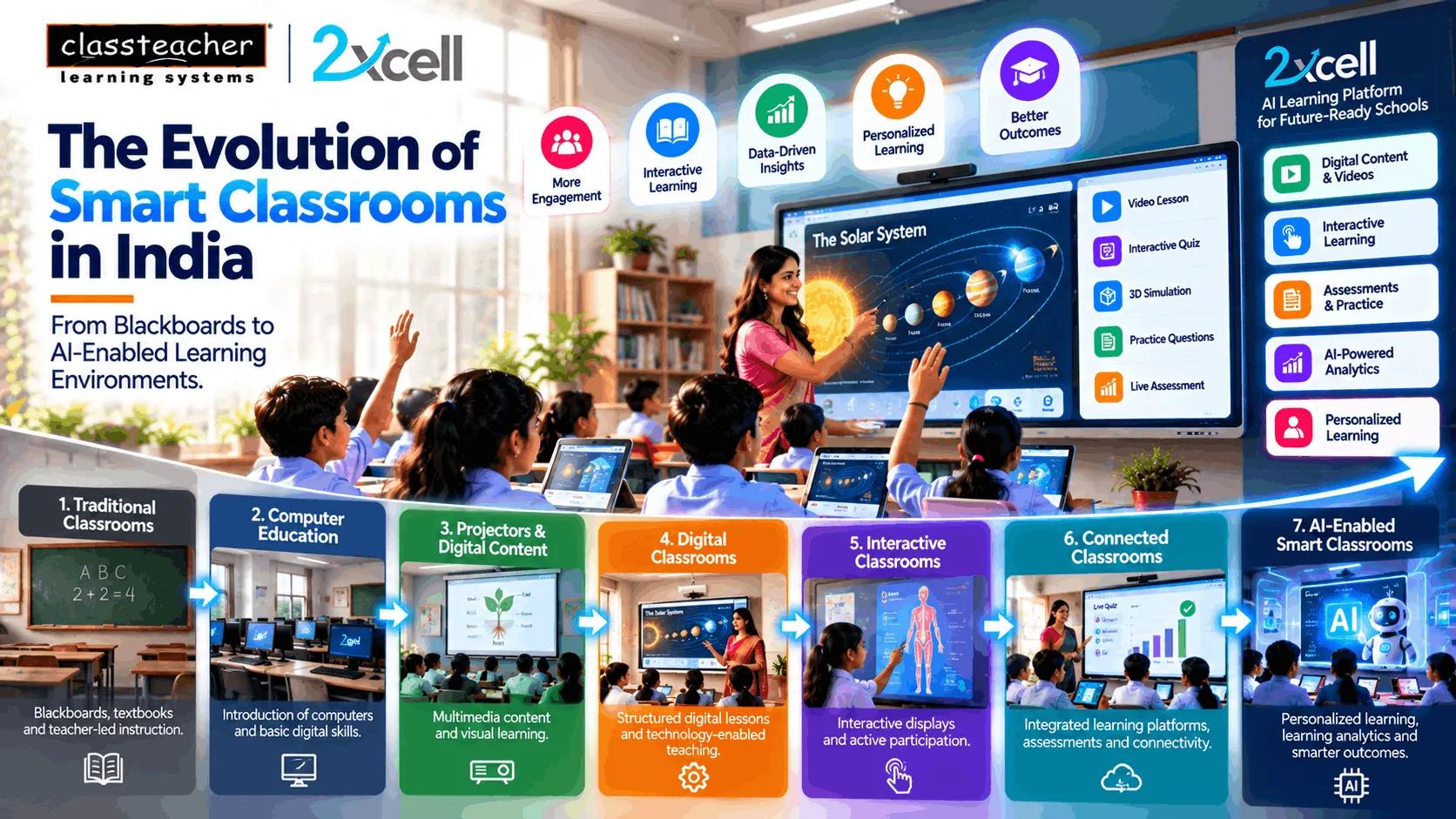
Traditional Classroom → Digital Classroom → Interactive Classroom → Connected Classroom → AI-Enabled Smart Classroom
What Is a Smart Classroom?
A smart classroom is a technology-enabled learning environment where digital tools are integrated with classroom teaching.
Depending on the school's requirements, a smart classroom may include:
- Interactive Flat Panels
- Digital educational content
- Audio-visual learning resources
- Digital assessments
- Student response systems
- Learning platforms
- Internet-connected resources
- AI-enabled learning tools
- Learning analytics
- Digital collaboration tools
The purpose is not technology for its own sake.
The objective is to make teaching more interactive, support different learning requirements, and provide teachers with useful tools for classroom instruction.
The Early Stage: Traditional Classrooms
Before digital technology became common, most Indian classrooms followed a relatively straightforward teaching model.
The teacher explained the lesson.
Students listened, wrote notes, read textbooks, completed exercises, and appeared for periodic examinations.
The primary resources were:
- Blackboard
- Chalk
- Textbooks
- Notebooks
- Printed worksheets
- Physical teaching aids
- Teacher explanations
This model remains important even today because teacher-student interaction continues to form the foundation of education.
However, explaining certain concepts using only static resources could be challenging.
Processes involving movement, complex diagrams, simulations, or real-world demonstrations often required additional teaching resources.
Stage One: The Introduction of Computers
One of the early steps towards classroom digitalization was the introduction of computers.
Computer laboratories allowed students to interact with technology directly.
Students began learning:
- Basic computer skills
- Word processing
- Presentations
- Internet usage
- Educational software
- Programming fundamentals
For schools, this represented an important shift.
Technology was no longer limited to administrative activities. It was becoming part of the learning environment.
However, computer-based learning was often concentrated in dedicated computer laboratories rather than integrated into every classroom.
Stage Two: Projectors and Digital Content
The next major development was the increasing use of projectors and multimedia content.
Teachers could now display:
- Presentations
- Images
- Videos
- Diagrams
- Animations
- Maps
- Educational demonstrations
Instead of drawing every diagram manually on the blackboard, teachers could present prepared visual material.
A science lesson, for example, could include an animated explanation of the human body.
A geography lesson could display maps and climate patterns.
A history lesson could incorporate photographs, timelines, and documentary clips.
This introduced a stronger visual dimension to classroom teaching.
Stage Three: The Rise of Digital Classrooms
As educational technology became more accessible, schools began adopting dedicated digital classroom solutions.
Digital classrooms brought together technology, content, and teaching resources.
Teachers could access structured digital lessons instead of depending entirely on printed material.
The classroom experience gradually moved from:
Teacher + Blackboard + Textbook
towards:
Teacher + Digital Content + Display + Multimedia
This did not eliminate traditional teaching.
Instead, technology became another resource that teachers could use when appropriate.
Stage Four: Interactive Flat Panels
Interactive Flat Panels brought another significant change.
Unlike a traditional projector setup, an interactive display can allow teachers and students to interact directly with digital content.
Teachers can:
- Write on the screen
- Highlight important information
- Display videos
- Annotate diagrams
- Open digital resources
- Conduct activities
- Present interactive lessons
Students can also participate more actively in certain classroom activities.
This changes the display from a passive screen into an interactive teaching surface.
Stage Five: Interactive Assessment Enters the Classroom
Another important development in smart classrooms is the integration of digital assessment.
Traditional classroom assessment often depends on:
Question → Student Response → Teacher Checking
Digital assessment tools can introduce faster feedback.
For example, teachers can conduct:
- Live quizzes
- Polls
- Knowledge checks
- Concept assessments
- Classroom surveys
- Quick formative assessments
Student responses can be collected digitally, allowing teachers to identify patterns during or immediately after an activity.
This can help create a stronger connection between teaching and assessment.
Stage Six: Connected Learning Environments
Smart classrooms are increasingly becoming part of larger digital learning ecosystems.
Instead of classroom technology operating independently, schools can connect:
Classroom → Learning Platform → Content → Practice → Assessment → Analytics
This creates a more continuous learning environment.
A student may learn a concept during class, practise it digitally, complete an assessment, and receive additional learning resources based on performance.
The classroom therefore becomes connected to learning activities beyond the physical classroom.
Stage Seven: AI Enters the Smart Classroom
Artificial Intelligence is adding another layer to classroom technology.
AI-enabled education platforms can analyse learning information and help identify patterns.
Depending on the system, AI can support areas such as:
- Personalized learning
- Learning-gap identification
- Practice recommendations
- Performance analysis
- Content recommendations
- Automated insights
- Progress tracking
- Adaptive learning
For example, if a student repeatedly struggles with a particular concept, an AI-enabled platform may identify the pattern and recommend additional practice.
The teacher can then decide how to respond.
The important relationship is:
AI Identifies Patterns → Teacher Understands Context → Teacher Takes Action
How Smart Classrooms Have Changed Teaching
The evolution of classroom technology has also changed the range of resources available to teachers.
Earlier, teachers primarily worked with physical teaching materials.
Today, they can potentially combine:
Explanation + Visuals + Video + Interactive Content + Activities + Assessment + Analytics
A teacher can explain a concept, demonstrate it using digital content, conduct a quick assessment, and review student responses.
This creates a more dynamic teaching cycle.
How Smart Classrooms Have Changed Student Participation
Technology can also create additional opportunities for student participation.
Students can interact with:
- Digital simulations
- Interactive lessons
- Educational videos
- Quizzes
- Digital activities
- Collaborative exercises
- Virtual resources
- Practice platforms
For example, instead of only reading about a scientific process, students may be able to observe an animation or simulation.
Instead of waiting until an examination to discover an incorrect concept, a student may receive feedback during a digital activity.
The Growth of Hybrid and Blended Learning
The development of smart classrooms has also supported blended learning.
Students no longer have to depend entirely on classroom time to access educational resources.
A learning journey may look like:
Classroom Lesson → Digital Resource → Home Practice → Online Assessment → Teacher Review
This became particularly important as schools increasingly explored combinations of physical and digital learning.
Smart classroom technology can therefore serve as a bridge between classroom instruction and digital learning.
Smart Classrooms Are Becoming More Data-Informed
One of the biggest changes in modern education technology is the growing role of learning data.
Earlier, teachers primarily depended on:
- Classroom observation
- Assignments
- Tests
- Examination results
Modern digital systems can potentially provide additional information such as:
- Topic-wise performance
- Assessment trends
- Practice activity
- Concept mastery
- Learning progress
- Areas requiring support
This can help schools move towards more informed academic planning.
However, data should support teacher decision-making rather than replace it.
The Role of Smart Classrooms in Personalized Learning
Students in the same classroom do not always have identical learning requirements.
One student may understand a concept quickly.
Another may require additional examples.
A third student may be ready for more advanced application.
Digital learning systems can help provide different resources according to learning requirements.
A simplified model is:
Assess → Understand → Practise → Support → Reassess
This can help schools move towards more personalized learning experiences.
Smart Classrooms Beyond Screens
A modern smart classroom is not simply a classroom containing an interactive display.
The broader ecosystem can include:
Smart Infrastructure
Interactive displays, digital devices, connectivity, and classroom technology.
Digital Content
Videos, animations, simulations, presentations, and curriculum-aligned resources.
Interactive Assessment
Quizzes, polls, student response systems, and formative assessments.
Learning Platforms
Digital content, practice, assignments, and learning activities.
Analytics
Performance reports, learning trends, and academic insights.
AI
Personalization, recommendations, pattern identification, and intelligent learning support.
The real value comes from connecting these components.
The Role of Teachers Has Not Disappeared
Despite the increasing use of technology, teachers remain central to the learning process.
Technology can display information.
Teachers provide:
- Explanation
- Context
- Encouragement
- Classroom management
- Mentoring
- Feedback
- Interpretation
- Emotional support
- Individual guidance
For example, analytics may indicate that a student is struggling with a particular topic.
Only the teacher may fully understand whether the reason is conceptual difficulty, lack of practice, language barriers, or another classroom-related factor.
Therefore, the future smart classroom is not:
Technology Instead of Teachers
It is:
Technology Supporting Teachers
How Smart Classrooms Can Support Different Subjects
The technology used in a smart classroom can vary according to the subject.
Science
Animations, experiments, simulations, diagrams, and demonstrations can help explain scientific processes.
Mathematics
Interactive graphs, step-by-step problem solving, visual models, and digital practice can support mathematical learning.
Geography
Digital maps, climate visualizations, satellite imagery, and geographical simulations can make concepts more visual.
History
Timelines, maps, photographs, archival resources, and documentary content can add context to historical topics.
Languages
Videos, pronunciation activities, conversations, storytelling, and interactive exercises can support language development.
Computer Science
Coding demonstrations, software walkthroughs, programming activities, and simulations can support practical learning.
Smart Classrooms and STEM Education
The evolution of smart classrooms has also created opportunities to integrate STEM education more effectively.
Schools can combine classroom technology with:
- Robotics
- Coding
- Artificial Intelligence
- Engineering activities
- Digital simulations
- Problem-solving exercises
- Practical projects
This can shift certain lessons from simply understanding concepts towards applying them.
For example:
Learn the Concept → Build Something → Test It → Identify the Problem → Improve It
Such activities can encourage students to apply knowledge in practical situations.
Smart Assessment and Immediate Classroom Feedback
One of the important developments in smart classrooms is the ability to connect teaching with immediate assessment.
A teacher can explain a topic and then conduct a quick digital quiz.
If many students answer incorrectly, the teacher receives an immediate signal that the concept may require further explanation.
The cycle becomes:
Teach → Check → Understand → Adjust → Teach Again
This can be particularly useful for formative assessment.
The Evolution of Smart Classrooms in India: A Broader Journey
The development can be viewed as a series of connected stages:
Phase 1
Traditional Teaching
Blackboards, textbooks, notebooks and teacher-led instruction.
Phase 2
Computer Education
Computer laboratories and basic digital literacy.
Phase 3
Multimedia Classrooms
Projectors, presentations, videos and digital content.
Phase 4
Digital Classrooms
Structured digital learning resources and technology-enabled lessons.
Phase 5
Interactive Classrooms
Interactive displays, digital activities and classroom participation.
Phase 6
Connected Classrooms
Learning platforms, assessments, digital resources and connectivity.
Phase 7
AI-Enabled Classrooms
Personalization, analytics, intelligent recommendations and continuous learning insights.
The journey continues as schools explore increasingly connected education ecosystems.
How 2xcell Fits Into the Modern Learning Ecosystem
2xcell AI Learning Platform by CLASSTEACHER Learning Systems can support the broader transition towards connected digital learning.
Its positioning within a modern learning environment can bring together:
Learning Content → Practice → Assessment → Analytics → Personalized Learning
This allows schools to look beyond individual digital tools and consider how different parts of the learning process can work together.
The objective is to create a connected environment where students can learn, practise, receive feedback, and continue improving.
What Schools Should Consider Before Building a Smart Classroom
Technology selection should begin with educational requirements rather than equipment alone.
Schools can consider:
1. Learning Objectives
What should students achieve through the technology?
2. Teacher Usability
Can teachers comfortably use the system during regular lessons?
3. Curriculum Alignment
Does the content support the school's curriculum?
4. Student Engagement
Does the technology encourage meaningful participation?
5. Assessment
Can teachers measure understanding effectively?
6. Analytics
Does the system provide useful academic information?
7. Scalability
Can the solution expand as the school's requirements grow?
8. Data Security
How is student and school information protected?
9. Technical Support
What support is available when technology-related issues arise?
A successful smart classroom requires more than installing hardware.
Common Challenges in Smart Classroom Adoption
Technology can create significant opportunities, but implementation also comes with challenges.
Schools may need to address:
- Teacher training
- Infrastructure requirements
- Internet connectivity
- Device maintenance
- Content quality
- Technology adoption
- Technical support
- Budget planning
- Data security
- Long-term scalability
This means smart classroom transformation should be planned as an ongoing process rather than a one-time technology purchase.
The Future of Smart Classrooms in India
The next generation of smart classrooms is likely to become increasingly connected.
Future classrooms may combine:
Interactive Displays + AI + Digital Content + Robotics + Assessment + Analytics + Personalized Learning
A lesson could begin on an interactive panel, continue through digital practice, generate assessment data, and provide insights through an AI-enabled learning platform.
The physical classroom and digital learning environment may increasingly operate as parts of the same ecosystem.
However, technology should continue to serve educational objectives.
The goal is not to make classrooms more technological simply for the sake of technology.
The goal is to make learning:
More Connected. More Interactive. More Measurable. More Personalized.
Conclusion
The evolution of smart classrooms in India reflects a broader transformation in education.
The journey has moved from blackboards and textbooks to computers, projectors, digital content, interactive displays, connected learning platforms, digital assessments, analytics, and AI-enabled education.
Each stage has added new possibilities without eliminating the importance of teachers.
The modern smart classroom is therefore not defined by a single device.
It is defined by how technology, teachers, students, content, assessment, and data work together.
With 2xcell AI Learning Platform by CLASSTEACHER Learning Systems, schools can explore a connected approach to digital learning, assessment, analytics, and personalized education.
The evolution continues:
Teach → Interact → Assess → Analyse → Personalize → Improve
The future of smart classrooms is not simply about smarter technology.
It is about creating smarter learning experiences for students and stronger teaching support for educators.
2xcell AI Learning Platform
By CLASSTEACHER Learning Systems
Empowering Education with AI & Innovation.