Introduction
Examinations are an important part of the school learning journey. They help measure how well students understand concepts, apply knowledge, manage time, and perform under examination conditions.
However, exam preparation often follows a familiar pattern: students revise chapters, solve practice papers, take mock tests, check their marks, and repeat the process.
Artificial Intelligence is creating new possibilities within this process.
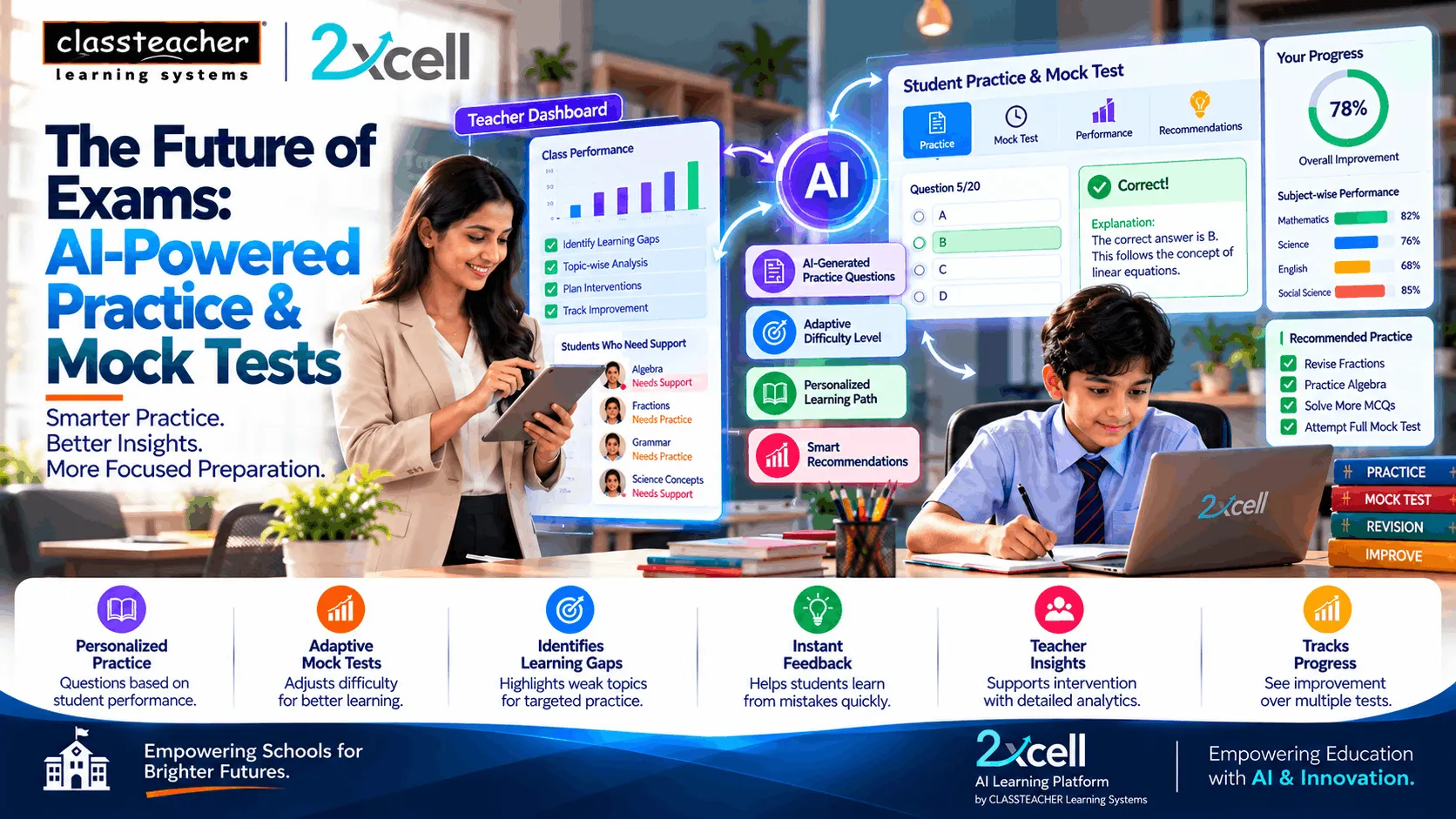
AI-powered practice and mock-test platforms can make exam preparation more adaptive, data-driven, and personalized. Instead of simply giving students another set of questions, AI can help identify what they need to practise, where they are making mistakes, and which areas require additional attention.
The future of exam preparation is therefore moving towards a model where technology supports students before, during, and after practice assessments.
What Are AI-Powered Practice Tests?
AI-powered practice tests use Artificial Intelligence and digital learning technologies to create, analyze, and personalize assessment experiences.
Depending on the platform, AI can support activities such as:
- Generating practice questions
- Creating topic-wise quizzes
- Analysing student responses
- Identifying learning gaps
- Adjusting question difficulty
- Recommending revision topics
- Tracking performance
- Providing instant feedback
- Creating personalized practice pathways
- Monitoring progress over multiple attempts
The objective is not simply to automate testing.
The objective is to make practice more relevant to the individual learner.
How Traditional Mock Tests Usually Work
A traditional mock test generally follows a fixed structure.
Question Paper → Test → Manual Evaluation → Score → Revision
Every student may receive the same paper, complete it within the same time, and receive a score after evaluation.
This approach remains useful because it can simulate examination conditions and help students practise time management and written responses.
However, a fixed mock test may not always explain why a student performed poorly or what they should practise next.
AI-powered systems can add another layer of information.
How AI Can Change Exam Preparation
AI can transform mock testing from a one-time evaluation into a continuous learning cycle.
A possible model is:
Practice → Assess → Analyse → Recommend → Practise Again → Reassess
This means the result of one assessment can influence the next learning activity.
For example, if a student repeatedly makes mistakes in algebraic equations, the system can highlight the topic and provide relevant practice.
The next assessment can then measure whether the student's understanding has improved.
1. Personalized Question Practice
One of the key possibilities offered by AI is personalized practice.
Students in the same classroom may have very different levels of understanding.
One student may require basic questions, while another may be ready for application-based or higher-order questions.
AI-supported practice can use performance information to help provide questions according to the learner's current requirements.
For example:
Basic Concept → Guided Practice → Application → Advanced Questions
This can make practice more targeted than simply giving every student the same worksheet.
2. AI Can Adjust Question Difficulty
A student's performance can change during the preparation process.
If a student consistently answers basic questions correctly, continuing with the same level of questions may provide limited challenge.
Similarly, if a student is struggling with foundational concepts, immediately presenting difficult questions can make practice frustrating.
Adaptive systems can potentially adjust the level of questions based on performance.
A simplified progression could be:
Understand → Practise → Demonstrate → Challenge
This creates opportunities for students to gradually build competence.
3. Instant Feedback Can Shorten the Learning Cycle
In traditional practice, students may complete a paper and wait until the teacher checks it.
Digital practice can provide immediate feedback for supported question types.
Students can quickly understand:
- Which answer was incorrect
- Which concept needs revision
- What type of mistake was made
- Which topic should be practised next
This can reduce the gap between making a mistake and learning from it.
The student does not have to wait until the next class to discover where improvement is required.
4. AI Can Identify Repeated Mistakes
One incorrect answer may not indicate a major problem.
Repeated mistakes around the same concept can provide a stronger signal.
For example, a student may repeatedly struggle with:
- Fractions
- Algebraic equations
- Grammar rules
- Chemical equations
- Reading comprehension
AI-powered analytics can help identify these recurring patterns across multiple practice sessions.
Teachers can then decide whether the student needs:
Revision + Additional Explanation + Targeted Practice
5. Mock Tests Can Become More Data-Rich
A traditional mock test may produce a score such as:
72/100
That number is useful, but it does not provide the complete picture.
A digital analytics system may additionally organize information around:
- Topic-wise performance
- Question difficulty
- Accuracy
- Attempt patterns
- Time spent
- Repeated mistakes
- Strength areas
- Areas requiring support
- Progress across multiple tests
This can help students and teachers understand the performance behind the score.
6. Students Can Track Their Progress
Exam preparation can become more motivating when students can see measurable progress.
For example:
Mock Test 1 — 58%
↓
Targeted Practice
↓
Mock Test 2 — 66%
↓
Revision
↓
Mock Test 3 — 74%
↓
Advanced Practice
↓
Mock Test 4 — 81%
The important information is not just the final score.
The progression shows how practice and revision are affecting performance.
7. AI Can Recommend What to Study Next
Students often ask:
"What should I study now?"
A large syllabus can make this difficult to answer.
AI-supported learning systems can potentially use performance information to recommend the next activity.
For example:
Strong Topic: Move to application questions.
Developing Topic: Complete additional practice.
Weak Topic: Revise the concept and attempt guided questions.
This creates a more structured preparation pathway.
8. AI Can Support Different Learning Speeds
Students do not prepare for examinations at exactly the same speed.
Some students may complete a topic quickly.
Others may need additional examples and practice before moving ahead.
AI-powered practice can support different learning speeds by allowing students to spend more time on areas where they need support.
This can make exam preparation less dependent on a single pace for the entire class.
9. Teachers Can Use Mock-Test Analytics for Intervention
AI does not need to operate independently of teachers.
Instead, analytics can help teachers identify where intervention may be required.
For example, a teacher may discover that:
- A group of students is struggling with one chapter.
- Several students repeatedly make the same mistake.
- Some students are ready for advanced questions.
- A particular concept requires classroom revision.
The teacher can then plan an appropriate response.
This creates a useful relationship:
AI Finds Patterns → Teacher Adds Context → Teacher Plans Intervention
10. AI Can Help Create More Practice Material
Preparing multiple practice papers can take considerable time.
Depending on the platform and curriculum structure, AI can assist with generating different types of practice material.
These may include:
- Topic-wise questions
- Revision quizzes
- Multiple-choice questions
- Application-based questions
- Practice sets
- Mock examinations
- Revision tests
Teacher review remains important to ensure that generated material is accurate, relevant, age-appropriate, and aligned with learning objectives.
AI Mock Tests vs Traditional Mock Tests
AI-powered and traditional mock tests can serve different purposes.
Traditional Mock TestsAI-Powered Practice & Mock TestsFixed question setsCan support personalized question setsManual evaluation may be requiredCan automate supported evaluationResults often reviewed after the testCan provide immediate insightsSame paper for many studentsCan support adaptive practiceLimited performance dataCan provide broader analyticsTeacher-led analysisAI can organize patterns for reviewUseful for exam simulationUseful for continuous practice and personalization
This does not mean traditional mock tests become unnecessary.
A balanced approach can use both.
The Importance of Real Exam Simulation
AI-powered practice should not completely replace traditional examination simulation.
Students still need opportunities to experience:
- Fixed examination duration
- Full-length question papers
- Examination-style instructions
- Time management
- Written responses
- Pressure management
- Complete syllabus coverage
Therefore, schools can use AI-powered practice during preparation while continuing to conduct realistic mock examinations.
AI Can Support Different Stages of Exam Preparation
AI-powered practice can be useful at different stages.
Stage 1: Concept Building
Students learn and understand the topic.
Stage 2: Guided Practice
Students solve questions with appropriate support.
Stage 3: Topic Assessment
Students test their understanding.
Stage 4: Learning Gap Identification
Analytics highlight areas requiring additional attention.
Stage 5: Targeted Revision
Students practise weaker concepts.
Stage 6: Mock Examination
Students attempt a complete examination-style paper.
Stage 7: Performance Analysis
The system and teacher review the results.
Stage 8: Final Preparation
Students focus on the areas that still require improvement.
This creates a structured preparation journey instead of relying only on repeated full-length tests.
The Role of Teachers in AI-Powered Exam Preparation
AI can process information quickly, but teachers remain essential.
Teachers can provide:
- Conceptual explanations
- Academic guidance
- Feedback
- Motivation
- Context
- Individual support
- Examination strategies
- Intervention
An AI system may identify that a student is struggling with a topic.
The teacher can determine why the student is struggling and decide how to support them.
The ideal model is:
AI Provides Insights → Teacher Provides Guidance → Student Takes Action
How 2xcell Can Support AI-Enabled Exam Preparation
2xcell AI Learning Platform by CLASSTEACHER Learning Systems can support a connected digital learning approach involving learning content, practice, assessments, analytics, and personalized learning.
A possible exam-preparation cycle can be:
Learn → Practise → Assess → Analyse → Personalize → Improve
Students can use digital learning and practice activities, while teachers can use assessment information and analytics to understand areas requiring additional attention.
The objective is to make assessment part of the overall learning journey rather than treating a mock test as an isolated event.
The Role of Classteacher in Technology-Enabled Assessment
CLASSTEACHER Learning Systems provides technology-enabled solutions for modern school education.
Its broader education ecosystem includes:
- Smart Classrooms
- Digital Learning
- Artificial Intelligence
- Robotics
- Coding
- STEM Education
- Interactive Assessments
- Clickers
These technologies can complement classroom teaching and help schools create more engaging and measurable learning environments.
What Schools Should Consider Before Using AI for Exams
Schools should evaluate AI-powered assessment solutions carefully.
Important considerations include:
Curriculum Alignment
Practice and mock tests should support the school's curriculum and learning objectives.
Accuracy
AI-generated questions and analysis should be reviewed for accuracy and relevance.
Teacher Oversight
Teachers should remain involved in interpreting results and making academic decisions.
Student Data Protection
Schools should establish appropriate policies for handling student information.
Usability
The system should be simple enough for teachers and students to use effectively.
Meaningful Analytics
Dashboards should provide useful insights rather than overwhelming users with unnecessary data.
The Future of Exam Preparation
The future of examinations may not be about replacing traditional papers with AI.
Instead, schools can move towards a combination of:
AI + Digital Practice + Mock Tests + Learning Analytics + Teacher Expertise
Students can practise more frequently, receive faster feedback, identify learning gaps earlier, and focus their preparation where it is most needed.
At the same time, traditional examinations and teacher-led assessment can continue to provide important measures of knowledge, application, reasoning, and performance under examination conditions.
Conclusion
AI-powered practice and mock tests are changing the way students can prepare for examinations.
By supporting personalized practice, adaptive difficulty, instant feedback, performance analytics, learning-gap identification, and progress tracking, AI can make exam preparation more connected and responsive.
However, technology should support—not replace—the teacher.
The most useful model combines the analytical capabilities of AI with the experience and judgement of educators.
With 2xcell AI Learning Platform by CLASSTEACHER Learning Systems, schools can explore a connected approach to digital learning, practice, assessment, analytics, and personalized learning.
Smarter Practice. Better Insights. More Focused Preparation.
2xcell AI Learning Platform
By CLASSTEACHER Learning Systems
Empowering Education with AI & Innovation.