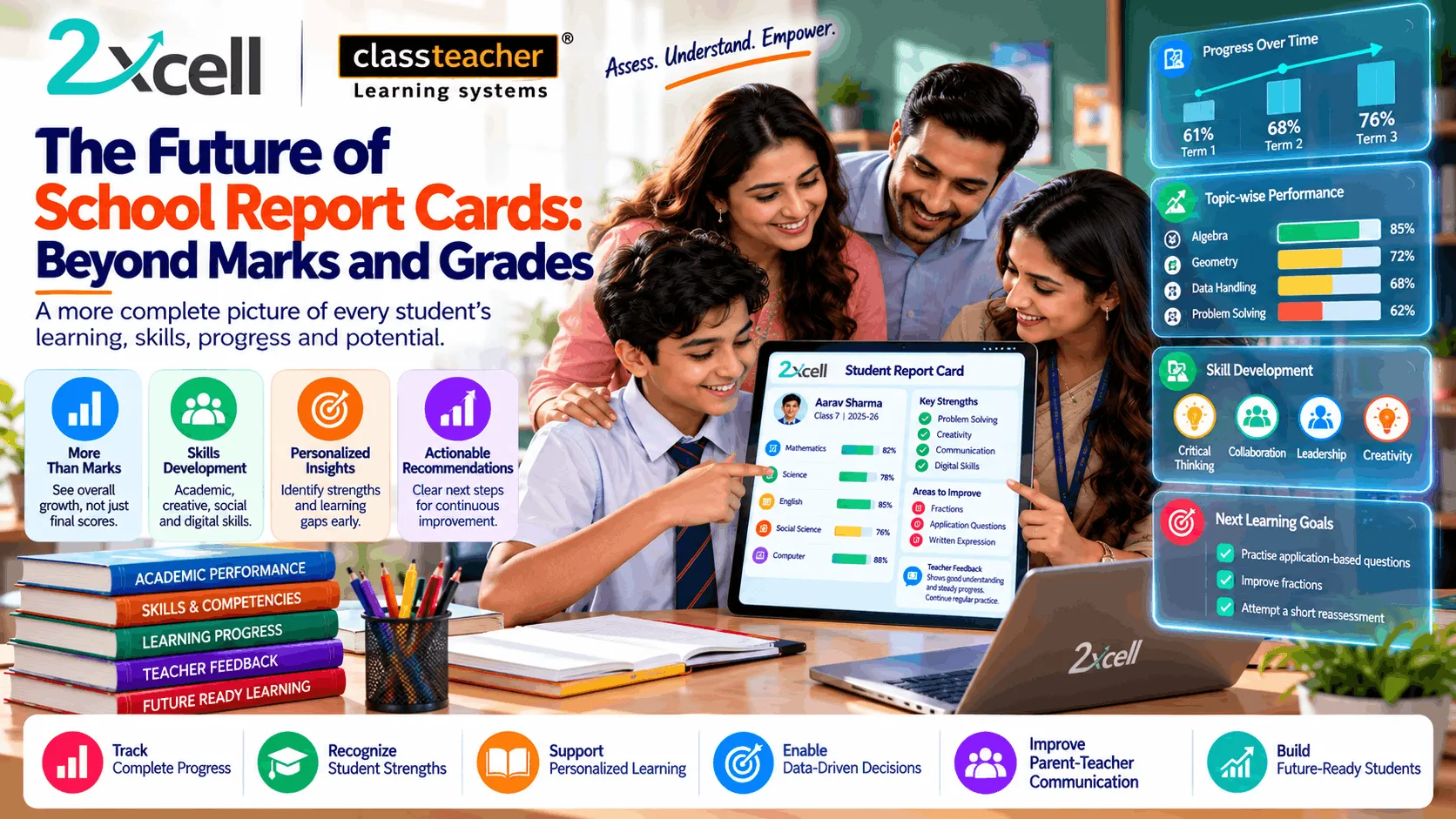
The Future of School Report Cards: Beyond Marks and Grades
Introduction
For many years, school report cards have been closely associated with marks, grades, percentages, and class positions.
A student scores 82% in Mathematics, receives a B+ in another subject, and the report card records the results. This information is useful, but it represents only one part of the student's educational journey.
Learning is much broader than examination performance.
A student may improve significantly even if the final score changes only slightly. Another student may achieve high marks but need support with communication, problem-solving, collaboration, or practical application. A third student may struggle in one subject while demonstrating exceptional creativity, curiosity, leadership, or technical ability.
This raises an important question:
Should a school report card only show what a student scored, or should it also explain how the student is learning and progressing?
Modern digital education is creating opportunities for schools to rethink this traditional approach.
Instead of:
Marks → Grades → Final Result
a more complete model can become:
Performance → Skills → Progress → Strengths → Learning Needs → Next Steps
The future of school report cards is therefore not necessarily about removing marks and grades.
It is about putting them into a larger picture of student development.
What Is a Modern School Report Card?
A modern report card can be viewed as a structured summary of a student's academic progress, learning behaviour, skills, achievements, and areas requiring further development.
Depending on the school's approach, it may include:
- Subject-wise performance
- Assessment results
- Topic-level understanding
- Skill development
- Learning progress
- Areas of strength
- Concepts requiring additional practice
- Projects and practical activities
- Classroom participation
- Competency development
- Learning goals
- Teacher observations
- Personalized recommendations
The purpose is not to create a longer report.
The purpose is to make the information more meaningful and actionable.
A parent should ideally be able to look at a report and understand:
Where is my child now?
What is the child doing well?
Where is additional support needed?
What should happen next?
Why Marks Alone Cannot Tell the Full Story
Marks are useful indicators, but they are not complete descriptions of learning.
Consider two students who both score 70%.
Student A
The student understands concepts well but makes occasional calculation mistakes.
Student B
The student memorizes information effectively but struggles to apply concepts to unfamiliar problems.
Both students receive the same score.
However, their learning requirements are different.
A conventional report card may show:
Mathematics: 70%
A more detailed learning report could show:
Concept Understanding: Strong
Problem Solving: Developing
Application: Needs Practice
Accuracy: Good
This additional information can help teachers and parents understand what the score actually represents.
1. Report Cards Can Show Progress, Not Just Final Performance
A single examination result is a snapshot.
Student learning is a journey.
For example:
Term 1: 61%
Targeted Practice: Fractions and Algebra
Term 2: 68%
Additional Revision: Application-based Problems
Term 3: 76%
The progression provides valuable context.
Instead of seeing only the latest score, teachers and parents can understand how the student has developed over time.
This can shift the conversation from:
"What did you score?"
to:
"How much have you improved?"
2. Topic-Wise Reporting Can Reveal Hidden Gaps
Overall subject marks can sometimes hide specific learning difficulties.
Suppose a student scores 74% in Science.
A deeper report might show:
Biology: 86%
Chemistry: 79%
Physics: 64%
Application Questions: 58%
This information can help identify where additional support may be required.
Rather than asking the student to revise the entire subject, teachers can focus on particular concepts.
This makes academic intervention more targeted.
3. Skills Can Become Part of Student Reporting
Education is increasingly focused on capabilities that students can apply beyond examinations.
Modern report cards can include skills such as:
- Problem-solving
- Critical thinking
- Communication
- Collaboration
- Creativity
- Digital literacy
- Research
- Logical reasoning
- Decision-making
- Application of knowledge
For example:
Problem-Solving
Developing
Communication
Strong
Collaboration
Strong
Digital Skills
Advanced
Critical Thinking
Developing
This gives parents a broader understanding of their child's development.
4. Report Cards Can Highlight Student Strengths
Academic reporting often focuses heavily on areas where students need improvement.
However, recognizing strengths is equally important.
A student may demonstrate exceptional ability in:
- Coding
- Robotics
- Public speaking
- Art
- Mathematics
- Science
- Writing
- Leadership
- Sports
- Creative problem-solving
A modern report card can make these strengths more visible.
This can help students understand what they are good at and encourage them to develop those abilities further.
5. Learning Gaps Can Be Identified Earlier
Traditional report cards are often prepared at specific intervals.
By the time a weakness appears in a final report, the student may have already moved through several related concepts.
Digital learning systems can provide more frequent academic information.
For example:
Practice Result → Concept Gap → Additional Support → Reassessment
This allows teachers to respond earlier.
The report card can then become part of a continuous academic process rather than simply a record generated at the end of a term.
6. Personalized Recommendations Can Make Reports More Useful
A report that says:
"Needs Improvement in Mathematics"
does not tell the student what to do next.
A more useful report could say:
Recommended Focus:
- Practise fractions
- Review algebraic expressions
- Complete two application-based activities
- Attempt a short reassessment
This converts reporting into action.
The student does not only receive information about performance.
The student receives a possible pathway towards improvement.
7. Teachers Can Add Context to Digital Data
Technology can provide numbers, patterns, and trends.
Teachers provide context.
For example, a digital system may show that a student's assessment performance declined during a particular period.
The teacher may know that:
- The topic was unusually challenging
- The student was absent
- The student changed learning groups
- Additional classroom support was provided
- The student performed better during practical activities
Therefore, a modern report card should not rely entirely on automated analysis.
The stronger model is:
Data → Teacher Interpretation → Meaningful Feedback
8. Report Cards Can Include Learning Behaviour
Academic performance is influenced by more than examination marks.
Schools may also consider appropriate indicators such as:
- Assignment completion
- Practice participation
- Classroom engagement
- Project involvement
- Revision activity
- Participation in discussions
- Consistency of learning
These indicators should be used carefully.
They should provide useful context rather than become unnecessary measurements.
9. Project-Based Learning Can Be Reflected
Students often demonstrate abilities through projects that cannot be fully represented by a percentage.
For example, a student may build:
- A robotics project
- A science model
- A coding application
- A research presentation
- A digital portfolio
- An environmental project
A modern report card can include project participation and outcomes.
It could record:
Project: Smart Water Monitoring System
Skills Demonstrated: Research, Coding, Problem-Solving, Collaboration
This creates a stronger connection between classroom learning and practical application.
10. Competency-Based Reporting Can Provide More Meaning
Competency-based education focuses on what students can understand and apply.
Instead of reporting only:
History – 78%
a school could also report:
Knowledge: Strong
Analysis: Developing
Source Interpretation: Strong
Application: Developing
This helps explain what the student can actually do with the knowledge they have acquired.
11. Digital Report Cards Can Show Learning Trends
Digital systems can make it easier to visualize changes across multiple assessments.
For example:
Mathematics
Term 1: 62%
Term 2: 69%
Term 3: 77%
Science
Term 1: 71%
Term 2: 74%
Term 3: 81%
Visual trends can help parents and teachers quickly understand whether performance is:
- Improving
- Stable
- Declining
- Fluctuating
This can support more informed academic discussions.
12. Parents Can Get Better Visibility Into Learning
Parents often receive detailed academic information only during report-card periods.
Digital reporting can create greater visibility throughout the year.
Parents may be able to understand:
- Recent assessment performance
- Topic-wise progress
- Areas requiring practice
- Strengths
- Learning goals
- Improvement over time
This does not mean parents need access to every data point.
The information should be presented in a simple and understandable format.
13. Report Cards Can Encourage Better Parent-Teacher Conversations
A traditional conversation may begin with:
"Your child scored 68%."
A more meaningful conversation could begin with:
"Your child has improved in problem-solving but still needs support with application-based questions."
This changes the nature of the discussion.
Parents and teachers can focus on:
- What is improving?
- What remains difficult?
- What support has already been provided?
- What should happen next?
This can make parent-teacher meetings more productive.
14. Students Can Become More Aware of Their Own Learning
Report cards should not only be designed for parents and teachers.
Students can also benefit from understanding their own progress.
A student-friendly report might show:
I Am Doing Well In
- Reading comprehension
- Science concepts
- Coding
I Need More Practice In
- Fractions
- Written expression
My Next Goal
- Improve application-based problem solving
This encourages students to become active participants in their own learning.
15. AI Can Help Analyse Academic Information
AI can help schools process large amounts of learning data.
Depending on the system, AI-assisted analytics may help identify:
- Performance trends
- Repeated mistakes
- Topic-level weaknesses
- Progress patterns
- Practice requirements
- Assessment changes
- Areas requiring teacher attention
The important point is that AI should support educational decisions rather than automatically define a student's ability.
The process can be:
AI Identifies a Pattern → Teacher Reviews It → Support Is Planned
16. AI Can Help Generate More Personalized Insights
Different students may require different types of feedback.
For example:
Student A
Strong conceptual understanding but needs more practice.
Student B
Good practice performance but struggles during assessments.
Student C
Low foundational understanding and requires additional explanation.
A digital system can help organize these differences into clearer learning insights.
This can make reporting more personalized.
17. Report Cards Can Connect Assessment With Next Steps
Assessment becomes more valuable when it leads to action.
A modern report could follow:
Assessment
↓
Analysis
↓
Learning Gap
↓
Recommended Support
↓
Practice
↓
Reassessment
This makes the report card part of an ongoing improvement cycle.
18. Co-Curricular Development Can Be Recognized
Students develop outside traditional academic subjects as well.
Depending on the school's reporting framework, report cards can recognize participation in:
- Sports
- Music
- Art
- Debate
- Robotics
- Coding
- Theatre
- Community activities
- Leadership programs
The purpose is not to assign unnecessary grades to everything.
It is to recognize broader development where appropriate.
19. Digital Portfolios Can Complement Report Cards
A report card provides a summary.
A digital portfolio can provide evidence.
For example, a student's portfolio may include:
- Projects
- Presentations
- Certificates
- Research work
- Coding activities
- Creative work
- Science experiments
- Assignments
Together:
Report Card + Digital Portfolio = Broader Student Profile
This can help demonstrate learning beyond examination scores.
20. How 2xcell Can Support Modern Student Reporting
2xcell AI Learning Platform by CLASSTEACHER Learning Systems can support a connected digital learning environment involving:
- Digital learning content
- Practice
- Assessments
- Analytics
- Personalized learning
- Student progress tracking
A connected learning cycle can follow:
Learn → Practise → Assess → Analyse → Support → Improve
Relevant academic information can help schools understand student progress and identify areas where additional support may be required.
This approach can help move reporting beyond isolated examination results towards a broader understanding of learning.
The objective is not simply to create a more detailed report card.
It is to create a more meaningful picture of student development.
What Should a Future-Ready Report Card Include?
A modern school can consider organizing reporting into several sections.
1. Academic Performance
Subject-wise results and assessment performance.
2. Learning Progress
Changes in performance across the academic period.
3. Concept Understanding
Topic-level areas of strength and difficulty.
4. Skills
Communication, collaboration, problem-solving, creativity, and other relevant competencies.
5. Learning Habits
Relevant information about participation and learning activity.
6. Projects
Practical work and application-based learning.
7. Strengths
Areas where the student demonstrates confidence or strong performance.
8. Areas for Development
Specific concepts or skills requiring additional attention.
9. Teacher Feedback
Professional observations and contextual guidance.
10. Next Learning Goals
Clear areas for future improvement.
This structure can make the report more useful without turning it into an overwhelming collection of data.
What Schools Should Avoid
Moving beyond traditional report cards does not mean adding every possible metric.
Schools should avoid:
Too Much Data
Hundreds of numbers can make reports difficult to understand.
Unclear AI Recommendations
Parents should understand why a recommendation has been made.
Overemphasis on Rankings
Student development should not become a competition based only on scores.
Labelling Students Permanently
A temporary difficulty should not become a permanent judgment about ability.
Ignoring Teacher Context
Automated information should complement professional judgement.
Excessive Testing
Continuous reporting should not mean continuous examination.
The objective should always remain:
Clarity → Understanding → Support → Improvement
Designing a Parent-Friendly Report Card
A good report card should be easy to understand.
Parents should not need technical knowledge to interpret academic information.
For example, instead of showing a complicated analytics dashboard, a report could highlight:
Current Performance
Good
Recent Progress
Improving
Key Strength
Problem Solving
Area Requiring Attention
Fractions
Recommended Action
Complete targeted practice
Next Goal
Improve application-based questions
This format turns complex information into practical guidance.
Data Privacy Should Remain a Priority
As report cards become more digital and data-driven, schools must also consider responsible handling of student information.
Important areas include:
- Secure authentication
- Access controls
- Protection of academic records
- Responsible AI use
- Data privacy
- Secure storage
- Appropriate data sharing
- Transparency around data usage
Technology should improve educational visibility without compromising student privacy.
The Future of School Reporting
The future report card may become less like a static document and more like a learning progress summary.
A future model could connect:
Student Activity
↓
Assessment
↓
Performance Analysis
↓
Skill Development
↓
Teacher Feedback
↓
Parent Visibility
↓
Learning Recommendations
↓
Next Learning Goal
This creates a more connected view of education.
The report card becomes a bridge between:
Student → Teacher → School → Parent
rather than simply a document showing final marks.
From Report Cards to Learning Profiles
The biggest shift may be from a report card to a student learning profile.
A report card traditionally answers:
"What result did the student achieve?"
A learning profile can answer:
"What has the student learned, what skills are developing, what challenges remain, and what should happen next?"
This difference is important.
The first focuses mainly on outcomes.
The second focuses on outcomes and development.
Conclusion
School report cards have an important role in communicating academic performance, but the future of education requires a broader view of student development.
Marks and grades can tell schools and parents how a student performed in a particular assessment.
They do not always explain:
- How the student has progressed
- Which concepts are strong
- Where learning gaps exist
- Which skills are developing
- What support may be required
- What the next learning goal should be
Modern digital learning and analytics can help schools bring these dimensions together.
With 2xcell AI Learning Platform by CLASSTEACHER Learning Systems, schools can explore a connected approach to digital learning, assessment, analytics, personalized learning, and student progress tracking.
The goal is not to replace marks and grades.
It is to place them within a larger and more meaningful picture of learning.
The future of school reporting can move from:
Marks → Grades → Results
towards:
Understand → Track → Support → Improve → Grow
A report card should not only tell students where they have been.
It should help show them where they can go next.
2xcell AI Learning Platform
By CLASSTEACHER Learning Systems
Empowering Education with AI & Innovation.