Introduction
The way students consume information has changed significantly with the growth of digital technology. In today's classrooms, learning is no longer limited to textbooks, blackboards, and verbal explanations.
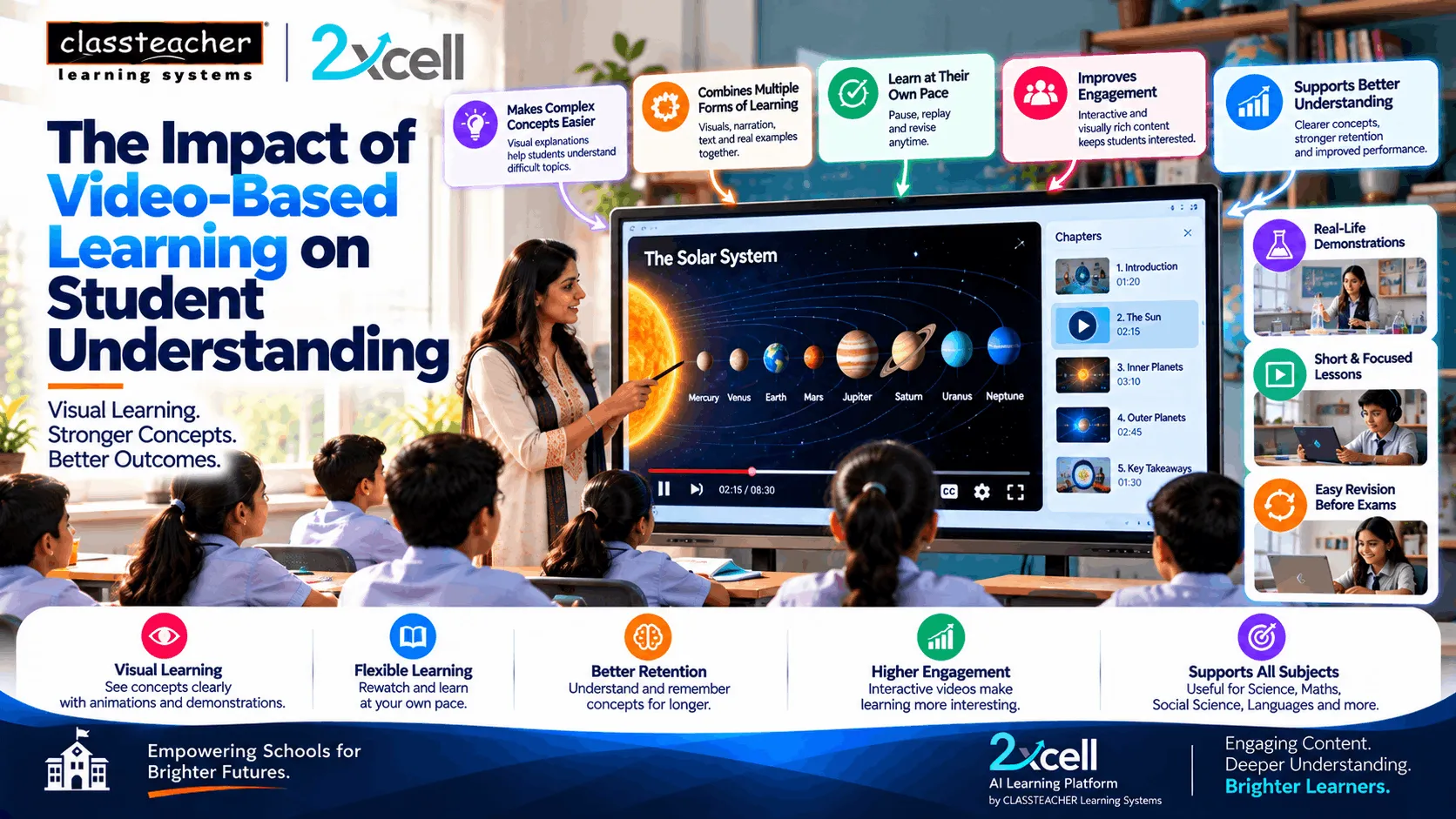
Video-based learning has become an increasingly useful way to present concepts through a combination of visuals, narration, demonstrations, animation, examples, and real-world situations.
A well-designed educational video can help students see how a concept works instead of only reading about it. This can be particularly useful for topics that are difficult to explain through text alone.
However, video learning is not simply about playing videos in a classroom. Its educational value depends on how videos are designed, how they are integrated with teaching, and what students do before and after watching them.
The real objective is:
Watch → Understand → Practise → Apply → Review
What Is Video-Based Learning?
Video-based learning is an educational approach that uses recorded or digital video content as part of the learning process.
Educational videos can include:
- Concept explanations
- Animated lessons
- Demonstrations
- Experiments
- Tutorials
- Recorded lectures
- Visual storytelling
- Simulations
- Practical examples
- Revision videos
- Subject-specific learning content
Videos can be used inside classrooms, at home, during revision, or as part of a blended learning environment.
The format allows teachers and students to revisit content when required.
Why Visual Learning Matters
Students do not all understand information in exactly the same way.
A written explanation may be sufficient for one student, while another may understand the same concept more easily after seeing an animation or demonstration.
For example, explaining the movement of planets through a paragraph can provide information, but an animation showing planetary movement can make the relationship between objects easier to visualize.
Similarly, a science experiment can be explained through text, but a demonstration can show the sequence of actions more clearly.
Video can therefore add another layer to the learning experience.
1. Videos Can Make Complex Concepts Easier to Visualize
Some academic concepts are difficult to understand through static content.
Subjects such as:
- Science
- Mathematics
- Geography
- Computer Science
- Biology
- Physics
- Environmental Studies
often involve processes, movements, structures, or sequences.
Video can demonstrate these elements step by step.
For example, instead of simply describing how a water cycle works, an animated lesson can visually show:
Evaporation → Condensation → Precipitation → Collection
Students can observe the relationship between each stage rather than memorizing isolated definitions.
2. Video Combines Multiple Forms of Explanation
A major strength of educational video is its ability to combine different communication formats.
A single lesson can include:
Visuals + Voice + Text + Animation + Demonstration
This allows a concept to be explained through multiple representations.
For example, a mathematics lesson could show a problem on screen while the teacher explains the solution verbally and highlights each calculation visually.
This can make the learning experience more structured and easier to follow.
3. Students Can Learn at Their Own Pace
A traditional classroom lesson happens according to a fixed schedule.
Once the teacher moves to the next concept, students may not always have enough time to revisit the previous explanation.
Video content can provide greater flexibility.
Students can:
- Pause the lesson
- Replay difficult sections
- Rewatch an explanation
- Slow down when needed
- Review important concepts
- Continue when they are ready
This can be particularly useful when students have different levels of prior understanding.
4. Video Can Support Concept Reinforcement
Understanding a concept once does not always mean that the student will remember it permanently.
Revision plays an important role in learning.
Short educational videos can be used to reinforce previously taught concepts.
For example:
Classroom Lesson → Video Revision → Practice → Assessment
A student who has forgotten a concept can revisit the relevant explanation without requiring the entire lesson to be repeated.
This can make revision more focused.
5. Demonstrations Can Connect Theory With Practice
One of the challenges of education is connecting theoretical knowledge with real-world application.
Video can help bridge this gap.
Consider a science topic involving an experiment.
A teacher can explain the theory in class and then use a video demonstration to show:
- Equipment
- Procedure
- Sequence
- Observation
- Result
- Practical application
Students can therefore see how theoretical knowledge connects with an actual process.
6. Video Can Improve Engagement With Learning Content
Traditional learning materials often require students to read large amounts of text.
Video introduces movement, narration, visual storytelling, and demonstrations.
When used appropriately, these elements can make learning content more dynamic.
For example, instead of presenting a long explanation about historical events, a teacher could use a short educational video containing:
- Historical photographs
- Maps
- Timelines
- Narration
- Important events
- Visual illustrations
The objective is not entertainment.
The objective is to make academic information easier to explore and understand.
7. Short Videos Can Break Large Topics Into Smaller Lessons
Large chapters can sometimes feel overwhelming.
Video-based learning allows schools to divide a broad topic into smaller learning units.
For example:
Chapter: Human Digestive System
Video 1 → Introduction
Video 2 → Mouth and Digestion
Video 3 → Stomach
Video 4 → Small Intestine
Video 5 → Absorption
Video 6 → Revision
This approach can allow students to focus on one concept at a time.
It can also make revision easier because students can return directly to the section they need.
8. Videos Can Support Different Learning Situations
Video content is not limited to traditional classroom teaching.
Schools can use educational videos for:
Classroom Learning
Teachers can use videos to introduce or explain concepts.
Homework
Students can watch assigned content before completing activities.
Revision
Previously taught topics can be revisited through short lessons.
Remedial Learning
Students who require additional explanation can review relevant content.
Advanced Learning
Students can explore additional material beyond the basic lesson.
Blended Learning
Video can connect classroom teaching with digital learning activities.
This flexibility makes video useful across different learning models.
9. Video Can Help Students Prepare Before a Lesson
Videos can also be used before classroom teaching.
For example, a teacher may provide a short introductory video before beginning a new chapter.
Students can watch the video and become familiar with the basic concept.
The classroom session can then focus on:
- Questions
- Discussions
- Activities
- Problem-solving
- Practical applications
This approach can help shift classroom time from simply delivering information towards deeper learning activities.
10. Video Can Support Better Revision Before Examinations
Exam preparation often involves revisiting a large number of concepts.
Instead of reading an entire chapter repeatedly, students can use short revision videos to refresh specific concepts.
For example:
Concept Review → Practice Questions → Mock Test → Identify Weak Areas → Video Revision
This creates a connection between video learning and assessment.
Students can use videos specifically for the areas where they require additional understanding.
Video Learning and Student Understanding
Watching a video does not automatically mean that a student has understood the topic.
This distinction is important.
A student may watch a ten-minute video without remembering its key concepts.
Therefore, video should ideally be combined with activities that require students to think and respond.
A useful learning sequence can be:
Watch → Question → Practise → Discuss → Assess
For example, after watching a video about fractions, students could solve related problems and answer a short quiz.
This gives teachers an opportunity to understand whether the video actually supported learning.
The Importance of Interactive Video Learning
Video becomes more useful when students are not passive viewers.
Interactive learning can include:
- Questions during or after videos
- Short quizzes
- Reflection activities
- Practice exercises
- Discussion prompts
- Assignments
- Concept checks
This can turn video from a content-delivery tool into part of a broader learning experience.
How Teachers Can Use Video Effectively
Teachers do not need to replace classroom teaching with videos.
Instead, videos can complement their existing teaching methods.
A teacher might follow this structure:
Before the Video
Introduce the learning objective.
During the Video
Ask students to focus on specific concepts.
After the Video
Conduct discussion or questioning.
Practice
Give students activities related to the topic.
Assessment
Check whether students understood the concept.
This keeps the teacher at the centre of the learning process.
Choosing the Right Educational Videos
Not every educational video is equally useful.
Schools and teachers should consider:
Accuracy
Does the content provide academically correct information?
Curriculum Relevance
Does the video connect with the learning objectives?
Appropriate Length
Is the video long enough to explain the concept without unnecessary content?
Visual Quality
Are diagrams, animations, and demonstrations clear?
Language
Can students understand the explanation comfortably?
Age Appropriateness
Is the content suitable for the students' grade level?
Learning Objective
Does the video actually help students understand something specific?
These factors can make a significant difference to the usefulness of video-based learning.
Video-Based Learning for Different Subjects
Video can support different subjects in different ways.
Science
Experiments, processes, simulations, and demonstrations.
Mathematics
Step-by-step problem solving, visual explanations, and graphical concepts.
Social Science
Historical events, maps, timelines, and documentary-style explanations.
Languages
Pronunciation, conversations, storytelling, and vocabulary.
Computer Science
Software demonstrations, coding tutorials, and practical walkthroughs.
Geography
Maps, environmental processes, climate systems, and geographical locations.
The format should be selected according to what students need to understand.
Video Learning and Personalized Education
Students can have different levels of understanding.
Video libraries can give learners opportunities to revisit specific topics according to their needs.
For example:
Student A: Needs a basic concept explanation.
Student B: Needs additional examples.
Student C: Is ready for an advanced application.
A digital learning environment can provide different learning resources for these requirements.
When video is connected with practice and assessment, schools can create a more structured learning pathway.
How 2xcell Can Support Video-Enabled Learning
2xcell AI Learning Platform by CLASSTEACHER Learning Systems can be positioned within a connected digital learning environment that brings learning content, practice, assessment, analytics, and personalized learning together.
A video-supported learning journey can follow:
Learn → Watch → Practise → Assess → Analyse → Improve
This approach can help schools connect digital learning resources with other parts of the learning process instead of treating video as an isolated activity.
Teachers can use digital learning resources as part of classroom instruction, revision, practice, and student support.
The objective is to create a more connected learning experience where digital content complements teacher-led education.
The Role of Teachers in Video-Based Learning
Technology does not replace the teacher's role.
A video can explain a concept, but the teacher can:
- Answer questions
- Identify misconceptions
- Provide context
- Encourage discussion
- Adapt explanations
- Monitor understanding
- Provide individual support
This makes the relationship:
Video Provides Explanation → Teacher Provides Guidance → Student Applies Knowledge
The combination can create a richer learning experience than relying on either approach alone.
Measuring Whether Video Learning Is Working
Schools should look beyond video views.
A high number of views does not necessarily indicate strong understanding.
Instead, schools can examine:
- Quiz performance
- Concept mastery
- Practice results
- Student participation
- Assessment outcomes
- Progress over time
- Student questions
- Assignment performance
The important question is:
Did watching the video help the student understand and apply the concept?
This makes assessment an important part of video-based learning.
Common Mistakes in Video-Based Learning
Using Videos Without a Learning Objective
Students should know what they are expected to understand.
Making Videos Too Long
Long videos can make it difficult for students to maintain focus.
Treating Videos as a Replacement for Teaching
Teachers remain essential for explanation, interaction, and support.
Using Videos Without Practice
Students need opportunities to apply what they have learned.
Ignoring Assessment
Schools should check whether students actually understood the content.
Adding Too Many Visual Effects
Visual design should support understanding rather than distract students.
Building an Effective Video Learning Strategy
Schools can gradually introduce video-based learning through a structured approach.
Step 1: Identify Difficult Concepts
Find topics where students commonly require additional explanation.
Step 2: Select or Create Relevant Videos
Choose content aligned with the curriculum.
Step 3: Keep Learning Objectives Clear
Define what students should understand after watching.
Step 4: Add Practice
Connect videos with questions, activities, or assignments.
Step 5: Assess Understanding
Use quizzes or classroom discussions.
Step 6: Analyse Results
Identify whether students have understood the topic.
Step 7: Provide Additional Support
Offer further explanation or practice where required.
This transforms video from passive content into an active learning resource.
The Future of Video-Based Learning
As digital education continues to develop, educational videos are likely to become more connected with AI, interactive assessments, personalized learning, and learning analytics.
Future learning experiences may combine:
Video + AI + Interactive Practice + Assessment + Analytics
A student could watch a concept explanation, complete practice questions, receive feedback, and continue with additional resources based on performance.
This creates a more connected learning cycle.
However, technology should continue to support educational objectives rather than become the objective itself.
Conclusion
Video-based learning can provide schools with another effective way to explain, demonstrate, reinforce, and revise academic concepts.
Its value comes from more than simply presenting information through a screen.
When videos are aligned with curriculum objectives and combined with teacher guidance, practice, interaction, and assessment, they can become an important part of a modern learning environment.
With 2xcell AI Learning Platform by CLASSTEACHER Learning Systems, schools can explore a connected approach to digital learning, assessment, analytics, and personalized learning.
The future of video-based education is not simply about watching more content.
It is about helping students see concepts clearly, understand them deeply, practise effectively, and apply what they learn.
Watch. Understand. Practise. Apply. Grow.
2xcell AI Learning Platform
By CLASSTEACHER Learning Systems
Empowering Education with AI & Innovation.