Introduction
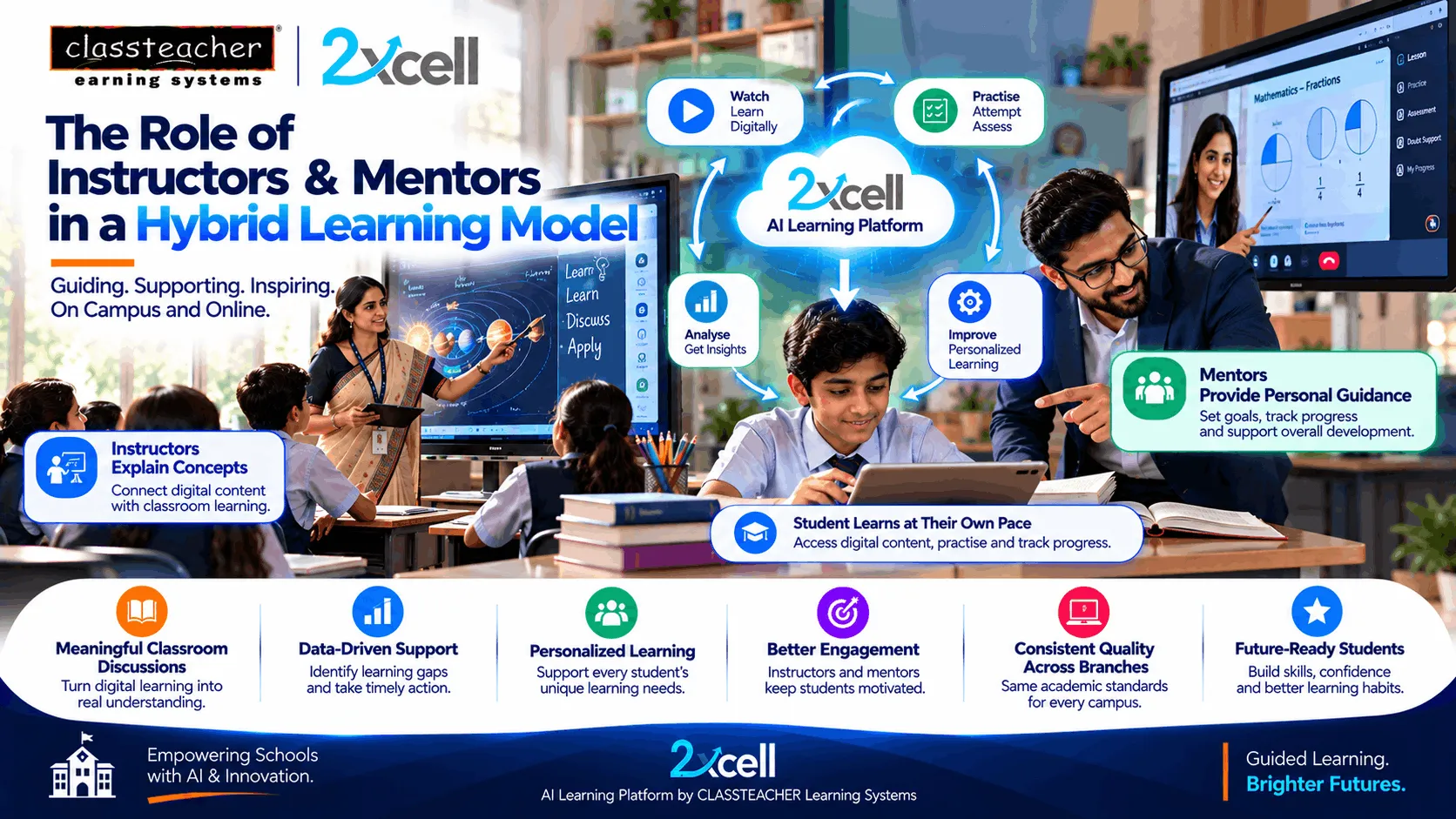
Hybrid learning combines face-to-face classroom education with digital learning experiences. Students may attend physical classes while also using videos, online resources, digital assessments, virtual activities, and learning platforms outside the classroom.
While technology provides access to content and learning tools, it does not replace the human guidance students need throughout the learning process.
This is where instructors and mentors play an important role.
An effective hybrid learning model is not simply:
Classroom + Technology
It is:
Teacher Guidance + Digital Resources + Student Participation + Continuous Support
Instructors help students understand concepts, ask questions, practise skills, and connect digital content with classroom learning. Mentors can provide additional guidance, encouragement, goal-setting, and personalized support.
Together, they help create a more connected learning experience.
What Is a Hybrid Learning Model?
Hybrid learning combines different modes of education within one learning journey.
Students may experience:
- Face-to-face classroom lessons
- Digital learning content
- Educational videos
- Online practice
- Digital assessments
- Interactive activities
- Virtual discussions
- Self-paced learning
- Teacher-led instruction
- Mentoring sessions
A hybrid model can therefore provide flexibility without removing the structure of classroom education.
A typical learning cycle may look like:
Learn in Class → Explore Digitally → Practise → Discuss → Assess → Improve
Why Human Guidance Still Matters
Digital platforms can provide information quickly, but learning involves more than accessing information.
Students may still need someone to:
- Explain difficult concepts
- Answer questions
- Identify misunderstandings
- Encourage participation
- Provide feedback
- Set learning goals
- Suggest better learning strategies
- Connect theory with practical situations
An instructor or mentor can provide the context that digital content alone may not provide.
The relationship becomes:
Technology Provides Resources → Instructor Provides Guidance → Student Applies Learning
1. Instructors Connect Digital Learning With Classroom Teaching
One of the biggest advantages of hybrid learning is the ability to combine digital resources with classroom instruction.
For example, a teacher may introduce a science concept in class and then assign an interactive digital activity.
The next classroom session can focus on:
- Questions
- Discussion
- Experiments
- Problem-solving
- Application
This creates a continuous connection between physical and digital learning.
2. Instructors Help Students Understand Difficult Concepts
Digital content can explain a concept, but some students may still require additional clarification.
An instructor can identify where confusion is occurring and explain the concept differently.
For example:
Digital Explanation → Student Question → Teacher Clarification → Practice
A teacher may use:
- Another example
- A diagram
- A practical demonstration
- A real-world situation
- A simpler explanation
This flexibility can make hybrid learning more responsive.
3. Mentors Can Provide Individual Learning Guidance
Mentoring can extend beyond subject explanations.
A mentor can help students understand:
- Learning goals
- Study habits
- Time management
- Areas requiring improvement
- Personal academic targets
- Learning progress
For example, a student struggling to maintain a regular practice routine may benefit from a mentor who helps create a manageable learning plan.
This makes the learning experience more structured.
4. Instructors Can Create Meaningful Classroom Discussions
Digital learning often provides students with information before or after a classroom session.
The instructor can use classroom time for deeper discussion.
For example:
Watch → Question → Discuss → Analyse → Apply
Instead of spending the entire class explaining basic information, teachers can encourage students to explore the concept further.
This can make classroom interaction more purposeful.
5. Mentors Can Help Students Set Learning Goals
Students may know that they want to improve but may not know exactly what they should focus on.
Mentors can help convert broad goals into specific targets.
For example:
Broad Goal
“I want to improve in mathematics.”
Specific Goal
“I will improve my understanding of algebra by completing topic-based practice three times a week.”
This creates a clearer learning direction.
6. Instructors Provide Context to Digital Content
Digital resources can sometimes present concepts in a general format.
Teachers can connect those concepts with:
- Local examples
- Classroom activities
- Student interests
- Current situations
- Practical applications
For example, a lesson about percentages can be connected to discounts, budgeting, sports statistics, or everyday financial decisions.
This helps students understand where academic concepts can be applied.
7. Mentors Can Encourage Students When They Struggle
Learning does not always happen smoothly.
Students may experience:
- Difficult topics
- Low confidence
- Repeated mistakes
- Lack of consistency
- Challenges with time management
A mentor can help students understand that difficulty is part of the learning process.
Instead of simply saying:
“You need to improve.”
a mentor can help identify:
What is difficult → Why it is difficult → What support is needed → What to do next
This makes support more actionable.
8. Teachers Can Monitor Whether Digital Learning Is Working
Using a digital platform does not automatically mean that students are learning effectively.
Teachers can review relevant information such as:
- Practice performance
- Assessment results
- Participation
- Frequently incorrect concepts
- Progress over time
- Completed activities
This information can help instructors decide whether additional classroom explanation or practice is required.
The cycle becomes:
Digital Activity → Performance Data → Teacher Review → Additional Support
9. Instructors Can Provide Immediate Classroom Feedback
Feedback becomes more useful when students receive it close to the learning activity.
During a hybrid lesson, teachers can observe student responses and provide clarification immediately.
For example:
Attempt → Teacher Feedback → Correction → Second Attempt
This allows students to learn from mistakes rather than simply seeing them as incorrect answers.
10. Mentors Can Help Students Become More Independent
Hybrid learning often requires students to manage some parts of their learning independently.
Mentors can gradually develop this ability.
Students can learn how to:
- Plan study time
- Select appropriate resources
- Track progress
- Review mistakes
- Set goals
- Evaluate their own learning
Over time, the mentor can move from direct guidance towards greater student independence.
11. Teachers Can Personalize Classroom Support
Students may use the same digital platform but require different kinds of classroom support.
For example:
Student A
Needs a basic concept explanation.
Student B
Needs additional practice.
Student C
Needs advanced application activities.
The instructor can adapt classroom support while the digital platform provides different resources.
This creates:
Common Learning Environment + Individual Support
12. Mentors Can Connect Learning With Long-Term Goals
Students may find it easier to stay engaged when they understand how learning connects with their future goals.
Mentors can discuss:
- Career interests
- Skills
- Higher education pathways
- Practical applications
- Personal development
For example, a student interested in technology may understand how mathematics, coding, problem-solving, and communication contribute to future opportunities.
This can make learning feel more purposeful.
13. Instructors Can Turn Digital Content Into Practical Activities
Digital content can introduce a concept, while teachers can turn that concept into an activity.
For example:
Digital Lesson → Classroom Experiment → Observation → Discussion → Application
A science video about chemical reactions could be followed by a teacher-led practical activity.
A coding lesson could be followed by a classroom programming challenge.
This connects digital learning with real-world application.
14. Mentors Can Support Students Outside Scheduled Classes
One advantage of hybrid learning is that learning does not have to stop when the classroom session ends.
Mentors can help students use digital resources effectively outside school hours.
They may guide students towards:
- Revision content
- Practice activities
- Additional resources
- Learning goals
- Assessment preparation
This can create continuity between classroom and independent learning.
15. Instructors Can Help Prevent Digital Learning From Becoming Passive
Watching videos or reading digital content does not necessarily mean that students are actively learning.
Teachers can introduce activities after digital content.
For example:
Watch → Question → Discuss → Practise → Assess
Students become active participants rather than passive viewers.
16. Mentors Can Help Interpret Learning Analytics
Digital platforms may generate information about student performance.
However, data alone does not always explain why a student is struggling.
For example, analytics may show lower performance in mathematics.
A mentor or teacher can investigate further:
- Is the concept difficult?
- Is the student missing practice?
- Is the learning pace too fast?
- Does the student need another explanation?
- Is there another factor affecting participation?
The model becomes:
AI/Data Shows Pattern → Mentor Adds Context → Support Is Planned
17. Teachers Can Encourage Collaboration
Hybrid learning does not have to be completely individual.
Instructors can use digital resources to support group activities such as:
- Research projects
- Presentations
- Collaborative problem-solving
- Digital assignments
- Peer discussions
- Group challenges
This helps students develop communication and teamwork alongside academic knowledge.
18. Mentors Can Support Different Learning Paces
Students do not always learn at the same speed.
Some may need more time with foundational concepts, while others may be ready for advanced material.
Mentors can help students select appropriate learning activities.
A possible pathway is:
Understand → Practise → Review → Progress
This can reduce the pressure to move through every topic at exactly the same pace.
19. Instructors Help Maintain Academic Structure
Flexibility is an advantage of hybrid learning, but too much flexibility can sometimes make learning difficult to manage.
Teachers can provide structure through:
- Learning schedules
- Deadlines
- Classroom activities
- Practice plans
- Assessments
- Review sessions
This creates a balance between:
Flexibility + Accountability
20. How 2xcell Can Support Instructors and Mentors
2xcell AI Learning Platform by CLASSTEACHER Learning Systems can support a connected digital learning environment involving:
- Digital learning content
- Practice
- Assessments
- Analytics
- Personalized learning
- Student progress tracking
In a hybrid learning environment, a connected learning journey can follow:
Learn → Practise → Assess → Analyse → Teacher Guidance → Improve
Digital resources can support students between classroom sessions, while instructors and mentors can use relevant learning information to provide additional guidance.
The objective is not to replace instructors or mentors.
It is to give them better tools and learning information to support students more effectively.
Hybrid Learning Works Best When Technology and People Work Together
Technology and human guidance serve different purposes.
Technology Can Provide
- Access
- Flexibility
- Practice
- Digital resources
- Assessment
- Analytics
- Personalized recommendations
Instructors Can Provide
- Explanation
- Context
- Feedback
- Classroom interaction
- Practical guidance
- Academic support
Mentors Can Provide
- Goal-setting
- Encouragement
- Learning strategies
- Progress guidance
- Personal support
Together, these elements create:
Technology + Instructor + Mentor + Student
The Instructor's Role Before, During, and After Digital Learning
Before Digital Learning
The instructor can explain the learning objective and prepare students for the activity.
During Digital Learning
The teacher can monitor participation and clarify questions.
After Digital Learning
The instructor can conduct discussions, activities, practice, or assessments.
This creates a complete learning cycle:
Prepare → Learn → Discuss → Practise → Assess → Improve
The Mentor's Role in a Hybrid Learning Journey
A mentor can work alongside the instructor by focusing on the student's broader learning journey.
Goal Setting
What does the student want to achieve?
Progress Review
What has improved?
Challenge Identification
Where is additional support required?
Learning Planning
What should the student work on next?
Follow-Up
Is the selected strategy producing progress?
This creates a continuous support system.
What Schools Should Consider When Building a Hybrid Learning Model
Schools should consider more than simply purchasing digital learning technology.
Teacher Training
Are instructors comfortable using digital resources?
Mentor Preparation
Do mentors understand how to support students in a hybrid environment?
Content Quality
Is the digital content aligned with curriculum objectives?
Assessment
Can student learning be measured effectively?
Analytics
Can teachers understand useful learning patterns?
Personalization
Can students receive appropriate support?
Communication
Can teachers, mentors, students, and parents stay connected?
Data Responsibility
Are student learning records handled appropriately?
Avoiding Overdependence on Technology
Hybrid learning should not become a situation where students are simply given digital content and expected to learn independently.
Technology can provide resources, but students may still require:
- Explanation
- Encouragement
- Discussion
- Feedback
- Motivation
- Human interaction
The objective should be:
Technology for Flexibility + Teachers for Instruction + Mentors for Guidance
The Future of Hybrid Learning
As AI, digital content, analytics, and personalized learning continue to develop, instructors and mentors may gain better tools for understanding student progress.
A future hybrid learning ecosystem could look like:
Digital Content
↓
Student Activity
↓
Assessment
↓
AI-Assisted Analysis
↓
Instructor Review
↓
Mentor Guidance
↓
Personalized Support
↓
Progress Measurement
This creates a connected learning journey where technology supports human expertise rather than replacing it.
Conclusion
Hybrid learning combines the flexibility of digital education with the structure and human interaction of classroom teaching.
But the success of a hybrid model depends heavily on the people supporting the learner.
Instructors help students understand concepts, apply knowledge, ask questions, and connect digital resources with classroom experiences.
Mentors provide additional guidance through goal-setting, progress reviews, encouragement, and personalized learning support.
Technology can strengthen this relationship by providing access to digital content, practice, assessments, analytics, and learning insights.
With 2xcell AI Learning Platform by CLASSTEACHER Learning Systems, schools can explore a connected approach to digital learning, assessment, analytics, personalized learning, and student progress tracking.
The most effective hybrid learning environment is not simply about adding technology to education.
It is about creating the right connection between:
Technology. Instructors. Mentors. Students.
The goal is simple:
Learn Anywhere. Get Guided. Stay Connected. Keep Improving.
2xcell AI Learning Platform
By CLASSTEACHER Learning Systems
Empowering Education with AI & Innovation.