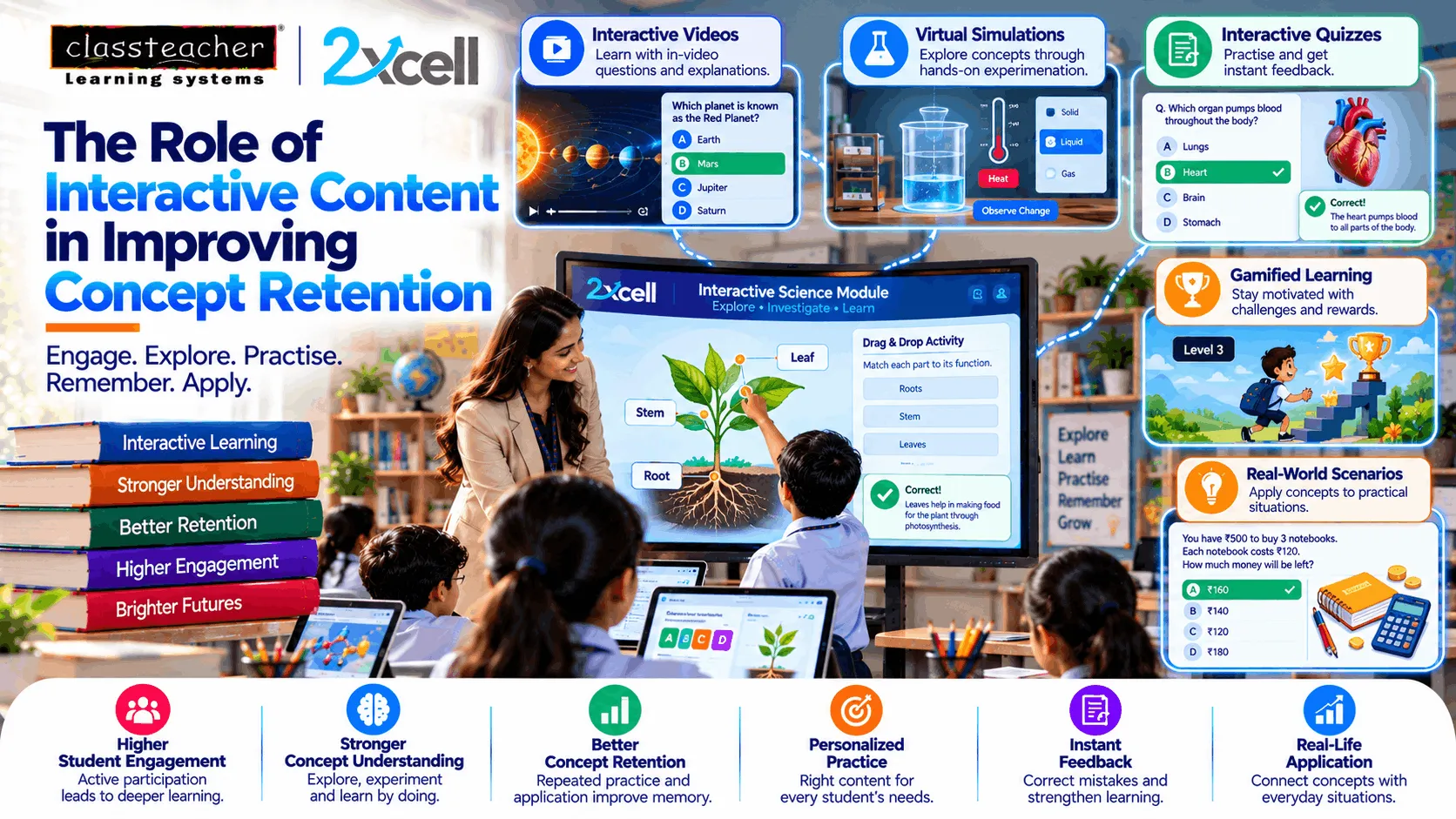
Introduction
Understanding a concept is different from remembering it later.
Students may listen to a classroom explanation, read a chapter, or complete an assignment successfully, yet struggle to recall the same information after several days or weeks. Long-term retention requires students to interact with knowledge repeatedly and use it in meaningful situations.
This is where interactive content can make learning more engaging and purposeful.
Instead of presenting information in only one direction, interactive learning encourages students to explore, respond, practise, make decisions, receive feedback, and apply concepts.
A more active learning cycle can look like:
Explore → Interact → Practise → Receive Feedback → Apply → Recall
The objective is not simply to make digital learning more attractive. It is to create more opportunities for students to actively work with what they are learning.
What Is Interactive Learning Content?
Interactive content is educational material that requires students to participate rather than simply consume information.
It can include:
- Interactive quizzes
- Simulations
- Digital activities
- Drag-and-drop exercises
- Virtual experiments
- Interactive diagrams
- Educational videos with questions
- Problem-solving activities
- Gamified learning tasks
- Concept-based assessments
- Scenario-based activities
- Interactive presentations
The level of interaction can vary depending on the subject, grade, and learning objective.
The important factor is that the student is doing something with the information.
Why Concept Retention Matters
Learning becomes more valuable when students can remember and apply knowledge after the original lesson.
For example, understanding a mathematical formula during a lesson is useful, but being able to recall and apply it later is more important for long-term learning.
Concept retention supports:
- Revision
- Problem-solving
- Application
- Future learning
- Examination preparation
- Skill development
- Independent learning
Many subjects also depend on previously learned concepts.
If students forget foundational knowledge, understanding advanced topics can become more difficult.
1. Interaction Makes Students Active Participants
Traditional content can sometimes position students as passive recipients of information.
Interactive content changes the learning experience.
Instead of:
Read → Remember
students can experience:
Explore → Respond → Think → Apply
For example, after learning about the water cycle, students could interact with an animated diagram and identify evaporation, condensation, and precipitation.
The concept becomes something they actively explore rather than simply read about.
2. Interactive Questions Encourage Active Recall
Recall is an important part of remembering information.
Interactive questions can ask students to retrieve information shortly after learning it.
For example:
Learn a Concept → Answer a Question → Receive Feedback → Try Again
Questions can include:
- Multiple-choice questions
- Matching activities
- True-or-false questions
- Short-answer questions
- Scenario-based questions
- Concept identification
This gives students opportunities to actively retrieve what they have learned.
3. Instant Feedback Helps Correct Misunderstandings
Feedback is particularly valuable when students make mistakes.
Suppose a student selects an incorrect answer in a digital activity.
Instead of simply showing:
Incorrect
the system can provide an explanation or direct the student towards the relevant concept.
This creates:
Mistake → Explanation → Understanding → Another Attempt
Correcting misunderstandings close to the point where they occur can make practice more meaningful.
4. Interactive Simulations Can Make Abstract Concepts Visible
Some concepts are difficult to understand through text alone.
Simulations can provide students with opportunities to observe processes and relationships.
For example:
Physics
Students can change variables and observe how motion changes.
Science
Students can explore a simulated experiment.
Geography
Students can interact with maps and environmental systems.
Mathematics
Students can manipulate graphs and observe changes.
This can help connect abstract ideas with visible outcomes.
5. Students Can Learn Through Exploration
Interactive content can encourage students to investigate rather than simply follow instructions.
For example, an activity could allow students to change different variables and observe what happens.
This creates a learning process based on:
Question → Experiment → Observation → Conclusion
Such activities can encourage curiosity and deeper engagement with concepts.
6. Interactive Content Can Connect Learning With Real Situations
Students may remember information more effectively when they understand how it can be used.
Scenario-based activities can place students in practical situations.
For example, a mathematics activity could ask students to calculate the cost of items within a shopping scenario.
A science activity could ask students to select the correct procedure for an experiment.
A computer science activity could involve identifying an error in a simple program.
This creates a connection between:
Concept → Situation → Decision → Application
7. Gamified Activities Can Increase Participation
Gamification can introduce elements such as:
- Points
- Levels
- Challenges
- Progress indicators
- Rewards
- Badges
- Timed activities
However, gamification should support the learning objective rather than become the objective itself.
A well-designed activity should make students think while keeping the experience engaging.
The focus should remain:
Playful Interaction + Meaningful Learning
8. Interactive Videos Can Improve Attention
Educational videos can become more interactive when students are asked to respond during or after the video.
For example:
Watch → Question → Think → Answer → Continue
A science video could pause before an experiment result and ask students to predict what will happen.
A history video could ask students to identify an event on a timeline.
This transforms video from passive viewing into an active learning activity.
9. Repeated Interaction Can Strengthen Memory
Retention often requires students to encounter and use concepts more than once.
Interactive content can provide multiple opportunities to revisit a concept without simply repeating the same activity.
For example:
Lesson → Interactive Activity → Quiz → Revision → Application
The concept remains connected across different learning experiences.
10. Interactive Content Can Break Large Topics Into Smaller Activities
Large chapters can feel overwhelming.
Interactive learning allows schools to divide them into smaller learning experiences.
For example:
Human Digestive System
Activity 1: Identify the organs
Activity 2: Arrange the digestive process
Activity 3: Explore nutrient absorption
Activity 4: Complete a concept quiz
Activity 5: Apply the concept to a real-world situation
Students can focus on one learning objective at a time.
11. Interactive Practice Can Help Students Learn From Mistakes
Mistakes can provide useful learning opportunities.
An interactive activity can allow students to:
Attempt → Make Mistake → Receive Hint → Review → Try Again
This can encourage students to treat mistakes as part of the learning process.
The goal is not simply to show the correct answer.
It is to help students understand why the answer is correct.
12. Interactive Content Can Support Different Subjects
Different subjects can use different types of interaction.
Mathematics
Interactive graphs, problem-solving tasks, simulations, and adaptive questions.
Science
Virtual experiments, diagrams, simulations, and process-based activities.
Geography
Interactive maps, climate simulations, and location-based activities.
History
Timelines, maps, historical scenarios, and visual storytelling.
Languages
Pronunciation activities, vocabulary exercises, listening tasks, and conversations.
Computer Science
Coding exercises, debugging tasks, simulations, and interactive challenges.
The format should always support the learning objective.
13. Interactive Content Can Encourage Problem-Solving
Some learning activities can be designed around challenges rather than direct explanations.
For example:
Problem → Explore Information → Select Strategy → Solve → Review
Students are required to think about the problem before selecting an answer.
This can support deeper engagement with the concept.
14. Interactive Activities Can Support Personalized Practice
Students may not all require the same amount of practice.
A digital learning environment can provide different activities according to student performance.
For example:
Student A
Needs foundational questions.
Student B
Needs standard application practice.
Student C
Is ready for advanced problems.
This creates a more flexible learning experience while maintaining the same academic objective.
15. Interactive Assessments Can Reveal Concept Understanding
A student's final score does not always explain what they understand.
Interactive assessments can provide more detailed information.
For example, teachers may identify:
- Concepts mastered
- Concepts requiring revision
- Question types causing difficulty
- Repeated mistakes
- Application challenges
This can help teachers decide what should happen after the assessment.
16. Interactive Content Can Support Revision
Revision becomes more useful when students actively retrieve and apply information.
Instead of simply rereading notes, students can use:
- Interactive quizzes
- Flashcards
- Concept matching
- Practice questions
- Quick challenges
- Topic assessments
A revision cycle can become:
Review → Recall → Practise → Check → Improve
17. Interactive Learning Can Increase Classroom Participation
Teachers can use interactive activities to involve more students during a lesson.
For example, a classroom can use:
- Live quizzes
- Polls
- Concept checks
- Interactive questions
- Group challenges
This can help teachers quickly understand whether students are following the lesson.
It also provides opportunities for students to participate rather than simply listen.
18. Interactive Content Gives Teachers Additional Learning Signals
Student responses to interactive activities can provide useful information.
Teachers may be able to identify:
- Which questions students found difficult
- Which concepts require another explanation
- Which students need additional practice
- Which areas were understood quickly
The relationship becomes:
Student Interaction → Learning Data → Teacher Insight → Targeted Support
19. Interactive Learning Can Connect Classroom and Digital Education
Interactive content can extend classroom learning beyond the lesson period.
For example:
Classroom Explanation
↓
Digital Interactive Activity
↓
Practice
↓
Assessment
↓
Revision
This creates continuity between teacher-led instruction and independent digital learning.
20. How 2xcell Can Support Interactive Learning
2xcell AI Learning Platform by CLASSTEACHER Learning Systems can support a connected digital learning environment involving:
- Digital learning content
- Practice
- Assessments
- Analytics
- Personalized learning
- Student progress tracking
A connected learning journey can follow:
Learn → Interact → Practise → Assess → Analyse → Improve
Relevant learning information can help schools understand how students perform across learning activities and where additional support may be useful.
The objective is to connect content with practice and assessment rather than treating digital resources as isolated materials.
Interactive Content Should Have a Clear Learning Objective
Interaction alone does not guarantee learning.
A colourful activity may attract attention but provide limited educational value if it does not support a specific concept.
Before introducing an interactive activity, teachers can ask:
What should students understand after completing this activity?
The interaction should then be designed around that objective.
Avoiding Too Much Digital Interaction
More interaction is not always better.
Too many animations, sounds, buttons, or activities can distract students from the concept.
Effective interactive learning should maintain a balance between:
Engagement + Clarity + Academic Purpose
The technology should make the concept easier to explore, not harder to understand.
How Schools Can Build Effective Interactive Learning
Schools can gradually introduce interactive content through a structured approach.
Step 1: Identify Difficult Concepts
Find topics that students commonly struggle to understand or remember.
Step 2: Choose the Right Interactive Format
Select a simulation, quiz, video, activity, or practical exercise according to the topic.
Step 3: Define the Learning Objective
Clearly identify what students should understand.
Step 4: Add Interaction
Give students opportunities to answer, explore, predict, solve, or apply.
Step 5: Provide Feedback
Help students understand their mistakes.
Step 6: Reinforce the Concept
Connect the activity with practice or revision.
Step 7: Measure Retention
Use assessments or follow-up activities to check whether understanding remains over time.
This creates:
Concept → Interaction → Practice → Feedback → Retention
Measuring Whether Interactive Content Improves Retention
Schools should not measure success only through activity completion.
They can also examine:
- Assessment performance
- Concept mastery
- Recall after revision
- Practice accuracy
- Repeated mistakes
- Student participation
- Progress over time
- Application of concepts
The most important question is:
Did the interaction help students remember and apply the concept later?
The Future of Interactive Learning
As AI and digital learning continue to evolve, interactive content may become increasingly connected with personalized learning and analytics.
A future learning experience could look like:
Student Learns
↓
Interactive Activity
↓
AI Observes Performance
↓
Feedback Provided
↓
Personalized Practice
↓
Assessment
↓
Retention Measured
↓
Learning Path Adapted
This can create a more responsive learning environment where students do not simply consume educational content but actively interact with it.
Conclusion
Interactive content can play an important role in helping students move from simply receiving information to actively working with concepts.
Through quizzes, simulations, practical activities, interactive videos, problem-solving tasks, and personalized practice, students can receive more opportunities to explore, recall, apply, and reinforce what they learn.
However, effective interactive learning is not about adding technology to every lesson.
It is about choosing the right interaction for the right learning objective.
With 2xcell AI Learning Platform by CLASSTEACHER Learning Systems, schools can explore a connected approach to digital learning, practice, assessment, analytics, and personalized learning.
The goal is to move beyond:
Watch → Read → Forget
towards:
Explore → Interact → Practise → Understand → Remember → Apply
Interactive Learning. Stronger Understanding. Lasting Retention.
2xcell AI Learning Platform
By CLASSTEACHER Learning Systems
Empowering Education with AI & Innovation.