Introduction
Examinations are an important part of academic life, but they can also become a major source of pressure for students.
As exams approach, students may experience stress because of large syllabuses, revision pressure, limited preparation time, uncertainty about performance, and difficulty identifying the topics they need to improve.
Technology cannot eliminate examination stress completely. However, when used thoughtfully, it can help students prepare in a more organized, personalized, and measurable way.
Digital learning platforms, practice tools, online assessments, progress tracking, educational videos, and AI-powered learning systems can help students understand what they need to study and where they require additional practice.
The goal is not simply to study more.
It is to make preparation more structured:
Plan → Learn → Practise → Identify Gaps → Improve → Reassess
Why Exam Stress Happens
Exam stress can come from several academic challenges.
Students may feel pressure when they:
- Have a large syllabus to complete
- Are unsure where to begin revision
- Struggle with particular subjects
- Repeat the same mistakes
- Have limited practice opportunities
- Do not know whether they are sufficiently prepared
- Receive results only after completing major assessments
- Try to revise everything at the same time
A structured digital learning environment can help address some of these challenges by making preparation more organized.
1. Technology Can Help Students Organize Their Preparation
One common problem during examination preparation is deciding what to study first.
Digital learning platforms can help students organize content by:
- Subject
- Chapter
- Topic
- Learning objective
- Difficulty level
- Practice requirement
- Assessment status
Instead of creating an unstructured revision plan, students can follow a clearer sequence.
For example:
Chapter → Concept → Practice → Quiz → Revision
This can make preparation feel more manageable.
2. Digital Learning Allows Students to Practise Regularly
Regular practice can help students become familiar with different types of questions.
Digital platforms can provide practice activities that students can complete outside regular classroom hours.
Students may practise:
- Multiple-choice questions
- Concept-based questions
- Application questions
- Topic-wise exercises
- Revision questions
- Mock tests
Frequent practice can help students understand which areas they have already covered and which topics still require attention.
3. AI Can Help Identify Learning Gaps
Students may sometimes know that they are struggling without knowing exactly why.
AI-powered learning systems can analyse performance across assessments and practice activities to identify patterns.
For example:
Mathematics
Algebra → Strong
Geometry → Moderate
Fractions → Needs Practice
This can help students focus their revision instead of spending equal time on every topic.
Teachers can also use these insights to provide targeted support.
4. Personalized Practice Can Reduce Unnecessary Revision
Every student does not need exactly the same revision material.
One student may already understand a concept, while another may require several additional examples.
AI-enabled learning systems can support personalized practice based on performance.
A simplified learning cycle can be:
Assess → Analyse → Recommend → Practise → Reassess
Students can spend more time on areas where they require support and less time repeatedly revising concepts they have already mastered.
5. Mock Tests Can Make Exam Preparation More Structured
Mock tests allow students to experience an examination-like environment before the actual examination.
Digital mock tests can help students practise:
- Time management
- Question selection
- Accuracy
- Subject coverage
- Exam-style questions
- Completing assessments within a defined time
After the test, performance information can help students identify areas that require additional preparation.
This changes mock testing from simply getting a score to understanding what the score means.
6. Immediate Feedback Can Help Students Correct Mistakes Earlier
Waiting until the end of a long preparation cycle to discover mistakes can make revision less effective.
Digital assessments can provide immediate feedback for certain types of questions.
Students can see:
- Which answer was incorrect
- Which concept was involved
- What type of mistake occurred
- Which topic requires additional practice
This creates a faster feedback loop:
Attempt → Feedback → Understand → Practise Again
Correcting misunderstandings earlier can make subsequent revision more focused.
7. Educational Videos Can Make Difficult Topics Easier to Revisit
Some concepts are easier to understand through visual explanations.
Digital learning platforms can provide:
- Concept videos
- Animated explanations
- Demonstrations
- Step-by-step lessons
- Revision videos
- Visual examples
If a student finds a topic difficult during revision, they can revisit the explanation rather than relying only on textbook reading.
This can be particularly useful for concepts involving processes, diagrams, calculations, or demonstrations.
8. Technology Can Support Learning at the Student's Own Pace
Traditional classroom lessons follow a fixed schedule.
Digital resources can provide greater flexibility.
Students may be able to:
- Pause a lesson
- Replay an explanation
- Review a difficult topic
- Repeat practice
- Attempt another assessment
- Revise a chapter again
This can be useful when students have different levels of understanding.
A student who needs more time can revisit the material without disrupting the learning pace of the entire class.
9. Progress Tracking Can Give Students Greater Visibility
Students may feel stressed when they do not know how much preparation they have completed.
Digital progress tracking can provide a clearer picture.
For example:
Syllabus Coverage: 78%
Practice Completed: 72%
Mock Tests: 4
Strong Topics: 12
Topics Requiring Revision: 5
Such information can help students understand their current preparation status.
The objective is not to create additional pressure.
It is to replace uncertainty with useful information.
10. Technology Can Help Break Large Syllabuses Into Smaller Goals
A large syllabus can appear overwhelming when viewed as one task.
Digital learning systems can divide preparation into smaller units.
For example:
Science
Chapter 1 → Concept Review
Chapter 2 → Practice
Chapter 3 → Quiz
Chapter 4 → Revision
Chapter 5 → Mock Assessment
Students can focus on completing one manageable section at a time.
This can make preparation more structured.
11. Digital Reminders Can Support Consistent Study Habits
Students sometimes postpone revision until examinations are very close.
Digital learning environments can help organize study schedules through planned activities and reminders.
For example:
Monday: Mathematics – Algebra
Tuesday: Science – Physics
Wednesday: English – Grammar
Thursday: Mathematics – Geometry
Friday: Science – Revision
A consistent study routine can help avoid concentrating all revision into the final few days.
12. Technology Can Help Teachers Identify Students Who Need Support
Exam preparation is not only a student responsibility.
Teachers also need to understand where students are struggling.
Digital assessment and analytics can help teachers identify:
- Frequently incorrect concepts
- Low-performing topics
- Students requiring additional practice
- Changes in performance
- Repeated mistakes
- Progress after intervention
Teachers can then provide:
- Additional explanation
- Remedial classes
- Practice worksheets
- Individual guidance
- Revision activities
The technology provides information, while the teacher decides how to respond.
13. Parents Can Gain Better Visibility Into Preparation
Parents often know that an examination is approaching but may not know exactly where their child needs support.
Meaningful digital progress information can help parents understand:
- Topics completed
- Practice activity
- Assessment performance
- Areas requiring revision
- Improvement over time
This can make parent-teacher discussions more specific.
Instead of simply asking, "How are the marks?", discussions can focus on:
What is improving?
Which areas need support?
What should the student practise next?
14. Digital Practice Can Help Students Prepare for Different Question Types
Examinations may require students to apply knowledge rather than simply remember information.
Digital practice can include different formats such as:
- Objective questions
- Application-based questions
- Scenario-based questions
- Concept checks
- Problem-solving activities
- Timed assessments
Exposure to different question types can help students understand how concepts may be tested.
15. AI Can Help Create More Targeted Revision Paths
AI-enabled platforms can use performance information to support different revision pathways.
For example:
Student A
Strong understanding → Advanced practice
Student B
Moderate understanding → Additional examples
Student C
Concept difficulty → Foundational explanation + practice
This can make revision more targeted.
Instead of giving every student exactly the same activity, learning resources can respond more closely to individual requirements.
16. Technology Can Help Students Learn From Repeated Mistakes
Making mistakes is part of learning.
The important question is whether students understand those mistakes.
Digital assessment systems can help identify repeated errors.
For example:
Attempt 1: 58%
Targeted Practice: 67%
Revision: 73%
Attempt 2: 81%
This type of progression can show whether additional learning activities are helping.
Students can therefore focus not just on the number of marks but on improvement over time.
17. Gamified Practice Can Make Revision More Engaging
Appropriately designed digital learning activities can introduce elements such as:
- Progress indicators
- Challenges
- Achievement milestones
- Interactive quizzes
- Practice streaks
- Topic completion
These features can make repetitive practice more engaging for some students.
However, gamification should support learning rather than turn preparation into a competition.
The academic objective should remain central.
18. Technology Can Support Revision Beyond the Classroom
Exam preparation does not stop when the school day ends.
Digital learning environments can allow students to continue learning at home.
A student can:
Attend Class → Review Digital Content → Practise → Take Quiz → Analyse Result
This can create continuity between classroom instruction and independent study.
19. Technology Should Support Teachers, Not Replace Them
Technology can process information quickly, but it cannot fully understand every student's situation.
A performance report may show that a student has struggled with mathematics.
The teacher may know that the student:
- Needs a different explanation
- Has a conceptual misunderstanding
- Requires more practice
- Is comfortable with another learning method
- Needs additional encouragement
Therefore:
Technology Provides Insights → Teacher Provides Context → Student Receives Support
The teacher remains central to exam preparation.
20. A Balanced Digital Exam Preparation Model
The most useful approach is not to depend entirely on technology.
A balanced preparation model can combine:
Teacher Guidance + Digital Content + Practice + Assessment + AI Insights
For example:
Teacher Explains
↓
Student Learns
↓
Digital Practice
↓
AI-Assisted Analysis
↓
Targeted Revision
↓
Teacher Support
↓
Mock Test
↓
Progress Review
This creates a continuous preparation cycle.
How 2xcell Can Support Exam Preparation
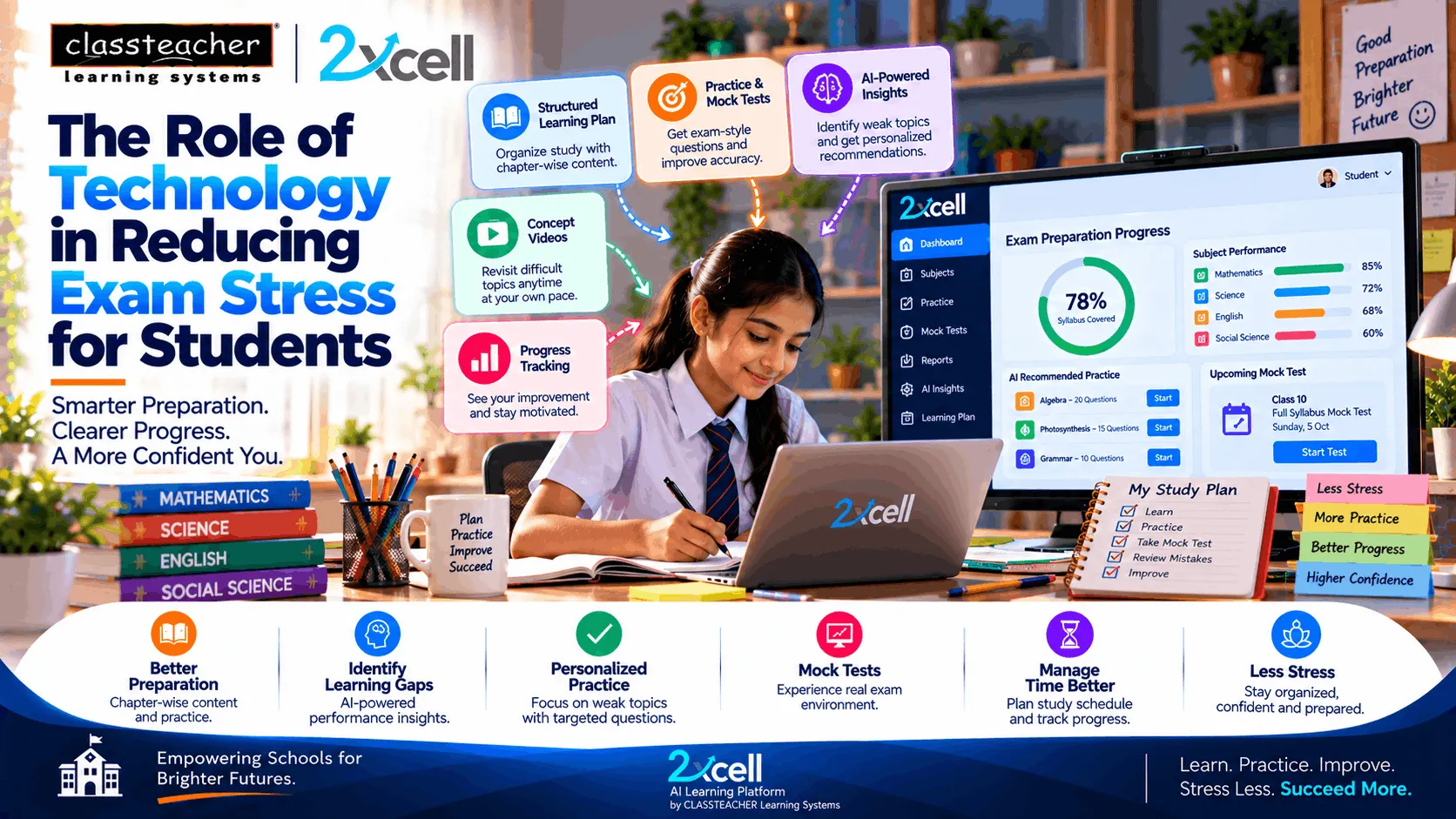
2xcell AI Learning Platform by CLASSTEACHER Learning Systems can support a connected digital learning environment that brings together learning content, practice, assessments, analytics, and personalized learning.
For examination preparation, a connected journey can follow:
Learn → Practise → Assess → Analyse → Revise → Improve
Students can use digital learning resources to revisit concepts, practise questions, complete assessments, and understand areas requiring additional preparation.
Teachers can use performance information to identify students or topics that may need additional support.
The objective is not simply to provide more practice.
It is to make preparation more structured, focused, and informed.
What Schools Should Consider When Using Technology for Exam Preparation
Technology should be implemented thoughtfully.
Schools can consider:
Curriculum Alignment
Does the digital content match the school's curriculum?
Quality of Content
Are the explanations accurate and age-appropriate?
Ease of Use
Can students and teachers use the platform without unnecessary complexity?
Meaningful Analytics
Does the data actually help teachers and students make decisions?
Personalized Learning
Can students receive support based on their learning requirements?
Assessment Variety
Does the system support different types of practice and assessments?
Teacher Involvement
Can teachers review and interpret student performance?
Data Privacy
Are student records and learning information handled responsibly?
Avoiding Technology-Related Exam Pressure
Technology should reduce uncertainty, not create additional pressure.
Schools should avoid turning every digital activity into another performance metric.
Students do not need endless dashboards, notifications, or assessments.
The focus should remain on:
Clarity + Practice + Feedback + Support
Technology is most useful when it helps students understand:
What have I learned?
What do I need to improve?
What should I practise next?
The Future of Technology-Enabled Exam Preparation
As AI, digital assessments, learning analytics, and personalized learning continue to develop, examination preparation may become increasingly data-informed.
Future learning environments may connect:
Digital Content + AI + Practice + Mock Tests + Feedback + Analytics
A student could complete a practice test, receive performance insights, revisit weak concepts, complete targeted practice, and attempt another assessment.
This creates a continuous improvement loop:
Assess → Understand → Practise → Improve → Reassess
The goal should not be to make students study constantly.
It should be to help them prepare more effectively and with greater clarity.
Conclusion
Technology can play an important role in helping schools create more organized and supportive examination preparation environments.
Digital content can help students revisit concepts. Practice platforms can provide additional opportunities to apply knowledge. Mock tests can simulate examination conditions. Analytics can highlight learning gaps, while AI can support more personalized learning pathways.
At the same time, technology should not become another source of academic pressure.
Teachers remain essential for interpretation, guidance, motivation, and individual support.
With 2xcell AI Learning Platform by CLASSTEACHER Learning Systems, schools can explore a connected approach to digital learning, practice, assessment, analytics, and personalized education.
The objective is simple:
Prepare Better. Understand More. Practise Smarter. Stress Less.
2xcell AI Learning Platform
By CLASSTEACHER Learning Systems
Empowering Education with AI & Innovation.