Introduction
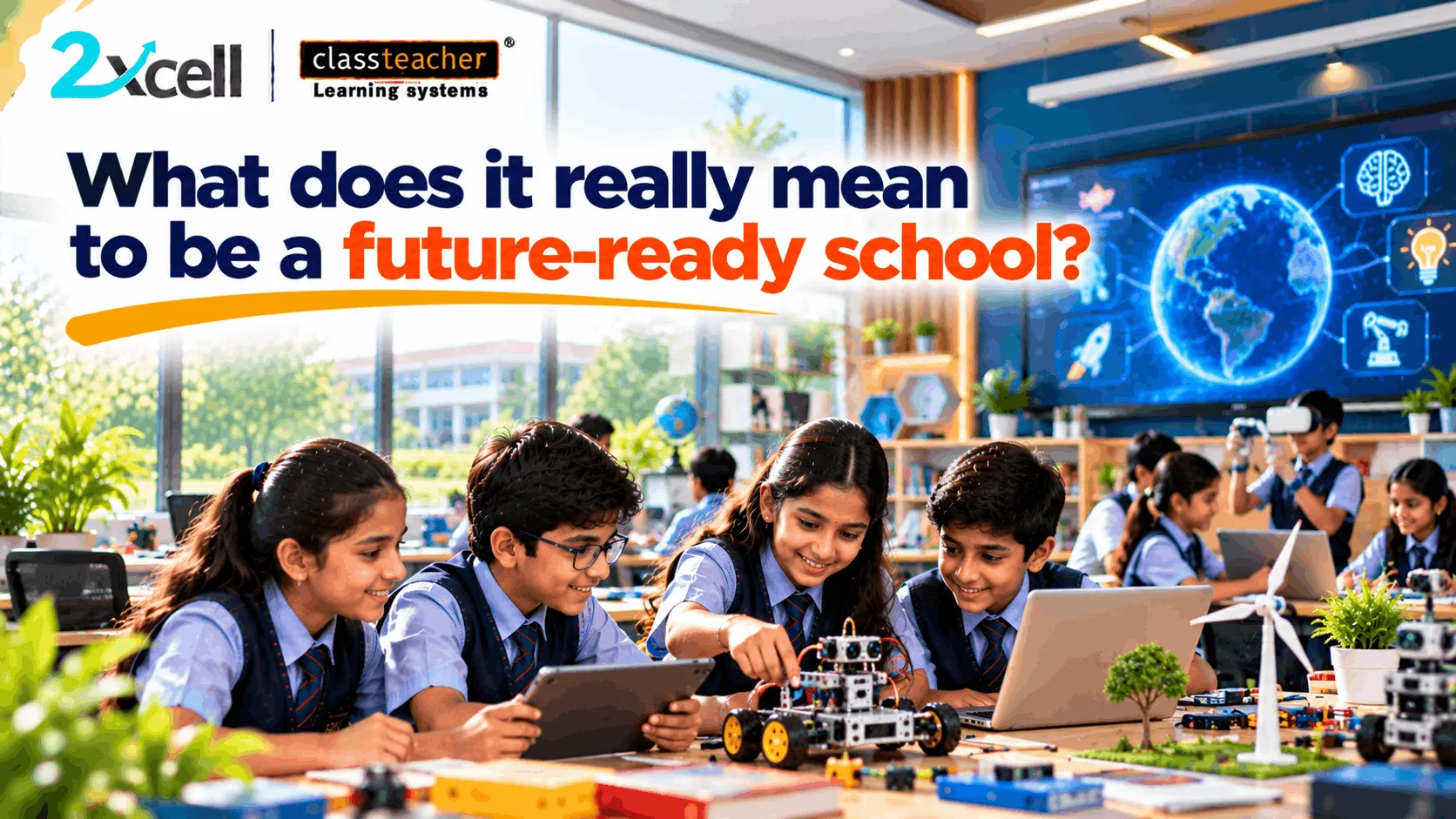
The meaning of a future-ready school goes far beyond installing digital screens, introducing new devices, or adopting the latest educational technology. It is about preparing students with the knowledge, skills, and mindset they need to navigate a world that continues to change.
As technology evolves and the nature of work and communication shifts, schools must consider how their teaching approaches can help students become adaptable, thoughtful, and confident learners.
A future-ready school combines strong academic foundations with opportunities to think critically, explore practical problems, understand digital technologies, and develop skills that extend beyond textbooks.
However, there is no single model that works for every institution. Each school has its own curriculum, infrastructure, teaching practices, student needs, and development priorities.
The journey towards becoming future-ready begins by understanding what students need and creating a realistic plan to support those needs.
1. Strong Academic Foundations Remain Essential
Preparing students for the future does not mean moving away from traditional academic learning. Reading, writing, mathematics, science, and subject knowledge continue to provide the foundation for higher-level thinking and practical application.
Students need a sound understanding of fundamental concepts before they can apply those concepts to unfamiliar situations.
For example, a student studying mathematics should not only learn how to solve a particular type of equation but also understand when and why that method is useful.
Similarly, science education should help students understand principles and relationships that can be explored through experiments and real-world observations.
Schools can strengthen academic foundations by:
- Connecting lessons with clearly defined learning objectives.
- Identifying gaps in understanding before introducing advanced concepts.
- Providing meaningful opportunities for practice and revision.
- Encouraging students to explain their reasoning.
- Using assessments to guide further teaching.
A future-ready school does not replace foundational learning with technology. It looks for effective ways to make foundational knowledge more meaningful and applicable.
2. Critical Thinking Helps Students Navigate Complexity
Students increasingly encounter large amounts of information through digital platforms, online resources, and AI-powered tools. Access to information alone does not guarantee that they can interpret it correctly.
Critical thinking helps students evaluate claims, compare evidence, recognise assumptions, and reach reasoned conclusions.
Schools can encourage these abilities by designing lessons that require more than memorisation.
For example, students could compare two explanations of an environmental issue, examine the evidence supporting each, and present a conclusion based on their findings.
Teachers can also ask students to explain why they selected a particular answer, identify alternative solutions, or challenge an assumption respectfully.
These activities encourage learners to become active thinkers rather than simply accepting information as presented.
A future-ready learning environment gives students regular opportunities to ask questions, examine evidence, and justify their decisions.
3. Creativity Turns Knowledge Into New Possibilities
Creativity is not limited to drawing, music, or other artistic activities. It also involves generating ideas, exploring alternatives, designing solutions, and improving existing approaches.
Students can develop creativity when they are encouraged to approach problems in different ways instead of following only one prescribed method.
For example, a classroom design challenge could ask students to develop a model that uses limited materials to solve a practical problem.
Different groups may create different solutions, each with its own strengths and limitations.
Teachers can encourage this process by giving students room to experiment, explain their ideas, and revise their work after receiving feedback.
Schools can support creative thinking through:
- Open-ended projects.
- Design and construction activities.
- Collaborative assignments.
- Research and presentation tasks.
- Opportunities to test and improve ideas.
The objective is to help students understand that learning can involve exploring possibilities, making informed choices, and developing original solutions.
4. Practical Exploration Connects Concepts With Real Life
Students often understand a concept more deeply when they have opportunities to observe, test, construct, or apply it.
Practical learning can help bridge the gap between theoretical explanations and real-world situations.
Depending on the subject and available resources, activities may include scientific experiments, robotics projects, coding challenges, model construction, design tasks, and investigations using everyday materials.
Consider a lesson about renewable energy. Students could explore how a small solar-powered model works, observe the relationship between light and energy output, and discuss the factors that affect its performance.
The activity gives students a practical context in which to examine scientific concepts.
Schools do not need to make every lesson hands-on. Instead, they can identify topics where practical activities offer clear educational value and plan them accordingly.
A future-ready school creates opportunities for students to move from understanding an idea to applying it.
5. Digital and AI Literacy Are Becoming Important Learning Priorities
Digital tools and artificial intelligence are influencing how people find information, communicate, create content, and complete tasks.
Students therefore need more than the ability to operate devices. They should learn how to evaluate digital information, protect personal data, recognise limitations, and use technology responsibly.
Digital and AI literacy can include:
- Understanding basic digital tools and their appropriate uses.
- Checking information against reliable sources.
- Recognising that AI-generated answers may contain mistakes.
- Protecting passwords and personal information.
- Understanding responsible and ethical technology use.
- Using digital resources to investigate and solve problems.
For example, students could compare an AI-generated explanation with a textbook and identify which claims need verification.
This encourages them to question information rather than accept every digital response automatically.
Schools should introduce these topics according to students' age, readiness, curriculum, and applicable policies. The focus should remain on building understanding and responsible judgement, not simply introducing more tools.
6. Teachers Need the Confidence and Support to Lead Change
Teachers play a central role in helping students develop future-ready skills. They select learning activities, explain concepts, guide discussions, assess understanding, and provide support when students encounter difficulties.
Technology can complement these responsibilities, but successful implementation depends on how teachers use it.
Introducing a new platform or classroom device without adequate preparation can create additional work and limit its usefulness.
Schools should therefore consider teacher readiness alongside decisions about technology and infrastructure.
Support may include:
- Practical training on relevant educational tools.
- Opportunities to practise before classroom implementation.
- Curriculum-aligned teaching resources.
- Access to technical assistance.
- Time to share experiences and collaborate with colleagues.
- Regular feedback about implementation challenges.
Teachers should also be involved in decisions about technology because they understand the everyday realities of classroom teaching.
A future-ready school invests in the people who make learning possible, not only in the equipment used to support it.
7. Personalised Support Can Help Address Different Learning Needs
Students do not all learn at the same pace or encounter the same difficulties. Some may need additional explanation of foundational concepts, while others may benefit from more challenging activities.
A future-ready learning environment recognises these differences and gives teachers ways to respond appropriately.
This does not require a completely separate lesson for every student. Teachers can use flexible grouping, differentiated tasks, targeted revision, and additional practice to support varied learning needs.
Where suitable digital tools are available, assessment information may also help teachers identify patterns in student performance.
For example, if several students struggle with the same mathematical concept, the teacher can revisit the topic before moving forward.
Technology should support these instructional decisions rather than determine them automatically.
The goal is to help students progress while ensuring that additional support remains connected to meaningful learning objectives.
8. Collaboration Prepares Students to Work With Others
Many real-world challenges require people to share knowledge, communicate clearly, and coordinate their efforts.
Collaborative learning gives students opportunities to practise these skills in a structured environment.
Group projects can require learners to divide responsibilities, discuss competing ideas, resolve disagreements, and combine their contributions into a final result.
For example, a group designing a simple robotic model might need to coordinate construction, programming, testing, and presentation.
Each student can contribute different skills while learning how the parts of a project fit together.
Teachers can strengthen collaboration by assigning clear responsibilities, encouraging respectful discussion, and assessing both individual understanding and group outcomes.
The purpose is not simply to place students in groups. It is to help them learn how to work productively with others.
9. Emotional Well-Being and Adaptability Also Matter
Preparing students for the future involves more than academic achievement and technical knowledge.
Students also benefit from developing resilience, self-awareness, communication skills, and the ability to respond constructively to change.
When students encounter a difficult assignment or an unsuccessful project, teachers can help them reflect on what happened, identify possible improvements, and decide what to try next.
This approach encourages students to see challenges as opportunities to learn rather than as evidence that they cannot succeed.
Schools can support these abilities by creating environments where students feel comfortable asking questions, receiving feedback, and learning from mistakes.
Adaptability is particularly important because students may encounter technologies, expectations, and challenges that are difficult to predict today.
A supportive learning environment can help them develop the confidence to continue learning as circumstances change.
10. How Schools Can Evaluate Their Readiness for the Future
Becoming future-ready does not require every school to make every change at once. A more practical approach is to assess existing strengths, identify priorities, and plan improvements in manageable stages.
School leaders can begin by examining five areas.
Academic Learning
Are students developing strong foundational knowledge and receiving appropriate support when they struggle?
Skills Development
Do students have opportunities to practise critical thinking, creativity, communication, and problem-solving?
Practical Learning
Can students apply concepts through suitable projects, experiments, and activities?
Digital and AI Literacy
Are students learning to use digital resources responsibly and evaluate information critically?
Teacher Readiness
Do teachers have the training, resources, time, and support required to implement planned changes?
The results can help school leaders identify which areas require immediate attention and which can be developed over time.
11. A Practical Roadmap for Becoming Future-Ready
Schools can use a structured process to move from broad aspirations to practical implementation.
Step 1: Understand Student Needs
Review academic performance, classroom observations, teacher feedback, and existing learning challenges.
Step 2: Identify Priorities
Select a manageable number of areas where improvement would offer clear educational value.
Step 3: Set Measurable Objectives
Define what the school wants to improve and how progress will be evaluated.
Step 4: Prepare Teachers
Provide relevant professional development, resources, and implementation support.
Step 5: Introduce Suitable Activities and Tools
Choose approaches that align with the curriculum, available infrastructure, and intended learning outcomes.
Step 6: Review Progress
Collect feedback, assess student learning, and examine whether the chosen approach is meeting its objectives.
Step 7: Refine the Plan
Use the findings to adjust activities, provide additional support, and establish the next priorities.
This approach allows schools to develop their capabilities without assuming that a single investment can solve every challenge.
12. How Educational Technology Can Support Future-Ready Learning
Educational technology can help schools deliver digital content, facilitate interactive activities, support assessment, and provide access to additional learning resources.
However, its value depends on the purpose for which it is introduced and how it fits into the wider teaching strategy.
CLASSTEACHER Learning Systems offers education-focused solutions that schools can evaluate as part of their digital learning and skills-development plans.
The 2xcell AI Learning Platform by CLASSTEACHER Learning Systems may also be considered according to its available features and the school's requirements.
When evaluating any platform or classroom solution, school leaders should consider curriculum relevance, teacher training, student needs, practical implementation, and how the results will be reviewed.
Technology should contribute to the school's educational objectives rather than become an objective in itself.
The most effective approach combines appropriate resources with thoughtful teaching, practical experiences, and ongoing evaluation.
Conclusion
A future-ready school is not defined by the number of devices in its classrooms or the novelty of its technology. It is defined by how effectively it prepares students to understand, question, create, collaborate, and adapt.
Strong academic foundations remain essential, while critical thinking, creativity, practical exploration, digital and AI literacy, and teacher support help extend learning beyond memorisation.
Every school will have different priorities and resources. The most useful starting point is to understand the needs of students and teachers, identify realistic goals, and build a plan that can be reviewed and improved over time.
By connecting educational purpose with thoughtful implementation, schools can create learning environments that help students develop the knowledge, skills, and confidence they need for a changing world.
A future-ready school does not simply prepare students for what comes next. It helps them become ready to keep learning.