Introduction
Academic performance is no longer something schools need to understand only after a term-end examination.
Modern schools manage multiple classrooms, subjects, grade levels, assessments, assignments, learning activities, and student support requirements. With so much academic information being generated, relying only on report cards or examination marks can make it difficult to see the complete learning picture.
This is where academic monitoring tools can make a difference.
Academic monitoring tools help schools organize and review information related to student performance, attendance, assessments, practice, learning progress, and areas requiring additional support.
Instead of asking only:
“What marks did the student get?”
schools can begin asking:
“What is the student learning, where are the gaps, what is improving, and what support is needed next?”
A modern academic monitoring approach can follow:
Collect → Understand → Identify → Support → Track → Improve
What Are Academic Monitoring Tools?
Academic monitoring tools are digital systems designed to help schools track and understand student learning and academic performance.
Depending on the platform, these tools can bring together information such as:
- Assessment results
- Subject-wise performance
- Topic-level progress
- Practice activity
- Assignment performance
- Learning gaps
- Progress trends
- Student participation
- Intervention records
- Academic reports
The purpose is not simply to collect more data.
The purpose is to turn relevant academic information into something that teachers, coordinators, school leaders, and parents can understand and use.
Why Traditional Academic Tracking May Not Be Enough
Traditional academic monitoring often depends on:
- Examination marks
- Report cards
- Homework
- Worksheets
- Teacher observations
- Periodic assessments
These remain valuable sources of information.
However, they may provide only occasional snapshots of student performance.
For example, a student scoring 70% in an examination tells the school how the student performed in that particular assessment.
It may not immediately explain:
- Which topics were difficult
- Which concepts were mastered
- Whether performance is improving
- Which mistakes are repeated
- Whether additional practice is helping
Digital monitoring can add more context to these observations.
1. Academic Monitoring Helps Schools Track Progress Continuously
Student learning develops over time.
A single examination cannot always represent the complete learning journey.
Academic monitoring tools can help schools observe performance across multiple learning activities.
For example:
Assessment 1 → Practice → Assessment 2 → Intervention → Assessment 3
This makes it easier to observe changes over time.
Instead of viewing academic performance as isolated marks, schools can look at the overall progression.
2. Topic-Wise Monitoring Can Reveal Learning Gaps
Overall subject marks can sometimes hide specific difficulties.
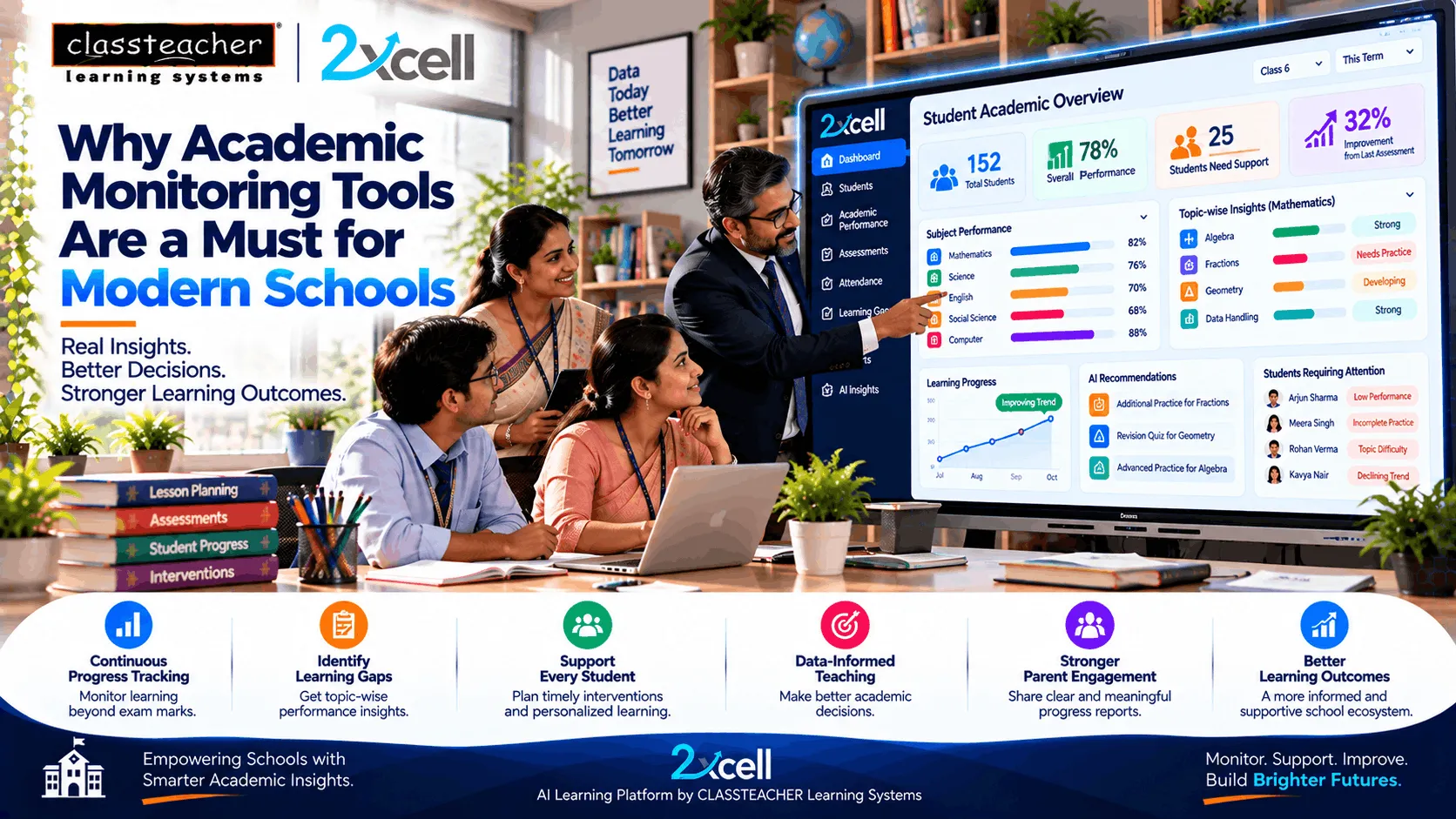
Imagine a student receives 74% in Mathematics.
A detailed academic report could show:
- Algebra — Strong
- Geometry — Developing
- Fractions — Needs Practice
- Data Handling — Strong
This provides more useful information than the overall percentage alone.
Teachers can then focus on the particular concepts that require attention.
3. Teachers Can Identify Students Who Need Additional Support
Not every student requires the same type of academic support.
Monitoring tools can help teachers identify patterns such as:
- Repeated low performance
- Declining results
- Difficulty with specific topics
- Incomplete practice
- Repeated mistakes
- Slow progress
Teachers can then decide whether a student requires:
- Additional explanation
- Remedial practice
- Revision
- One-to-one support
- Alternative learning resources
The technology provides information; the teacher decides the appropriate response.
4. Academic Monitoring Supports Data-Informed Teaching
Teachers already use their classroom experience and professional judgement to understand students.
Academic monitoring tools can add another layer of information.
For example:
Teacher Observation + Assessment Data + Practice Results + Progress Trends
Together, these can provide a broader view of student learning.
This can help teachers make more informed decisions about what to teach next and which concepts may require reinforcement.
5. Schools Can Monitor the Effectiveness of Interventions
Identifying a learning gap is only the beginning.
Schools also need to understand whether the support provided is helping.
A monitoring cycle can look like:
Identify Gap → Intervention → Practice → Reassessment → Compare Results
For example:
Initial Score: 56%
Additional Practice: Completed
Follow-up Assessment: 68%
The improvement provides useful information about the student's progress.
If the difficulty continues, teachers can consider a different support strategy.
6. Academic Monitoring Can Help Teachers Plan Better Lessons
Student performance from one lesson or assessment can influence what happens next.
For example:
Topic Assessment → Performance Review → Identify Weak Concept → Plan Revision Lesson
This creates a feedback loop between assessment and lesson planning.
Teachers can use available information to decide whether to:
- Continue to the next topic
- Re-explain a concept
- Provide additional examples
- Assign more practice
- Conduct a revision activity
7. School Leaders Can Get a Broader Academic View
Academic monitoring is useful not only at the individual student level.
School leaders may need to understand performance across:
- Grades
- Sections
- Subjects
- Teachers
- Assessments
- Academic periods
A centralized monitoring system can help present this information in an organized format.
This can support academic discussions and planning without requiring school leaders to manually combine information from multiple sources.
8. Monitoring Can Help Identify Subject-Level Trends
Sometimes an issue may not be limited to one student.
Suppose multiple students in a particular grade show low performance in the same topic.
This could indicate that the school needs to examine:
- Content difficulty
- Teaching approach
- Practice opportunities
- Assessment design
- Available learning resources
Academic monitoring can help identify such patterns earlier.
9. Parents Can Gain Better Visibility Into Learning
Parents often receive information through report cards, examination results, homework, and teacher meetings.
Academic monitoring tools can potentially provide additional visibility into:
- Current progress
- Topic-wise performance
- Practice activity
- Learning strengths
- Areas requiring attention
- Improvement over time
This can help shift conversations from simply discussing marks to discussing learning.
For example:
Instead of:
“Your child scored 65%.”
the conversation can become:
“Your child is performing well in algebra but needs additional practice with fractions.”
This is more specific and actionable.
10. Academic Monitoring Can Support Personalized Learning
Students do not always progress at the same pace.
One student may understand a topic quickly, while another may require additional examples and practice.
Monitoring tools can help identify these differences.
A personalized learning cycle can follow:
Assess → Analyse → Recommend → Practise → Reassess
This allows schools to provide learning support based on observed requirements rather than assuming that every student needs exactly the same intervention.
11. AI Can Add Another Layer of Academic Analysis
As schools adopt AI-enabled learning platforms, academic monitoring can become more intelligent.
AI can help analyse patterns across learning data and highlight areas that may require attention.
For example:
Performance Data → Pattern Identification → Learning Insight → Recommended Focus
Possible areas may include:
- Repeated mistakes
- Weak topics
- Changing performance
- Practice requirements
- Progress patterns
AI should not make final academic decisions independently.
Its role can be to help organize information and surface useful patterns for teachers and schools.
12. Monitoring Tools Can Support Early Academic Intervention
Waiting until final examinations to identify difficulties can limit the time available for intervention.
Continuous monitoring can help schools identify concerns earlier.
For example:
September: Topic difficulty identified
October: Additional practice
November: Progress reviewed
December: Support adjusted
This gives teachers more opportunities to support students during the learning process.
13. Academic Monitoring Can Reduce Manual Reporting Work
Schools often need to prepare academic reports for:
- Teachers
- Coordinators
- Principals
- School management
- Parents
When information is collected digitally, reporting can become more organized.
Instead of manually compiling information from different sources, schools can work with structured academic data.
This can save administrative effort and allow staff to spend more time reviewing the information itself.
14. Monitoring Can Connect Assessment With Action
Assessment becomes more useful when it leads to a clear next step.
A simple model is:
Assess → Understand → Act
For example:
Assessment: Students struggle with a topic
Insight: Concept-level performance is low
Action: Teacher provides targeted practice
Follow-up: Students complete another assessment
This makes assessment part of an ongoing improvement process.
15. Academic Monitoring Can Support Different Learning Levels
A classroom may contain students with different levels of understanding.
Monitoring information can help teachers divide support according to need.
Students Requiring Additional Support
Foundational explanation and additional practice.
Students at Expected Level
Regular learning and assessment.
Students Progressing Faster
Advanced activities and application-based tasks.
This can make classroom support more targeted.
16. Monitoring Tools Can Help Schools Move Beyond Marks
Marks remain important, but they are only one part of academic performance.
Modern academic monitoring can also consider:
- Concept mastery
- Practice
- Progress
- Participation
- Assessment patterns
- Learning gaps
- Improvement
This creates a more complete academic picture.
The question changes from:
“What did the student score?”
to:
“What does the student's learning data tell us?”
17. Academic Monitoring Can Improve Parent-Teacher Conversations
Parent-teacher meetings become more useful when discussions are based on specific information.
Instead of discussing general performance, teachers and parents can discuss:
- Strong subjects
- Difficult concepts
- Practice requirements
- Recent improvement
- Recommended support
- Learning goals
This can create a stronger connection between school-based teaching and support at home.
18. Monitoring Can Help Schools Set Academic Goals
Schools can use academic information to establish measurable learning objectives.
For example:
Current Performance → Target → Intervention → Progress Review
Goals can be established at different levels:
- Student
- Class
- Subject
- Grade
- School
The purpose should be to support learning improvement rather than simply increase the number of metrics being tracked.
19. Academic Monitoring Supports a Connected Learning Ecosystem
Modern schools increasingly use multiple digital tools.
A connected academic ecosystem can bring together:
Content → Practice → Assessment → Analytics → Intervention → Progress
This makes it easier to connect classroom activities with academic monitoring.
Teachers can teach.
Students can practise.
Assessments can measure understanding.
Analytics can organize the results.
Teachers can then decide what happens next.
20. How 2xcell Supports Academic Monitoring
2xcell AI Learning Platform by CLASSTEACHER Learning Systems can support a connected digital learning environment involving:
- Digital learning content
- Practice
- Assessments
- Analytics
- Personalized learning
- Student progress tracking
A school can use a connected learning cycle such as:
Learn → Practise → Assess → Analyse → Support → Improve
This approach can help schools move from isolated academic activities towards a more connected learning process.
The objective is not simply to generate reports.
It is to help teachers and schools understand those reports and use relevant insights to support students.
What Schools Should Look for in Academic Monitoring Tools
Before adopting an academic monitoring solution, schools can consider several factors.
1. Ease of Use
Can teachers access important information without unnecessary complexity?
2. Curriculum Alignment
Does the platform connect with the school's academic structure?
3. Detailed Insights
Can schools view performance beyond overall marks?
4. Progress Tracking
Can performance be compared across relevant learning periods?
5. Assessment Integration
Can assessment information connect with other learning activities?
6. Personalization
Can the platform support different student learning requirements?
7. Reporting
Can useful reports be generated for teachers, school leaders, and parents?
8. Data Security
Are student records protected through appropriate security practices?
9. Scalability
Can the system support the school's future digital learning requirements?
Avoiding Data Overload
More data does not automatically mean better academic decisions.
If teachers receive hundreds of charts, numbers, and notifications without clear priorities, monitoring can become difficult.
Useful academic monitoring should focus on:
Relevant Data → Clear Insight → Practical Action
A teacher should be able to understand:
What is happening?
Why might it be happening?
Which students or topics require attention?
What can be done next?
This makes academic monitoring more meaningful.
Technology Should Support Teachers
Academic monitoring tools should not replace teacher judgement.
A digital system may identify that a student has declining performance.
But the teacher may know that the reason could involve:
- A conceptual difficulty
- Lack of practice
- Language challenges
- Classroom circumstances
- A change in learning pace
Therefore:
Technology Shows the Pattern → Teacher Provides Context → School Plans Support
The teacher remains at the centre of the academic process.
The Future of Academic Monitoring
Academic monitoring is likely to become increasingly connected with AI, digital learning, assessments, and personalized education.
A future academic ecosystem could look like:
Digital Learning
↓
Practice
↓
Assessment
↓
AI-Assisted Analysis
↓
Teacher Review
↓
Targeted Intervention
↓
Progress Tracking
This can help schools move towards a continuous academic improvement cycle.
The goal is not to monitor students constantly.
It is to provide the right information at the right time so that teachers can provide the right support.
Conclusion
Academic monitoring tools are becoming increasingly relevant for modern schools because education now generates more learning information than ever before.
When organized effectively, this information can help schools understand student progress, identify learning gaps, plan interventions, track improvement, support personalized learning, and improve communication between teachers and parents.
The real value of academic monitoring is not in collecting more data.
It is in turning data into understanding and action.
With 2xcell AI Learning Platform by CLASSTEACHER Learning Systems, schools can explore a connected approach to digital learning, practice, assessment, analytics, personalized learning, and student progress tracking.
The modern academic monitoring cycle can be:
Monitor → Understand → Support → Measure → Improve
When technology and teacher expertise work together, academic monitoring can become a practical tool for supporting better learning outcomes.
2xcell AI Learning Platform
By CLASSTEACHER Learning Systems
Empowering Education with AI & Innovation.