Introduction
Learning is not a one-time event.
A student may understand a concept during a classroom lesson but struggle to remember it later. Another student may perform well in one assessment but face difficulties when the topic becomes more advanced. Some students may require additional practice, while others may need a different explanation or more time to build confidence.
This is why academic support should not stop after a lesson, worksheet, or examination.
Continuous academic support means providing students with ongoing guidance, practice, feedback, revision, assessment, and intervention throughout their learning journey.
Instead of following:
Teach → Test → Move On
schools can create a more supportive cycle:
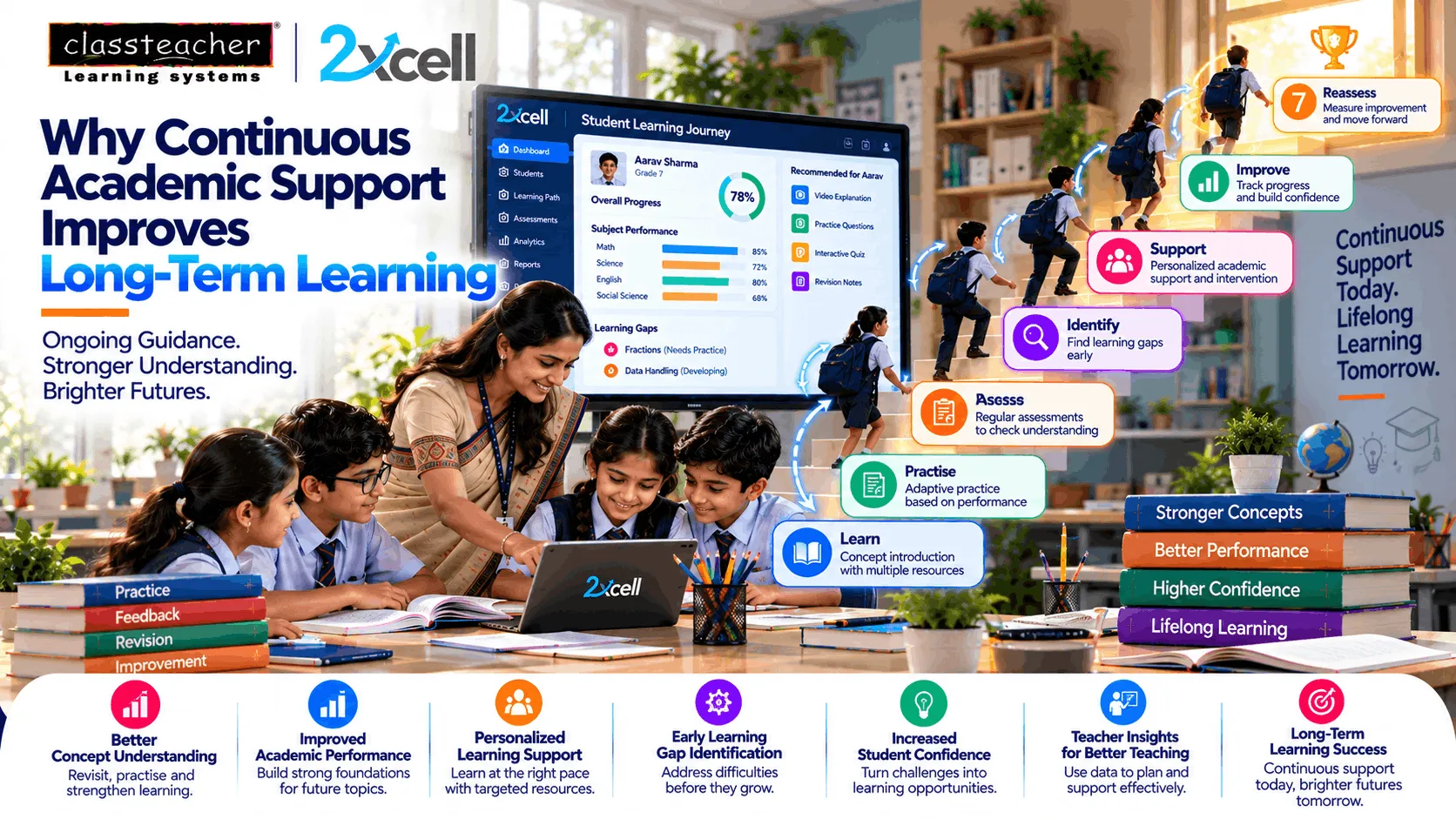
Teach → Practise → Assess → Identify → Support → Improve → Reassess
This approach can help students build stronger foundations and make learning more sustainable over time.
What Is Continuous Academic Support?
Continuous academic support refers to the ongoing assistance provided to students before, during, and after classroom instruction.
It can include:
- Additional explanations
- Practice activities
- Revision resources
- Assessments
- Personalized learning
- Teacher feedback
- Mentoring
- Learning-gap identification
- Remedial support
- Progress tracking
- Targeted intervention
The objective is not to give students more work.
It is to provide the right support at the right stage of learning.
Why One-Time Teaching Is Not Always Enough
A student may listen carefully during a lesson and still have difficulty applying the concept later.
Understanding can develop gradually through:
Explanation → Practice → Mistakes → Feedback → Repetition → Application
For example, a student may understand the basic rules of fractions during a classroom lesson but struggle when those rules are applied to word problems.
Continuous support allows the teacher to identify this difficulty and provide additional practice before the learning gap becomes larger.
1. Continuous Support Strengthens Concept Understanding
Strong learning begins with clear conceptual understanding.
When students receive opportunities to revisit difficult concepts, they can strengthen their foundation.
A learning cycle may look like:
Learn → Review → Practise → Apply
For example, after introducing a science concept, teachers can provide a short revision activity followed by application-based questions.
This gives students multiple opportunities to work with the same concept.
2. Regular Practice Helps Reinforce Learning
Learning improves when students actively use what they have learned.
Practice can help students:
- Recall information
- Apply concepts
- Identify mistakes
- Develop problem-solving skills
- Build confidence
However, practice should be meaningful rather than repetitive for the sake of repetition.
Digital learning platforms can help provide topic-specific practice based on student performance.
3. Continuous Feedback Helps Students Correct Mistakes
A mistake becomes more useful when students understand why it happened.
Regular feedback can help students identify:
- Incorrect answers
- Misunderstood concepts
- Repeated mistakes
- Areas requiring revision
- Skills that need more practice
The process becomes:
Attempt → Feedback → Understand → Correct → Try Again
This can help prevent the same misunderstanding from continuing across future topics.
4. Continuous Support Can Identify Learning Gaps Earlier
Learning gaps can become harder to address when they remain unnoticed for a long period.
For example:
Basic Concept Not Understood
↓
Next Topic Builds on It
↓
Student Faces More Difficulty
↓
Performance Declines
Early academic support can interrupt this pattern.
Teachers can identify areas requiring attention and provide additional support before the gap becomes more significant.
5. Students Can Receive Support According to Their Needs
Every student may not require the same level of support.
One student may need:
Basic Explanation → Guided Practice
Another may need:
Additional Examples → Independent Practice
An advanced learner may benefit from:
Application Questions → Advanced Challenges
Continuous academic support makes it possible to move beyond a one-size-fits-all approach.
6. Continuous Support Encourages Learning at an Appropriate Pace
Classroom schedules often require teachers to move through a curriculum within a specific timeframe.
However, students may understand topics at different speeds.
Digital learning resources can give students opportunities to:
- Rewatch explanations
- Review notes
- Repeat practice
- Attempt additional questions
- Revise difficult concepts
- Explore advanced material
This allows students to spend more time where they need it.
7. Regular Assessment Provides Better Learning Visibility
Assessment should not only happen at the end of a term.
Short quizzes, topic tests, practice assessments, and concept checks can provide ongoing information about student understanding.
For example:
Lesson → Quick Assessment → Analyse → Support → Reassess
This helps teachers understand whether students are ready to move forward.
8. Continuous Support Can Improve Student Confidence
Repeated difficulty can affect a student's confidence.
When students receive appropriate support and see gradual improvement, they may become more comfortable with challenging subjects.
For example:
Difficulty → Support → Practice → Improvement → Confidence
The objective is not to eliminate mistakes.
It is to help students understand that mistakes can become part of the learning process.
9. Academic Intervention Becomes More Targeted
Traditional intervention may involve giving additional work to an entire class.
Learning analytics can help teachers identify specific areas requiring support.
For example:
Student A
Needs help with fractions.
Student B
Needs support with algebraic equations.
Student C
Is performing well and is ready for advanced problems.
This allows intervention to become more focused.
10. Continuous Revision Supports Long-Term Retention
Students can forget concepts that are not revisited regularly.
Short revision activities can help bring previously learned concepts back into focus.
A long-term revision cycle could include:
Learn → Practise → Review → Apply → Revisit
This is especially useful when students prepare for cumulative examinations where earlier concepts remain important.
11. Continuous Support Helps Connect Different Topics
Many academic subjects are structured progressively.
One topic may provide the foundation for another.
For example:
Basic Algebra → Equations → Functions → Advanced Mathematics
If students struggle with the foundation, later topics may become more difficult.
Ongoing academic monitoring can help schools identify whether foundational knowledge is strong enough for future learning.
12. Teachers Can Use Learning Data More Effectively
Continuous support becomes more useful when teachers have access to meaningful information.
Relevant data may include:
- Assessment performance
- Practice results
- Topic-wise performance
- Repeated mistakes
- Progress over time
- Concept mastery
- Learning activity
The goal is not to overwhelm teachers with data.
It is to provide information that supports better academic decisions.
13. Technology Can Extend Support Beyond the Classroom
Academic support does not have to end when the school day finishes.
Digital platforms can provide students with access to:
- Learning content
- Practice questions
- Revision resources
- Assessments
- Explanatory videos
- Personalized recommendations
This can create continuity between classroom learning and independent study.
The model becomes:
Classroom Learning + Digital Support = Connected Learning
14. Parents Can Better Understand Student Progress
Continuous academic support can also provide parents with a clearer picture of learning progress.
Instead of receiving information only through periodic examination results, parents may be able to understand:
- Areas of strength
- Topics requiring attention
- Practice progress
- Assessment performance
- Improvement over time
This can encourage more meaningful conversations about learning.
15. Continuous Support Helps Teachers Adjust Instruction
If assessment results show that many students are struggling with a particular concept, teachers can reconsider how it is being taught.
They may introduce:
- Another explanation
- A visual demonstration
- A practical activity
- Additional examples
- Group discussion
- Targeted practice
This creates a responsive teaching environment.
Student Response → Teacher Insight → Instructional Adjustment
16. Mentoring Can Strengthen Academic Support
Academic support is not limited to subject teaching.
Mentors can help students with:
- Goal setting
- Study planning
- Time management
- Learning habits
- Progress reviews
- Motivation
This creates support beyond individual lessons.
A student may not only need to know what to learn, but also how to organize the learning process.
17. Continuous Support Can Help Students Prepare for Examinations
Exam preparation becomes more manageable when it happens throughout the academic year.
Instead of:
Entire Syllabus → Last-Minute Revision
students can follow:
Learn → Practise → Review → Assess → Improve → Mock Test
This can make preparation more structured and provide opportunities to address weak areas before the final examination.
18. AI Can Help Personalize Ongoing Support
AI-powered learning systems can analyse relevant learning information and recommend appropriate resources.
For example:
Low Performance in Topic
↓
Identify Learning Gap
↓
Recommend Practice
↓
Student Attempts Questions
↓
Analyse Performance
↓
Adjust Learning Support
This creates a more responsive learning pathway.
19. Continuous Support Can Create a Culture of Improvement
When schools consistently monitor learning and provide support, academic improvement can become an ongoing process rather than something that happens only before examinations.
The focus shifts from:
“What marks did the student get?”
to:
“What has the student understood, where is support needed, and what should happen next?”
This can encourage a stronger learning culture.
20. How 2xcell Can Support Continuous Academic Learning
2xcell AI Learning Platform by CLASSTEACHER Learning Systems can support a connected digital learning environment involving:
- Digital learning content
- Practice
- Assessments
- Analytics
- Personalized learning
- Student progress tracking
A connected learning journey can follow:
Learn → Practise → Assess → Analyse → Support → Improve
Relevant learning information can help schools understand student performance and identify areas where additional practice or intervention may be useful.
The objective is to connect different stages of learning instead of treating lessons, practice, assessment, and support as separate activities.
Continuous Support Does Not Mean Constant Testing
An important distinction is that continuous academic support does not mean continuously testing students.
Support can include:
- Discussions
- Activities
- Practice
- Revision
- Projects
- Feedback
- Mentoring
- Concept checks
Assessment is one part of the process, not the entire process.
The goal is:
Understand → Support → Practise → Improve
What Schools Should Consider When Building Continuous Academic Support
Schools can consider several factors when developing an ongoing support system.
Curriculum Alignment
Does the support connect with the curriculum?
Teacher Involvement
Can teachers review and guide the support provided?
Personalization
Can students receive appropriate resources according to their needs?
Assessment
Can schools monitor understanding at relevant stages?
Analytics
Can learning information highlight meaningful patterns?
Accessibility
Can students access resources when they need them?
Parent Communication
Can families understand relevant progress?
Data Responsibility
Are student records handled securely and responsibly?
Building a Continuous Academic Support Cycle
Schools can create a structured process:
Step 1: Teach
Introduce the concept through classroom instruction and learning resources.
Step 2: Practise
Give students opportunities to apply what they learned.
Step 3: Assess
Use appropriate assessments or concept checks.
Step 4: Analyse
Identify strengths, mistakes, and learning gaps.
Step 5: Support
Provide targeted resources, explanations, or intervention.
Step 6: Reassess
Check whether the support has helped.
Step 7: Progress
Move towards the next learning objective.
This creates:
Teach → Practise → Assess → Support → Reassess → Progress
The Future of Continuous Academic Support
As AI, learning analytics, digital content, and personalized education continue to develop, schools may increasingly create learning environments where academic support continues throughout the student's journey.
A future learning ecosystem could connect:
Student Activity
↓
Assessment
↓
AI-Assisted Analysis
↓
Teacher Review
↓
Personalized Support
↓
Practice
↓
Progress Measurement
↓
Next Learning Goal
This creates a continuous feedback loop rather than a series of disconnected academic events.
Conclusion
Long-term learning requires more than a single explanation, assignment, or examination.
Students need opportunities to practise, receive feedback, revisit concepts, correct mistakes, and build upon previous knowledge.
Continuous academic support can help schools identify learning gaps earlier, provide targeted intervention, personalize learning experiences, and track progress over time.
Technology can strengthen this process by connecting digital content, practice, assessment, analytics, and personalized learning.
With 2xcell AI Learning Platform by CLASSTEACHER Learning Systems, schools can explore a connected approach to digital learning, assessment, analytics, personalized learning, and student progress tracking.
The goal is not simply to help students perform better in the next examination.
It is to create a learning environment where students receive the support they need to understand, practise, improve, and continue learning over the long term.
Support Continuously. Learn Deeply. Improve Consistently.
2xcell AI Learning Platform
By CLASSTEACHER Learning Systems
Empowering Education with AI & Innovation.