Introduction
Technology has become an important part of modern school education. Learning Management Systems, digital classrooms, online assessments, AI-powered learning platforms, student portals, communication tools, and analytics systems are helping schools create more connected learning environments.
But as schools become more dependent on digital platforms, another question becomes increasingly important:
How safely is student and school data being handled?
A school EdTech platform may process information related to students, teachers, parents, academic performance, assessments, attendance, learning activities, and institutional operations.
This makes data security more than an IT concern.
It is an important part of creating a trustworthy digital learning environment.
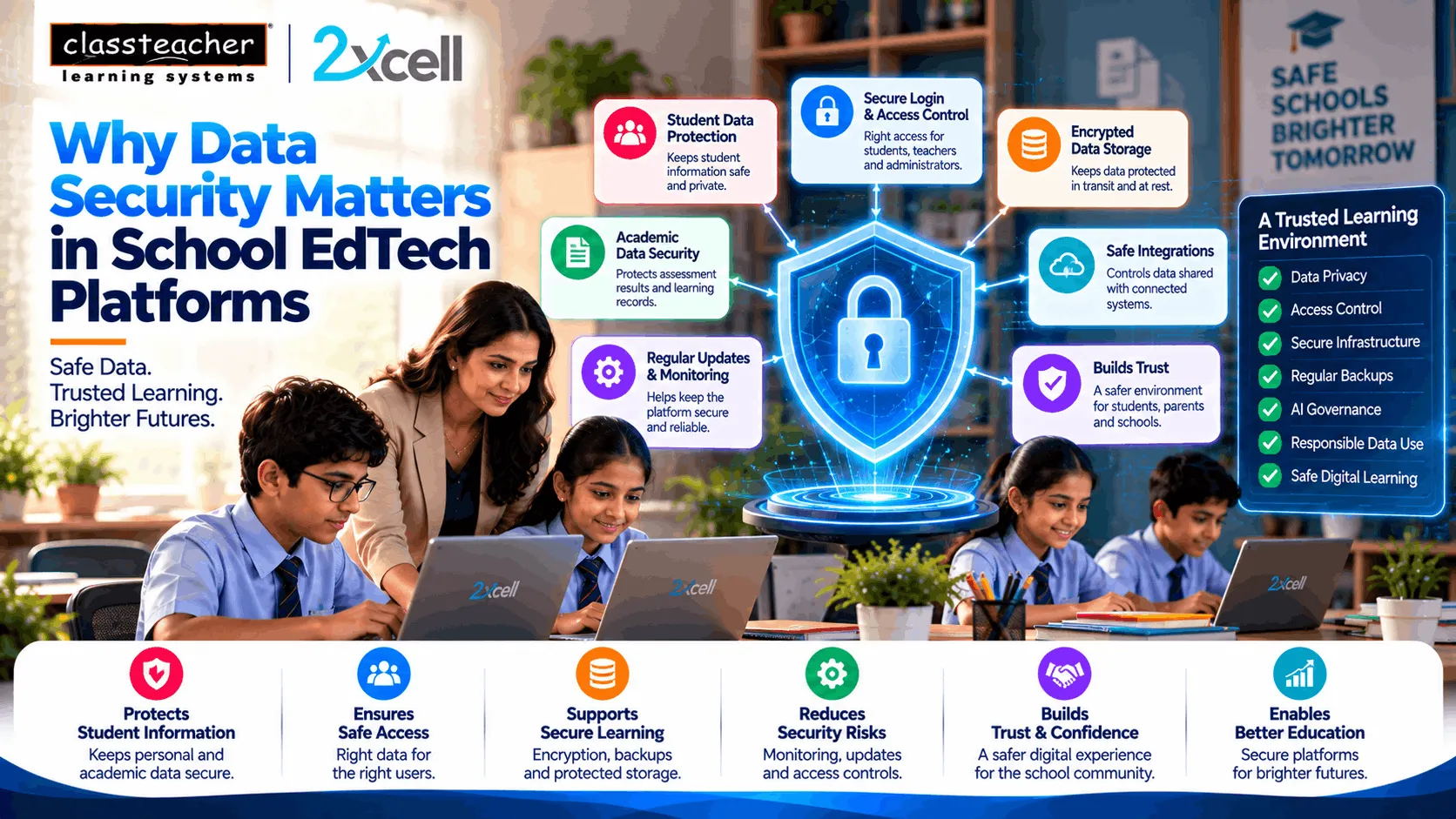
A secure EdTech ecosystem should allow schools to benefit from technology while ensuring that sensitive information is appropriately protected, accessed, stored, and managed.
What Is Data Security in School EdTech?
Data security refers to the practices, technologies, policies, and controls used to protect digital information from unauthorized access, misuse, alteration, loss, or disruption.
Within a school environment, this may involve protecting information such as:
- Student profiles
- Teacher accounts
- Assessment results
- Academic records
- Attendance information
- Assignments
- Learning activity
- School documents
- Parent information
- Login credentials
- Administrative information
The exact information collected depends on the platform and its purpose.
The central objective is simple:
The right information should be accessible to the right person for the right purpose.
Why School Data Requires Special Attention
Educational institutions manage information belonging to multiple groups.
A single digital ecosystem may involve:
Students + Teachers + Parents + School Leaders + Administrators
Each group may require different levels of access.
For example, a student may need access to their own learning activities, while a teacher may need access to relevant classroom performance information.
A school administrator may require broader institutional information.
This makes access management particularly important.
If everyone can access everything, the risk of inappropriate access increases.
1. Student Information Must Be Protected
Students are at the centre of school EdTech platforms.
Their digital profiles may contain academic and personal information that should be handled carefully.
Schools should understand:
- What information is being collected?
- Why is it being collected?
- Who can access it?
- How long is it retained?
- Where is it stored?
- How is it protected?
Clear answers to these questions can help schools establish stronger data-management practices.
2. Academic Data Is Also Sensitive
Data security is not limited to names, phone numbers, or login information.
Academic information can also require protection.
Examples include:
- Examination results
- Quiz scores
- Learning gaps
- Performance reports
- Teacher comments
- Assessment history
- Progress records
- Personalized learning information
This information can provide a detailed picture of a student's academic journey.
Therefore, access to academic data should be appropriately controlled.
3. Strong Authentication Helps Prevent Unauthorized Access
A secure platform needs to establish that users are actually who they claim to be.
Authentication mechanisms can include:
- Strong passwords
- Multi-factor authentication
- Secure login systems
- Account verification
- Session management
- Password recovery controls
Schools should also encourage users to follow basic account-security practices.
Technology alone cannot protect an account if users routinely share credentials or use weak passwords.
4. Role-Based Access Can Reduce Unnecessary Exposure
Not every user needs access to every piece of information.
Role-based access can help create different permissions for different users.
For example:
Student
Access to personal learning activities and relevant academic information.
Teacher
Access to assigned classes, assessments, and appropriate student performance information.
Parent
Access to information related to their child, where applicable.
School Administrator
Access to broader institutional functions according to their responsibilities.
This principle can be summarized as:
Access According to Responsibility.
5. Data Encryption Adds Another Layer of Protection
Encryption can help protect information by converting readable data into a protected format.
Secure systems commonly use encryption for data:
In Transit
When information moves between a user's device and the platform.
At Rest
When information is stored within systems or databases.
The specific encryption technologies and implementation should be evaluated by the school's IT and security teams according to the platform architecture.
6. Secure Data Storage Matters
Schools should understand how and where their EdTech data is stored.
Important questions include:
- What type of infrastructure is being used?
- How is stored data protected?
- Are backups maintained?
- How are backups secured?
- Who can access the storage environment?
- How is data deleted when it is no longer required?
A platform should have clear policies around data storage and retention.
7. Regular Backups Can Protect Against Data Loss
Data security also includes availability.
Imagine a school losing important academic information because of a system failure.
Regular and appropriately protected backups can help reduce the impact of such incidents.
A school should understand:
What is backed up?
How frequently is it backed up?
Where are backups stored?
Who can restore them?
How is backup access protected?
A backup strategy should also be tested periodically rather than simply assumed to work.
8. Software Updates Are an Important Security Practice
Technology changes continuously.
Security weaknesses may be discovered in software, libraries, operating systems, or infrastructure.
Keeping systems updated can help organizations address known vulnerabilities.
For EdTech platforms, schools and technology providers should have processes for:
- Security updates
- Vulnerability management
- Software maintenance
- Dependency updates
- Security testing
Security should be treated as an ongoing process rather than a one-time setup.
9. Schools Should Understand Third-Party Integrations
Modern EdTech platforms often connect with other systems.
For example:
LMS → Assessment Tool → Analytics → Communication Platform
Integrations can improve functionality, but they also create additional points where information may move between systems.
Before enabling an integration, schools should understand:
- What data is shared?
- Why is it shared?
- Which system receives it?
- Who controls the data?
- What security measures are used?
- Can the integration be disabled?
Every additional connection should be evaluated carefully.
10. AI Makes Data Governance Even More Important
AI-powered education platforms can analyse learning information to provide insights, recommendations, or personalized learning experiences.
This creates additional questions around data governance.
Schools should understand:
- What information is used by AI systems?
- What is the purpose of processing?
- Where is the information processed?
- Who can access AI-generated insights?
- How long is information retained?
- What controls exist around AI-generated recommendations?
AI should be introduced with appropriate governance rather than treating data as an unlimited resource.
Data Security and Student Privacy Are Connected
Data security and privacy are closely related, but they are not exactly the same.
Data Security focuses heavily on protecting information from unauthorized access, loss, alteration, or disruption.
Data Privacy focuses on how information is collected, used, shared, retained, and managed.
A school needs to consider both.
A technically secure system can still create privacy concerns if information is collected or used without appropriate purpose, transparency, or controls.
The Importance of Data Minimization
More data does not automatically create better education.
If a platform does not need a particular piece of information to provide its service, schools should question whether collecting it is necessary.
A useful principle is:
Collect What Is Needed. Protect What Is Collected.
Reducing unnecessary data collection can also reduce the amount of information that needs to be protected.
Transparency Builds Trust
Schools should be able to explain to relevant stakeholders how their digital platforms handle information.
Clear communication can address questions such as:
- What information is collected?
- Why is it collected?
- How is it used?
- Who can access it?
- How is it protected?
- How long is it retained?
Transparency can help students, parents, teachers, and school leaders better understand the digital environment they are using.
Teachers Also Play a Role in Data Security
Security is not only the responsibility of the technology provider or IT department.
Teachers interact with student information every day.
They can contribute to safer digital practices by:
- Protecting login credentials
- Avoiding unnecessary sharing of student information
- Using approved school platforms
- Locking devices when unattended
- Being careful with downloadable files
- Reporting suspicious activity
- Following school data policies
Small everyday practices can contribute to a stronger security culture.
Students Need Digital Security Awareness Too
Students increasingly use digital platforms for learning.
Schools can introduce age-appropriate digital safety education covering topics such as:
- Password security
- Phishing awareness
- Safe browsing
- Account protection
- Responsible sharing
- Privacy awareness
- Suspicious links and messages
Teaching students how to protect themselves digitally can become part of broader digital literacy.
What Happens When Data Security Is Ignored?
Weak data protection can create several risks.
These may include:
Unauthorized Access
Someone gains access to information they should not see.
Data Loss
Important academic or administrative information becomes unavailable.
Data Manipulation
Information is changed without authorization.
Account Compromise
User accounts are taken over.
Operational Disruption
A school may temporarily lose access to important digital services.
Loss of Trust
Security incidents can affect confidence among students, parents, teachers, and school leadership.
This is why security needs to be considered before a problem occurs.
A Secure EdTech Platform Needs Multiple Layers
Data security should not depend on a single feature.
A stronger approach can involve multiple layers:
Secure Authentication
↓
Role-Based Access
↓
Encryption
↓
Protected Infrastructure
↓
Monitoring
↓
Backups
↓
Security Updates
↓
Incident Response
↓
User Awareness
This layered approach helps reduce dependence on one security mechanism.
How Schools Can Evaluate an EdTech Platform
Before adopting a digital learning platform, schools can ask technology providers detailed security questions.
1. Data Protection
How is student and school data protected?
2. Access Control
Can permissions be configured according to user roles?
3. Authentication
What account-security mechanisms are available?
4. Data Storage
Where and how is information stored?
5. Backup
What backup and recovery processes are available?
6. Monitoring
How are unusual activities or security events detected?
7. Updates
How are vulnerabilities and security updates handled?
8. Integrations
What information is shared with connected systems?
9. Data Retention
How long is information retained?
10. Incident Response
What processes exist if a security incident occurs?
These questions can help school leaders make more informed technology decisions.
Security Should Not Make Learning Difficult
A common challenge is finding the right balance between security and usability.
If security procedures are unnecessarily complicated, users may look for workarounds.
For example, overly complex login processes may encourage users to share credentials or avoid certain systems.
The objective should be:
Strong Security + Practical Usability
Teachers and students should be able to use the platform conveniently while appropriate protection remains in place.
How 2xcell Can Fit Into a Secure Digital Learning Ecosystem
2xcell AI Learning Platform by CLASSTEACHER Learning Systems is designed as a connected digital learning environment involving learning content, practice, assessment, analytics, and personalized learning.
As schools explore AI-enabled digital learning, data security becomes an important consideration alongside platform functionality.
A connected learning ecosystem may involve information moving through multiple stages:
Learn → Practise → Assess → Analyse → Personalize → Improve
Each stage should be supported by appropriate access controls, data-management practices, and responsible handling of educational information.
For schools evaluating an AI-enabled platform, security should therefore be considered alongside usability, curriculum alignment, analytics, personalization, and scalability.
Creating a School-Wide Data Security Culture
Technology controls are important, but security also depends on people.
Schools can establish a culture of responsible data handling through:
Staff Training
Regular awareness sessions for teachers and administrators.
Student Awareness
Age-appropriate digital safety education.
Clear Policies
Simple guidelines explaining acceptable use and data handling.
Access Reviews
Periodic checks of user permissions.
Incident Reporting
A clear process for reporting suspicious activity.
Regular Evaluation
Periodic reviews of technology and security practices.
This makes security part of everyday school operations.
Data Security in Remote and Hybrid Learning
Remote and hybrid learning can introduce additional security considerations.
Students and teachers may access learning platforms from:
- School computers
- Home laptops
- Tablets
- Mobile devices
- Shared networks
Schools should consider how accounts, devices, connections, and data are protected across these environments.
Secure access practices become particularly important when learning moves beyond the physical school campus.
Measuring Security Readiness
Schools can periodically evaluate their digital environment by asking:
Are user permissions appropriate?
Are important systems regularly updated?
Are backups tested?
Are staff aware of security procedures?
Are connected applications reviewed?
Is sensitive information being shared appropriately?
Is there a documented response process for security incidents?
Regular review can help schools identify areas that need improvement.
The Future of Secure School Technology
As AI, analytics, digital assessments, personalized learning, and cloud-based platforms become increasingly connected, educational technology ecosystems may process more information across different learning activities.
This makes security and responsible data management increasingly important.
Future-ready schools will need to think about both:
What technology can do
and
How responsibly the technology handles information.
Innovation and security should develop together.
Conclusion
Digital technology can create powerful opportunities for schools, but those opportunities depend on trust.
Students, parents, teachers, and school leaders need confidence that educational information is being handled responsibly.
Data security in school EdTech platforms involves more than passwords or firewalls. It includes access control, encryption, secure storage, backups, software maintenance, responsible data practices, user awareness, monitoring, and clear governance.
For schools adopting AI-powered learning environments, security should be considered from the beginning rather than added after implementation.
With 2xcell AI Learning Platform by CLASSTEACHER Learning Systems, schools can explore a connected approach to digital learning, assessment, analytics, and personalized education while giving appropriate attention to responsible data management.
The future of EdTech should not only be smarter.
It should also be secure, responsible, and trustworthy.
Protect Data. Build Trust. Enable Better Learning.
2xcell AI Learning Platform
By CLASSTEACHER Learning Systems
Empowering Education with AI & Innovation.