Introduction
Schools in 2026 are no longer using technology only for smart boards, digital presentations, or online assignments. The role of technology in education has expanded into teaching, assessment, communication, academic monitoring, personalized learning, student engagement, and school management.
As different digital tools become part of everyday classroom activities, schools face a new challenge: how to connect these tools into one meaningful learning environment.
This is where a Digital Learning Ecosystem becomes important.
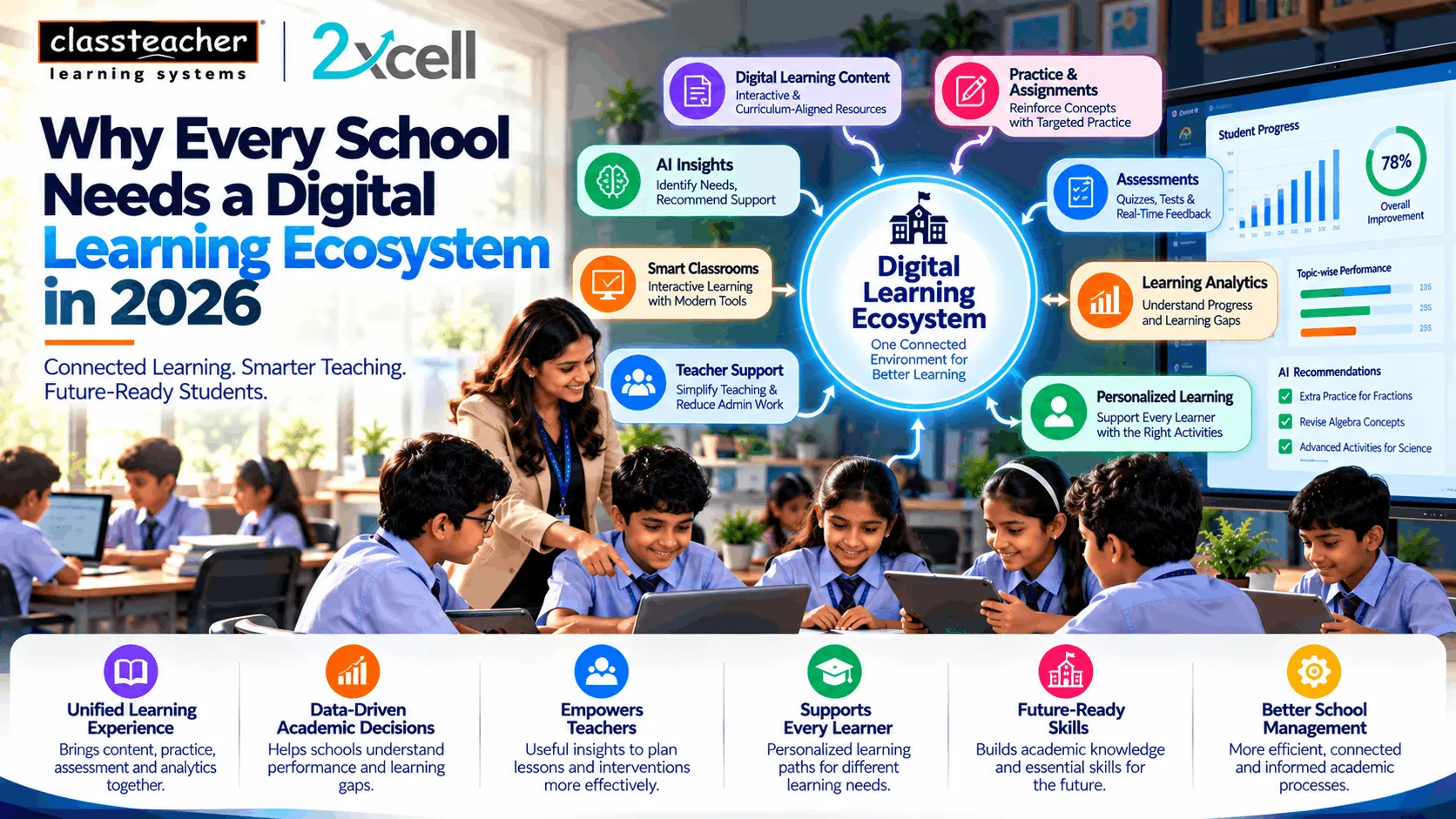
A digital learning ecosystem brings learning content, assessments, practice, analytics, communication, and technology-enabled classroom tools together so that they can work as connected parts of the learning journey.
Instead of using separate tools for separate activities, schools can create a more integrated approach:
Learn → Practise → Assess → Analyse → Personalize → Improve
What Is a Digital Learning Ecosystem?
A digital learning ecosystem is a connected environment where different educational technologies, learning resources, users, and academic processes work together.
Depending on the school's requirements, it can include:
- Digital learning content
- Learning Management Systems (LMS)
- Online assessments
- Interactive quizzes
- Student practice
- Learning analytics
- Personalized learning
- AI-powered tools
- Smart classrooms
- Digital communication
- Progress tracking
- Teacher resources
- Academic reporting
The objective is not simply to introduce more technology.
The objective is to create better connections between different stages of learning.
For example:
Learning Content → Practice → Assessment → Analytics → Teacher Action → Student Improvement
When these stages are connected, information generated during one activity can support the next academic decision.
Why Schools Need a Digital Learning Ecosystem in 2026
1. Learning Is No Longer Limited to the Classroom
Students can learn through classroom teaching, digital resources, assignments, practice activities, videos, quizzes, projects, and interactive applications.
A connected digital ecosystem can bring these different learning experiences together.
Students can continue learning beyond the physical classroom while teachers can maintain greater visibility into learning activities.
This creates a more flexible learning environment where education is not restricted to a single classroom period.
2. Schools Generate More Learning Data Than Before
Every digital learning activity can generate useful information.
For example:
- Quiz results
- Assessment scores
- Assignment performance
- Practice activity
- Topic-wise performance
- Learning progress
- Participation
- Concept mastery
- Areas requiring additional support
The challenge is not simply collecting this information.
The challenge is turning information into useful academic insights.
A connected ecosystem can help organize relevant learning information so teachers and school leaders can understand performance more effectively.
3. Teachers Need Information, Not More Administrative Work
Technology should make teaching easier rather than create additional complexity.
If teachers have to open multiple platforms to check:
- Assessments
- Assignments
- Student progress
- Practice activity
- Attendance
- Learning resources
the digital environment can become fragmented.
A connected ecosystem can reduce this fragmentation by bringing important learning information into a more structured environment.
This allows teachers to spend more time on:
Teaching + Mentoring + Intervention + Student Interaction
rather than repetitive administrative tasks.
4. Personalized Learning Becomes More Practical
Every student learns differently.
Some students may need additional explanation, while others may be ready for more challenging activities.
A digital ecosystem can support personalized learning by connecting student performance with appropriate learning resources.
For example:
Assessment → Identify Learning Need → Recommended Practice → Reassessment
A student struggling with a particular concept can receive additional practice.
A student who has already mastered the concept can move towards advanced activities.
This makes the learning journey more responsive to individual requirements.
5. AI Can Add Intelligence to the Learning Environment
Artificial Intelligence is becoming an important component of modern educational technology.
Within a digital learning ecosystem, AI can potentially support:
- Learning pattern analysis
- Performance insights
- Learning-gap identification
- Personalized recommendations
- Practice recommendations
- Automated analysis
- Student progress tracking
- Academic reporting
The important point is that AI should not operate separately from teaching.
The useful model is:
AI Identifies Patterns → Teacher Understands Context → Teacher Takes Action
This keeps educators involved in important academic decisions.
6. Assessment Can Become a Continuous Process
Traditional assessment often focuses on periodic tests and examinations.
A connected digital ecosystem can support more frequent learning checks through:
- Quizzes
- Practice questions
- Digital assessments
- Classroom activities
- Topic-based tests
- Formative assessments
This can help teachers understand student learning before major examinations.
The cycle can become:
Teach → Practise → Assess → Analyse → Support → Reassess
Assessment therefore becomes part of learning rather than simply an event at the end of a term.
7. School Leaders Can Get a Broader Academic View
Teachers need student-level information.
School leaders may also need a broader picture.
A digital learning ecosystem can help organize information around:
- Grade-level performance
- Subject-wise trends
- Class performance
- Learning gaps
- Assessment results
- Student progress
- Intervention requirements
This can support academic planning and help school leadership understand where additional attention may be required.
Instead of relying only on periodic reports, schools can work towards more continuous academic visibility.
8. Parents Can Receive More Meaningful Progress Information
Parents often want to understand more than examination marks.
They may want to know:
What is my child doing well?
Where does my child need support?
Is progress happening?
What should the student practise next?
A connected learning environment can provide more meaningful information for parent-teacher discussions.
Rather than discussing only a final score, conversations can include learning progress, strengths, areas requiring attention, and possible next steps.
9. Remote and Hybrid Learning Become Easier to Manage
A digital ecosystem can also support schools when learning needs to happen across different environments.
Students may sometimes learn:
- In the classroom
- From home
- Through digital platforms
- During additional practice
- Through recorded learning resources
A connected system can help maintain continuity between these different learning environments.
Students can access relevant resources, while teachers can continue supporting learning activities and monitoring progress.
10. Digital Tools Can Work Together Instead of Separately
One of the biggest advantages of an ecosystem approach is integration.
Consider a school using separate platforms for:
Content + Assessment + Practice + Analytics + Communication
If these systems operate independently, teachers may need to manually connect information.
An ecosystem approach aims to create stronger connections between these activities.
For example:
Digital Content
↓
Student Practice
↓
Assessment
↓
AI & Analytics
↓
Teacher Insights
↓
Personalized Support
↓
Progress Measurement
This creates a continuous learning loop.
11. A Digital Ecosystem Can Support Future-Ready Skills
Education is increasingly focused on skills alongside academic knowledge.
Schools may need to create opportunities for students to develop:
- Problem-solving
- Creativity
- Collaboration
- Digital literacy
- Coding
- Artificial Intelligence awareness
- Critical thinking
- Technology skills
A digital learning ecosystem can provide a foundation for integrating these experiences into everyday education.
Technology can become part of learning rather than simply an additional classroom feature.
12. It Can Help Schools Build a More Connected Academic Culture
A successful digital ecosystem is not only about software.
It connects people, processes, content, and technology.
The major stakeholders include:
Teachers
Use learning information to plan lessons, assessments, and interventions.
Students
Access learning resources, practice activities, assessments, and progress information.
School Leaders
Review academic trends and support institutional planning.
Parents
Gain meaningful information about student development.
When these stakeholders work within a connected environment, communication and academic coordination can become more structured.
What Should a Modern Digital Learning Ecosystem Include?
Schools do not necessarily need every technology available in the market.
The ecosystem should be built around actual academic requirements.
Important components can include:
Digital Learning Content
Curriculum-aligned resources that students can access across different learning situations.
Learning Management
A structured environment for organizing courses, resources, activities, and learning journeys.
Digital Assessment
Quizzes, tests, assignments, and other assessment formats.
Learning Analytics
Information that helps teachers understand performance patterns and progress.
AI Capabilities
Tools that can support analysis, personalization, recommendations, and learning insights.
Personalized Learning
Learning pathways that respond to student requirements.
Interactive Classroom Technology
Tools that increase classroom participation and provide immediate learning feedback.
Reporting
Clear academic information for teachers, school leaders, and other relevant stakeholders.
How 2xcell Fits Into a Digital Learning Ecosystem
2xcell AI Learning Platform by CLASSTEACHER Learning Systems is designed around a connected approach to digital learning.
The platform can bring together areas such as:
- Learning Content
- Practice
- Assessments
- Personalized Learning
- Analytics
- AI-enabled Learning
This creates a connected learning cycle:
Learn → Practise → Assess → Analyse → Personalize → Improve
Instead of treating every learning activity as a separate process, schools can work towards connecting these activities within a broader digital learning environment.
The objective is to help schools gain greater visibility into learning while supporting teachers and students with technology-enabled academic experiences.
The Role of Classteacher in a Connected Learning Environment
CLASSTEACHER Learning Systems provides technology-enabled solutions for modern school education.
Its education technology ecosystem includes areas such as:
- Smart Classrooms
- Digital Learning
- Artificial Intelligence
- Robotics
- Coding
- STEM Education
- Interactive Assessment
- Clickers
When these technologies are connected with digital learning and analytics, schools can move towards a more integrated approach to education.
How Schools Can Start Building a Digital Learning Ecosystem
Schools do not need to transform their entire technology infrastructure at once.
A structured approach can help.
Step 1: Identify Academic Requirements
Understand the school's current teaching, assessment, learning, and reporting processes.
Step 2: Identify Technology Gaps
Determine where teachers and students currently face difficulties.
Step 3: Connect Core Learning Activities
Start connecting learning content, practice, assessment, and progress tracking.
Step 4: Introduce Analytics
Use relevant learning data to understand student and class-level performance.
Step 5: Add AI Where It Creates Value
Use AI for appropriate activities such as analysis, recommendations, and personalized learning support.
Step 6: Train Teachers
Technology becomes useful only when teachers understand how to use it effectively.
Step 7: Measure Adoption and Impact
Schools can monitor technology usage, student participation, assessment outcomes, and learning progress.
Avoiding Technology Overload
Having more digital tools does not automatically create a better learning environment.
If teachers have to manage too many disconnected applications, technology can become another administrative challenge.
A useful ecosystem should focus on:
Simplicity + Integration + Usability + Academic Value
Schools should ask:
- Does this technology solve a real academic problem?
- Can teachers use it easily?
- Does it support students?
- Can different learning activities connect?
- Does it provide useful insights?
- Is student information handled responsibly?
The goal should be meaningful technology adoption, not technology adoption for its own sake.
Responsible Use of Student Data
Digital learning ecosystems can involve significant amounts of student information.
Therefore, schools should establish appropriate practices around:
- Data privacy
- Access controls
- Security
- Responsible data usage
- Transparency
- Teacher oversight
- Appropriate use of AI-generated insights
Technology should support learning while maintaining appropriate safeguards around student information.
The Future of School Education in 2026 and Beyond
The future of digital education is moving beyond individual tools.
The focus is increasingly on how different technologies can work together.
A connected school environment may look like:
Student Learning
↓
Digital Practice
↓
Assessment
↓
AI Analysis
↓
Teacher Insight
↓
Personalized Support
↓
Progress Tracking
↓
Improved Learning
This approach can create a continuous feedback loop between students, teachers, technology, and academic outcomes.
The objective is not to replace traditional teaching.
It is to give teachers and schools better digital infrastructure to support the learning process.
Conclusion
In 2026, a digital learning ecosystem can help schools move beyond isolated technology tools towards a more connected approach to education.
By bringing together digital content, practice, assessments, analytics, AI, personalized learning, and classroom technology, schools can create learning environments that are more connected and responsive.
The real value of a digital ecosystem is not the number of technologies a school uses.
It is how effectively those technologies work together to support teachers and students.
With 2xcell AI Learning Platform by CLASSTEACHER Learning Systems, schools can explore a connected approach to digital learning, AI, assessment, analytics, and personalized education.
Connect Learning. Empower Teachers. Support Students. Build Smarter Schools.
2xcell AI Learning Platform
By CLASSTEACHER Learning Systems
Empowering Education with AI & Innovation.