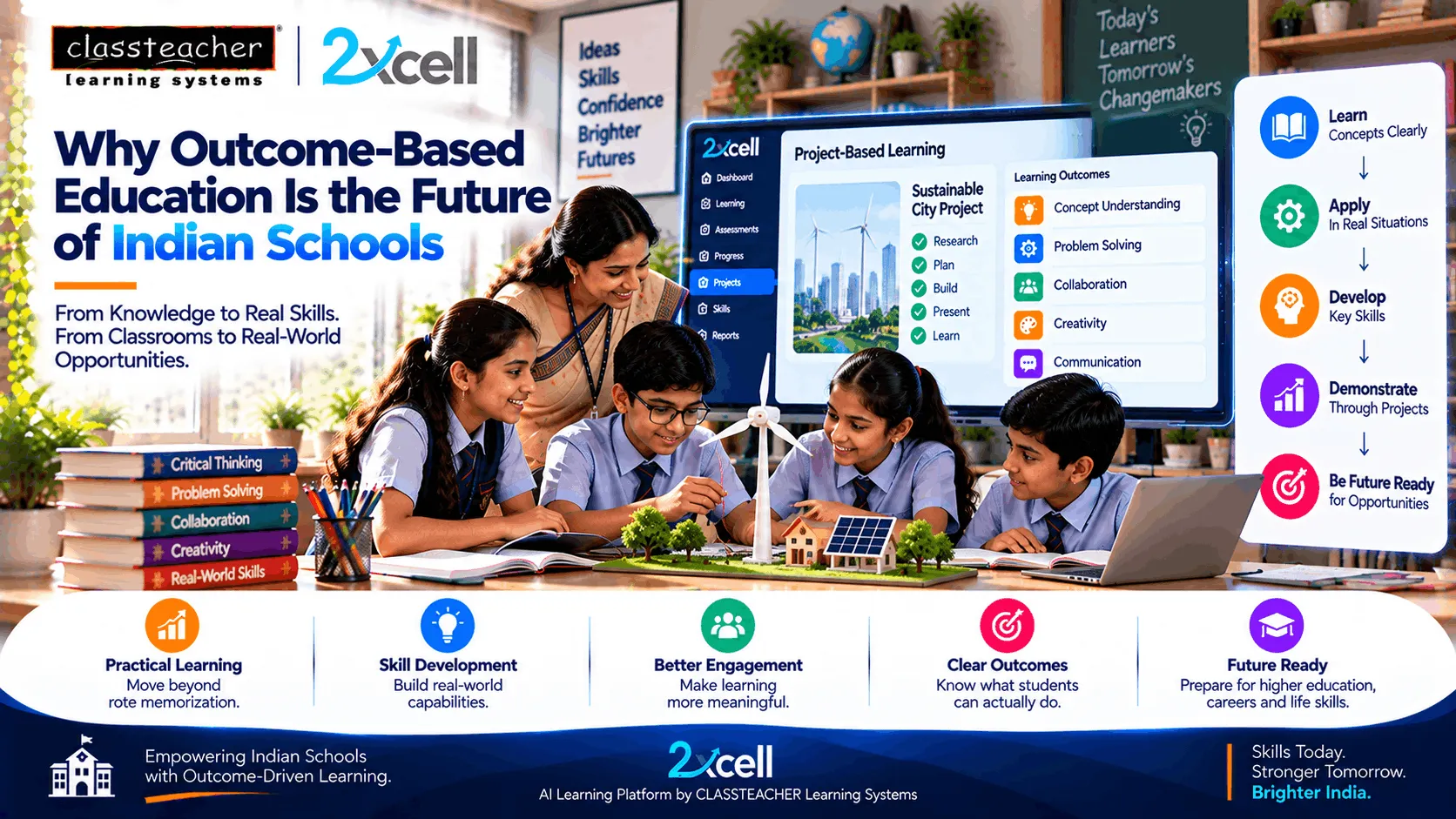
Introduction
For many years, school education has largely been measured through examinations, marks, grades, and completion of the prescribed syllabus.
These measures are important, but they do not always answer a bigger question:
What can a student actually do with what they have learned?
A student may remember a formula but struggle to apply it to a real problem. Another may perform well in a written examination but need more opportunities to develop communication, collaboration, creativity, or practical problem-solving skills.
This is where Outcome-Based Education (OBE) offers a different approach.
Instead of beginning with only the question “What should we teach?”, outcome-based education also asks:
“What should students know, understand, and be able to do after learning?”
This changes the focus from simply completing content to developing measurable learning outcomes.
The journey becomes:
Learning → Applying → Demonstrating → Assessing → Improving
What Is Outcome-Based Education?
Outcome-Based Education is an educational approach that focuses on the competencies and abilities students are expected to develop by the end of a learning experience.
An outcome may involve:
- Understanding a concept
- Applying knowledge
- Solving a problem
- Conducting an experiment
- Communicating an idea
- Working collaboratively
- Creating a solution
- Demonstrating a practical skill
For example, instead of defining a learning objective only as:
“Students will learn about renewable energy.”
an outcome-based objective could be:
“Students will explain different renewable energy sources and design a basic solution for using renewable energy in a practical situation.”
The second approach focuses more directly on application.
Why Indian Schools Are Exploring Outcome-Based Learning
Indian schools are increasingly dealing with a learning environment where students need both academic knowledge and broader capabilities.
Students may eventually enter higher education, professional courses, entrepreneurship, technology-driven workplaces, research, or other career paths.
This means education needs to provide opportunities to develop:
- Conceptual understanding
- Critical thinking
- Communication
- Creativity
- Problem-solving
- Collaboration
- Digital literacy
- Practical application
Outcome-based education provides a framework for connecting classroom learning with these capabilities.
1. OBE Shifts the Focus From Content Completion to Learning Outcomes
Completing a chapter does not necessarily mean that students have mastered the underlying concept.
A teacher may finish a chapter on electricity, for example, but students may still struggle to apply the principles.
Outcome-based education encourages schools to define what students should demonstrate after completing the learning experience.
The focus becomes:
Content Covered → Concept Understood → Skill Demonstrated
This creates a more meaningful connection between teaching and learning.
2. Learning Outcomes Can Make Teaching Objectives Clearer
Clear outcomes can help teachers understand what students are expected to achieve.
For example:
Traditional Objective
Students will study the water cycle.
Outcome-Based Objective
Students will explain the stages of the water cycle and describe how changes in one stage can affect the overall process.
The second objective gives the teacher a clearer direction for activities and assessment.
3. Students Can Understand Why They Are Learning Something
Students sometimes ask:
“Why do I need to learn this?”
Outcome-based learning can help connect academic concepts with practical applications.
For example:
Mathematics
Instead of only learning percentages, students can use percentages to understand discounts, budgets, and financial calculations.
Science
Instead of only memorizing scientific processes, students can investigate how those processes appear in real-world situations.
Computer Science
Instead of only learning programming syntax, students can build a simple digital solution.
This can make academic learning more connected to application.
4. Assessment Can Move Beyond Memorization
Outcome-based education encourages schools to evaluate whether students can demonstrate what they have learned.
Assessment can include:
- Projects
- Presentations
- Practical activities
- Case studies
- Experiments
- Problem-solving tasks
- Digital assessments
- Competency-based questions
- Portfolios
For example, a science student may demonstrate understanding by designing and explaining an experiment rather than answering only factual questions.
This allows assessment to capture different dimensions of learning.
5. Competency-Based Questions Can Test Application
A student may memorize a definition without fully understanding how it works.
Application-based questions can reveal deeper understanding.
For example:
Recall: What is evaporation?
Application: How would evaporation change if the temperature and humidity of an environment changed?
The second question requires the student to apply knowledge.
Outcome-based education can therefore encourage schools to include different levels of thinking in assessment.
6. OBE Can Encourage Critical Thinking
Modern education needs students to do more than remember information.
Students can be encouraged to:
- Compare ideas
- Analyse information
- Identify patterns
- Evaluate possible solutions
- Explain their reasoning
- Make evidence-based decisions
A classroom activity could present students with a real-world problem and ask them to propose and defend a solution.
This gives students an opportunity to practise thinking rather than simply recalling.
7. Practical Learning Becomes More Important
Outcome-based education can create stronger connections between theory and practical experience.
For example, students studying environmental science could:
Learn → Investigate → Collect Data → Analyse → Present Findings
The final outcome is not just knowledge of environmental concepts.
Students also practise research, analysis, teamwork, and communication.
8. OBE Supports Project-Based Learning
Projects can provide a useful environment for demonstrating learning outcomes.
Consider a project on Smart Water Management.
Students could:
- Research water consumption.
- Collect relevant information.
- Analyse the data.
- Identify a problem.
- Design a possible solution.
- Present their proposal.
A single project can develop multiple competencies.
It may involve:
Science + Mathematics + Technology + Communication + Problem-Solving
9. Students Can Develop Transferable Skills
Academic knowledge is important, but students also need skills that can be applied across different situations.
Outcome-based learning can encourage development of:
Communication
Explaining ideas clearly.
Collaboration
Working effectively with others.
Creativity
Developing original approaches.
Critical Thinking
Evaluating information and alternatives.
Problem-Solving
Finding practical solutions.
Digital Literacy
Using technology appropriately.
These capabilities can complement subject-specific knowledge.
10. Teachers Can Design Lessons Around Desired Outcomes
Outcome-based education can influence lesson planning.
Instead of beginning with:
“Which chapter do I need to finish today?”
teachers can begin with:
“What should students be able to demonstrate by the end of this lesson?”
A lesson may then follow:
Learning Objective → Activity → Practice → Demonstration → Assessment
This provides a clearer connection between teaching activity and expected outcome.
11. Assessment Can Become More Closely Connected With Teaching
In a well-designed outcome-based environment, assessment should measure the learning outcomes that were actually taught.
For example:
Learning Outcome: Students can analyse a dataset.
The assessment should provide an opportunity to analyse data.
Simply asking students to define “data” would not fully measure the intended outcome.
This alignment can improve the relationship between:
Teaching → Learning → Assessment
12. Digital Tools Can Support Outcome Tracking
Technology can make it easier for schools to organize learning outcomes and student performance.
Digital platforms can help track:
- Topics completed
- Competencies assessed
- Assessment results
- Practice performance
- Learning gaps
- Progress over time
Instead of maintaining disconnected records, schools can potentially create a more structured view of student development.
13. AI Can Provide Additional Learning Insights
AI-powered learning systems can analyse relevant student performance information and highlight patterns.
For example:
Assessment Results → Performance Pattern → Learning Gap → Recommended Practice
If students repeatedly struggle with a particular competency, teachers can use this information to plan additional support.
AI should not replace teacher judgement.
Its role can be to help teachers understand learning information more efficiently.
14. Outcome-Based Education Can Support Personalized Learning
Not every student develops every competency at the same pace.
One student may demonstrate strong analytical skills while requiring additional support with communication.
Another may understand the concept but need more opportunities to apply it practically.
Outcome tracking can help schools identify these differences.
A personalized learning cycle can follow:
Assess → Identify → Support → Practise → Demonstrate Again
This allows learning support to be more specific.
15. Students Can Build Evidence of Their Learning
Outcome-based learning can encourage students to demonstrate what they can actually do.
Evidence can include:
- Projects
- Presentations
- Practical work
- Portfolios
- Research assignments
- Digital creations
- Experiments
- Assessments
Over time, students can build a collection of work demonstrating their development.
This can provide a broader picture than examination marks alone.
16. OBE Can Make Feedback More Specific
Generic feedback such as “Improve your performance” provides limited direction.
Outcome-focused feedback can be more precise.
For example:
Outcome: Explain scientific evidence clearly.
Feedback: The concept is understood, but the explanation needs stronger evidence and clearer reasoning.
This tells the student what needs improvement.
The feedback cycle becomes:
Demonstrate → Review → Receive Feedback → Improve → Demonstrate Again
17. Schools Can Track Progress Across Grades
Outcome-based education can support longer-term tracking.
For example, a competency such as problem-solving may develop progressively.
Grade 5
Identify a simple problem.
Grade 7
Compare possible solutions.
Grade 9
Analyse evidence and develop a solution.
Grade 11
Evaluate complex situations and justify decisions.
This creates a progression rather than treating each grade as an isolated academic year.
18. OBE Can Connect Education With Future Skills
The future workplace requires more than subject knowledge.
Students may need to combine knowledge with:
- Technology
- Communication
- Collaboration
- Analytical thinking
- Creativity
- Adaptability
Outcome-based education can provide opportunities to develop these capabilities within academic learning.
For example, a technology project can involve coding, teamwork, research, presentation, and problem-solving simultaneously.
19. Teachers Become Learning Designers
Outcome-based education can expand the teacher's role from content delivery towards learning design.
Teachers can decide:
- What students need to achieve
- Which activities support the outcome
- How students will demonstrate learning
- Which assessment method is appropriate
- What intervention is needed afterward
Technology can support this process, but the teacher remains responsible for designing meaningful learning experiences.
20. How 2xcell Can Support Outcome-Based Learning
2xcell AI Learning Platform by CLASSTEACHER Learning Systems can support a connected digital learning environment involving:
- Digital learning content
- Practice
- Assessment
- Analytics
- Personalized learning
- Student progress tracking
A connected learning cycle can follow:
Learn → Practise → Assess → Analyse → Demonstrate → Improve
Schools can use digital learning resources and assessment information to gain greater visibility into student performance.
Teachers can use relevant insights to identify areas requiring additional practice or intervention.
The objective is to connect learning activities with measurable progress rather than treating content, practice, and assessment as separate processes.
What an Outcome-Based Classroom Can Look Like
Consider a Grade 8 science lesson on Water Conservation.
Learning Outcome
Students will be able to identify water-wastage problems and propose practical conservation measures.
Step 1 — Explore
Students learn about water consumption.
Step 2 — Investigate
They examine examples of water wastage.
Step 3 — Analyse
Students study relevant information and identify patterns.
Step 4 — Create
They develop a conservation proposal.
Step 5 — Present
Students explain their solution.
Step 6 — Assess
The teacher evaluates understanding and application.
Here, the learning outcome is demonstrated through multiple activities.
OBE and the Indian School Environment
Indian schools operate within diverse academic contexts, including different boards, curricula, student populations, and institutional requirements.
An outcome-based approach can be adapted according to the school's curriculum and grade-level expectations.
The important principle is to establish a clear relationship between:
What Students Should Learn
↓
How They Will Learn It
↓
How They Will Demonstrate It
↓
How Progress Will Be Measured
This structure can help schools build more purposeful learning experiences.
What Schools Should Consider Before Implementing OBE
Successful implementation requires more than changing assessment formats.
Schools can consider:
Clear Learning Outcomes
Are expected competencies defined clearly?
Teacher Training
Do teachers understand how to design outcome-focused lessons?
Assessment Alignment
Do assessments actually measure the intended outcomes?
Digital Infrastructure
Can technology support learning and progress tracking?
Student Participation
Are students given opportunities to demonstrate learning?
Feedback
Can students understand what they need to improve?
Progress Monitoring
Can schools track development over time?
Curriculum Integration
Can OBE work naturally with the existing academic framework?
Moving From Marks to Meaningful Evidence
Marks can answer an important question:
How did the student perform in this assessment?
Outcome-based education asks additional questions:
- What does the student understand?
- What can the student apply?
- Which competencies are developing?
- Where is additional support required?
- How has the student progressed?
- Can the student demonstrate learning in a different context?
This does not mean that marks become irrelevant.
Instead, marks can become one part of a broader learning picture.
The Future of Outcome-Based Education
Technology, AI, digital assessment, analytics, and personalized learning can make it easier for schools to monitor learning outcomes over time.
A future learning ecosystem could connect:
Curriculum
↓
Learning Outcome
↓
Digital Content
↓
Practice
↓
Assessment
↓
AI-Assisted Analysis
↓
Teacher Feedback
↓
Targeted Support
↓
Outcome Demonstration
This creates a continuous improvement cycle.
Conclusion
Outcome-Based Education shifts the focus of schooling from simply completing a syllabus towards understanding what students can know, apply, demonstrate, and improve.
For Indian schools, this approach can create stronger connections between academic knowledge, practical application, competency development, and real-world problem-solving.
Teachers remain central to the process because meaningful outcomes depend on thoughtful lesson design, classroom interaction, feedback, and professional judgement.
Technology can provide additional support by connecting digital content, practice, assessment, analytics, and personalized learning.
With 2xcell AI Learning Platform by CLASSTEACHER Learning Systems, schools can explore a connected approach to digital learning and outcome-focused education.
The future of education is not only about asking:
“What did the student score?”
It is also about asking:
“What can the student understand, demonstrate, create, and apply?”
Learn. Demonstrate. Apply. Improve.
2xcell AI Learning Platform
By CLASSTEACHER Learning Systems
Empowering Education with AI & Innovation.