Introduction
A grade can tell a student how they performed, but it does not always explain why they performed that way or what they should do next.
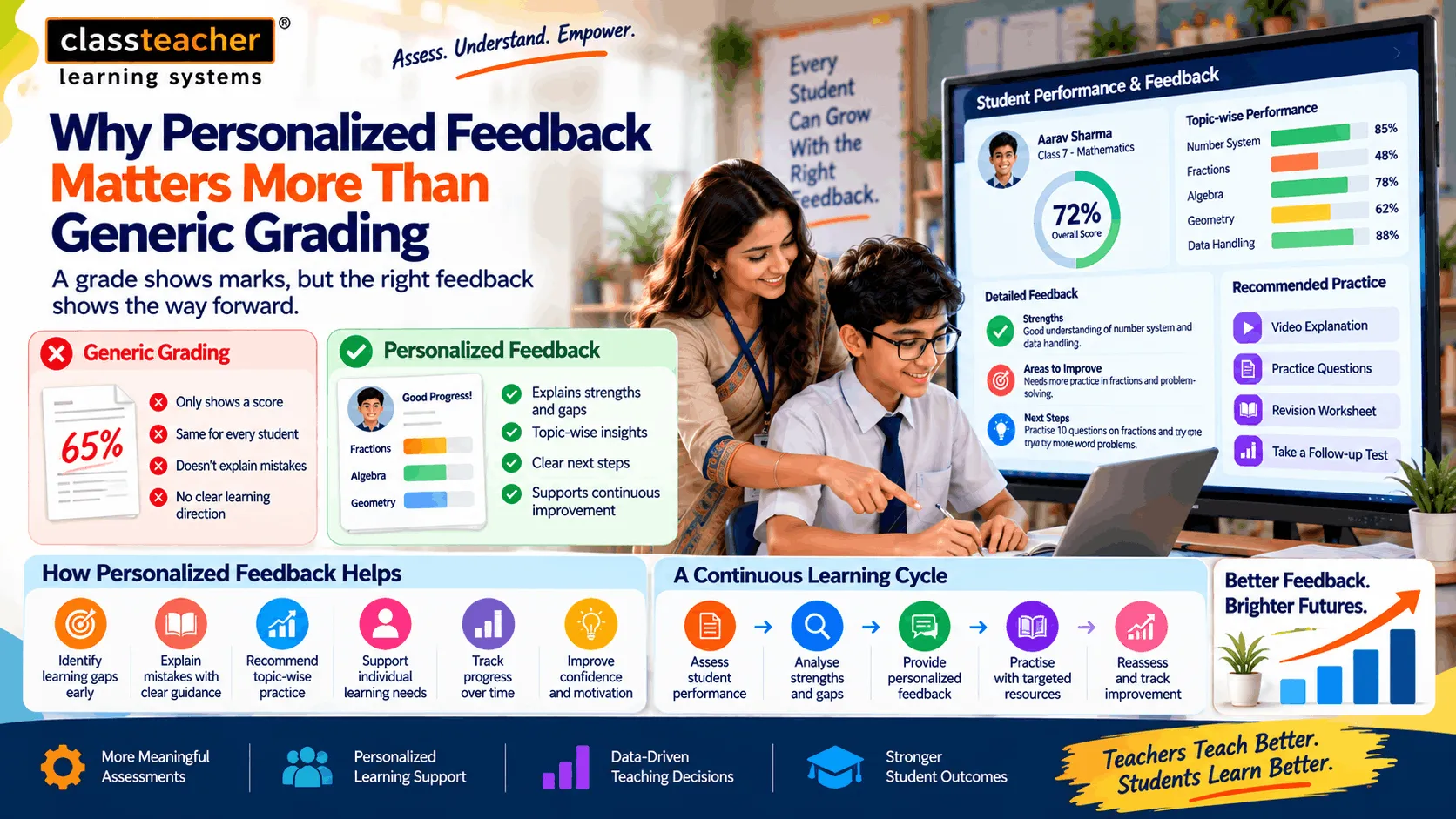
Consider two students who both receive 65% in a mathematics assessment.
For one student, the main difficulty may be fractions. For another, the problem may be interpreting word problems. Giving both students the same grade does not communicate these differences.
This is where personalized feedback becomes important.
Instead of simply reporting a score, personalized feedback can help students understand:
- What they did well
- Where they made mistakes
- Which concepts require attention
- Why an answer was incorrect
- What they should practise next
- How they can improve
The learning cycle can therefore move from:
Test → Grade → Move On
to:
Attempt → Analyse → Understand → Practise → Improve
What Is Personalized Feedback?
Personalized feedback is feedback that responds to an individual student's performance, mistakes, learning gaps, or progress.
It can be provided by teachers, digital learning platforms, or a combination of both.
Depending on the learning environment, personalized feedback may include:
- Specific explanations
- Correct-answer guidance
- Topic-level recommendations
- Additional practice
- Revision suggestions
- Performance trends
- Learning-gap identification
- Next-step recommendations
The goal is not to provide more feedback simply for the sake of it.
The goal is to make feedback relevant and actionable for the learner.
Why Generic Grading Has Limitations
Grades and marks are useful for measuring performance.
However, a score such as 72% does not necessarily explain:
- Which concepts were understood
- Which concepts were misunderstood
- Why mistakes occurred
- Which topics require additional practice
- Whether the student is improving
- What the student should do next
A grade provides a measurement.
Feedback provides context.
This distinction can be important for long-term learning.
1. Personalized Feedback Explains the Learning Gap
Imagine a student receives 60% in science.
The score indicates that improvement may be needed, but it does not identify the exact problem.
A detailed feedback system might show:
Physics: Strong
Chemistry: Developing
Biology: Needs Practice
This provides a clearer direction for further learning.
Instead of asking the student to revise the entire subject, teachers can focus on the specific area requiring attention.
2. Students Can Understand Their Mistakes
An incorrect answer is more useful when the student understands why it was incorrect.
For example:
Answer: Incorrect
is less informative than:
Answer: Incorrect
Concept: Fractions
Issue: Denominator was not considered correctly
Next Step: Practise equivalent fractions
This type of feedback can turn a mistake into a learning opportunity.
The process becomes:
Mistake → Explanation → Correction → Practice
3. Personalized Feedback Gives Students a Clear Next Step
Students often know that they performed poorly but may not know what to do afterward.
A score alone can leave students asking:
“What should I study now?”
Personalized feedback can provide a more useful direction.
For example:
Weak Topic → Recommended Revision → Practice Questions → Reassessment
This gives students a clearer learning pathway.
4. Feedback Can Strengthen Concept Understanding
Learning is not complete when a student selects the correct answer.
Students also need to understand the underlying concept.
Feedback can provide:
- Explanations
- Examples
- Hints
- Step-by-step guidance
- Related practice
For example, if a student makes a mistake while solving an algebra problem, feedback can highlight the step where the reasoning changed.
This can help the student understand the process rather than simply memorize the correct answer.
5. Personalized Feedback Can Make Practice More Effective
Not every student needs the same practice.
One student may need basic questions.
Another may require application-based problems.
A third student may already understand the concept and be ready for more challenging questions.
Personalized feedback can help connect performance with appropriate practice.
The cycle becomes:
Performance → Feedback → Recommended Practice → Reassessment
6. Students Can Track Their Improvement
Feedback becomes more meaningful when students can see progress over time.
For example:
Assessment 1: 54%
Targeted Practice
Assessment 2: 63%
Additional Feedback
Assessment 3: 74%
The progression can show that targeted support is helping.
This can also help students understand that improvement is a process rather than something determined by a single grade.
7. Personalized Feedback Can Support Student Motivation
A low grade can sometimes feel like a final judgement.
Specific feedback can shift the focus toward improvement.
Instead of:
“You scored 55%.”
the message can become:
“You understand the basic concept. Focus on application-based questions and practise two related topics.”
This creates a more constructive learning conversation.
The emphasis becomes:
Where You Are → What You Can Improve → What To Do Next
8. Feedback Can Help Teachers Intervene Earlier
Teachers may have limited time to manually analyse every student's mistakes in detail.
Digital learning systems can help organize relevant performance information.
For example, a teacher may see:
- Students struggling with the same topic
- Individual learning gaps
- Repeated mistakes
- Students showing improvement
- Students requiring additional practice
This can help teachers decide where intervention is needed.
9. Different Students Can Receive Different Support
A classroom may have students with different levels of understanding.
Personalized feedback allows academic support to become more specific.
Student A
Needs: Foundational revision
Student B
Needs: Additional examples
Student C
Needs: Application-based practice
Student D
Needs: Advanced challenges
The academic objective can remain the same while the support pathway changes.
10. Personalized Feedback Can Support Different Subjects
The type of feedback can change according to the subject.
Mathematics
Feedback can highlight calculation errors, incorrect steps, or misunderstood formulas.
Science
Feedback can identify misconceptions about processes, concepts, or applications.
Languages
Feedback can focus on grammar, vocabulary, comprehension, or pronunciation.
Social Science
Feedback can identify errors in facts, interpretation, chronology, or application.
Computer Science
Feedback can identify coding errors, logic problems, or incorrect approaches.
The feedback should be relevant to the learning task.
11. Feedback Can Make Assessments More Useful
An assessment should ideally answer more than:
“What score did the student get?”
It should also help answer:
- What was understood?
- What was misunderstood?
- What needs revision?
- What should happen next?
This transforms assessment into a learning-support mechanism.
The cycle becomes:
Assess → Understand → Support → Improve
12. Personalized Feedback Can Reduce Unnecessary Repetition
When students receive generic instructions such as “Study more”, they may spend time revising concepts they already understand.
Specific feedback can direct their attention towards areas that actually need improvement.
For example:
Instead of:
“Revise Mathematics.”
the recommendation could be:
“Revise fractions and practise application-based problems.”
This makes revision more focused.
13. Feedback Can Support Independent Learning
Students gradually need to become capable of identifying their own learning needs.
Personalized feedback can help them ask:
- What did I get wrong?
- Why did I make the mistake?
- Which concept do I need to revisit?
- What should I practise?
- Am I improving?
This encourages students to become more active participants in their learning.
14. Teachers Can Combine AI Insights With Professional Judgement
AI-powered feedback can organize performance information, but teachers remain essential.
A digital system may identify that a student repeatedly struggles with geometry.
The teacher can then investigate the reason.
Perhaps the student:
- Has misunderstood a basic concept
- Needs a visual explanation
- Requires additional practice
- Is struggling with a particular type of question
The relationship becomes:
AI Identifies Pattern → Teacher Adds Context → Student Receives Support
15. Personalized Feedback Can Connect With Adaptive Practice
Feedback becomes even more useful when it connects directly with practice.
For example:
Low Performance in Topic
↓
Personalized Explanation
↓
Targeted Practice
↓
Immediate Feedback
↓
Reassessment
↓
Updated Learning Recommendation
This creates a continuous learning cycle.
16. Feedback Can Help Identify Repeated Mistakes
One incorrect answer may be an isolated mistake.
Repeated errors can indicate a deeper learning gap.
For example:
Assessment 1: Incorrect
Practice: Incorrect
Assessment 2: Incorrect
A digital system can help teachers identify such patterns.
The teacher can then provide a more focused intervention.
This can prevent repeated mistakes from becoming persistent misunderstandings.
17. Parents Can Understand More Than a Grade
Personalized feedback can also make academic communication with parents more meaningful.
Instead of only sharing:
Mathematics — 62%
parents may receive information about:
- Strengths
- Topics requiring attention
- Practice completed
- Progress over time
- Recommended areas for revision
This can help parents have more constructive conversations with their children.
18. Schools Can Measure Whether Feedback Is Working
Providing feedback is only one part of the process.
Schools can also examine what happens afterward.
For example:
Learning Gap Identified
↓
Personalized Feedback
↓
Targeted Practice
↓
Follow-Up Assessment
↓
Performance Comparison
If performance improves, the support may have been useful.
If difficulties continue, teachers can consider another intervention.
19. Personalized Feedback Can Support Long-Term Learning
The purpose of feedback should not only be to improve the next test score.
Good feedback can help students develop habits of:
- Reflection
- Practice
- Correction
- Application
- Self-assessment
- Continuous improvement
This can contribute to a stronger learning process over time.
20. How 2xcell Can Support Personalized Learning Feedback
2xcell AI Learning Platform by CLASSTEACHER Learning Systems can support a connected digital learning environment involving:
- Learning content
- Practice
- Assessments
- Analytics
- Personalized learning
- Student progress tracking
A connected learning cycle can follow:
Learn → Practise → Assess → Analyse → Personalize → Improve
Relevant performance information can help schools understand where students are performing well and where additional learning support may be useful.
Instead of treating assessment results as the final outcome, schools can connect them with practice, analysis, and personalized learning pathways.
The objective is:
Better Information → Better Feedback → Better Support → Better Learning
Generic Grading vs Personalized Feedback
Generic GradingPersonalized FeedbackProvides a scoreExplains performanceShows the final resultIdentifies specific areasMay not explain mistakesCan explain misconceptionsSame message for many studentsMore relevant to individual needsOften focuses on measurementFocuses on improvementMay end with the gradeCan suggest the next step
The two approaches do not have to compete.
Grades can continue to provide a useful measurement, while personalized feedback adds the context students need to improve.
What Effective Personalized Feedback Should Include
Specific
Identify the exact area requiring attention.
Clear
Use language students can understand.
Actionable
Tell students what they can do next.
Timely
Provide feedback close to the learning activity when possible.
Relevant
Connect feedback with the student's actual performance.
Constructive
Focus on improvement rather than simply highlighting mistakes.
Teacher-Supported
Allow teachers to add context and guidance where necessary.
Common Mistakes in Providing Feedback
Giving Only a Score
A score does not explain the complete learning picture.
Using Generic Comments
Comments such as “Good,” “Improve,” or “Study More” may provide limited direction.
Giving Too Much Information
Excessive feedback can overwhelm students.
Delaying Feedback Too Long
Feedback can be more useful when provided close to the learning activity.
Ignoring Student Context
Performance data should be interpreted alongside teacher observations.
Treating AI Feedback as Final Judgement
AI-generated insights should support learning decisions rather than replace teacher judgement.
How Schools Can Build a Personalized Feedback Process
Step 1: Assess
Measure student understanding through appropriate assessments.
Step 2: Analyse
Identify strengths, mistakes, and learning gaps.
Step 3: Explain
Provide relevant feedback about the student's performance.
Step 4: Practise
Recommend activities related to the identified gap.
Step 5: Reassess
Check whether understanding has improved.
Step 6: Adapt
Modify the next learning activity according to the student's progress.
This creates:
Assess → Analyse → Feedback → Practise → Reassess → Improve
The Future of Feedback in Education
As AI, learning analytics, and personalized learning continue to develop, feedback can become increasingly connected with the complete learning journey.
A future learning cycle could look like:
Student Attempts Activity
↓
System Analyses Performance
↓
Personalized Feedback
↓
Recommended Resource
↓
Targeted Practice
↓
Follow-Up Assessment
↓
Learning Path Updated
This can help move education from static grading towards more continuous and responsive learning support.
Conclusion
Grades remain an important part of academic assessment, but a grade alone cannot always tell a student how to improve.
Personalized feedback can add the missing context by explaining mistakes, identifying learning gaps, recommending practice, and showing students what they can do next.
When feedback is connected with assessment, practice, teacher guidance, and progress tracking, it can become an important part of the learning process.
With 2xcell AI Learning Platform by CLASSTEACHER Learning Systems, schools can explore a connected approach to digital learning, assessment, analytics, personalized learning, and student progress tracking.
The goal is not to replace grading.
It is to make every grade more meaningful by answering the question that matters most:
“What should the student do next to improve?”
Grade the Performance. Personalize the Feedback. Improve the Learning.
2xcell AI Learning Platform
By CLASSTEACHER Learning Systems
Empowering Education with AI & Innovation.