Introduction
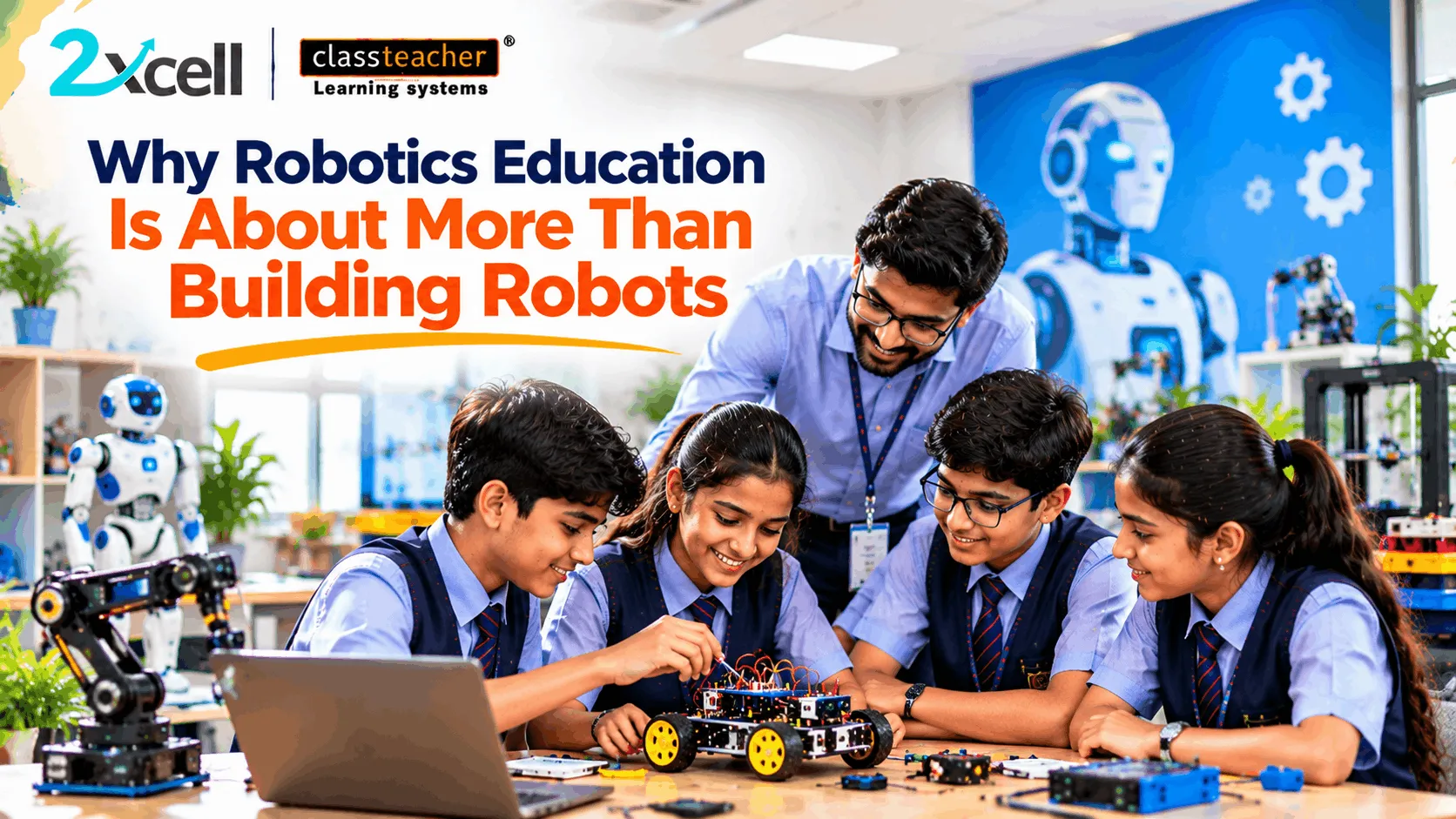
When students participate in a robotics activity, the finished robot is only one part of the learning experience. The real educational value often lies in the thinking, experimentation, collaboration, and problem-solving that take place while developing it.
Robotics education gives students opportunities to explore how ideas can be transformed into working models. They can investigate how components interact, test different designs, identify errors, and make improvements based on what they observe.
For schools, robotics can provide a practical way to connect science, technology, engineering, and mathematics with activities that encourage students to think independently and work collaboratively.
The objective is not simply to teach students how to assemble a robot. It is to help them understand how to approach a challenge, develop a solution, and learn from the process.
What Is Robotics Education?
Robotics education introduces students to the principles involved in designing, building, programming, and testing robotic systems.
Depending on their age, experience, and curriculum, students may work with mechanical components, motors, sensors, electronic circuits, coding environments, and programmable robotic models.
These activities can help learners understand how instructions translate into actions and how different components work together to perform a task.
For example, students might program a robot to follow a route, detect an obstacle, or move an object from one location to another.
As they work through the challenge, they need to consider the design, instructions, and conditions that affect the outcome.
This makes robotics a learning experience that combines technical understanding with practical thinking.
1. Robotics Encourages Logical Thinking
Robotics activities often require students to break a larger task into smaller, manageable steps.
Before programming a robot to complete a task, students must determine what should happen first, what should follow, and what conditions might change the outcome.
This encourages them to think in a structured way.
For example, a student programming a robot to navigate a simple path may need to define its movements, turns, and stopping conditions.
If the robot fails to follow the intended route, the student can examine the instructions and identify where the sequence needs adjustment.
Through these activities, learners get opportunities to practise:
- Breaking complex tasks into smaller steps.
- Recognising patterns and sequences.
- Following logical instructions.
- Identifying errors in a process.
- Testing whether a solution works as intended.
These thinking skills can also be useful in mathematics, computer science, and everyday problem-solving.
2. Design and Experimentation Become Part of Learning
Robotics projects rarely require students to accept the first design they create as the final solution.
A model may need structural changes, a program may require different instructions, or a sensor may need adjustment to perform a task correctly.
This creates opportunities for students to experiment with different approaches.
For instance, a group building a small robotic vehicle could investigate how wheel placement or the distribution of components affects its movement.
Students can change one element, test the result, and compare it with their earlier observations.
A practical design cycle can follow:
Plan → Build → Test → Observe → Modify → Test Again
The process helps students understand that experimentation is not a distraction from learning. It is one of the ways learning takes place.
3. Robotics Develops Problem-Solving Skills
A robotics challenge gives students a problem that requires investigation rather than simply recalling a memorised answer.
Suppose a robot must detect an obstacle and change direction. If it does not respond correctly, students need to investigate the possible reasons.
They might examine the sensor, review the program, check the connections, or test the robot under different conditions.
Instead of immediately receiving a solution, students can work through the available evidence and decide what to try next.
This approach encourages them to:
- Define the problem clearly.
- Explore possible causes.
- Develop alternative solutions.
- Test their assumptions.
- Evaluate the results.
- Improve their approach.
Teachers can support this process by asking guiding questions instead of correcting every mistake immediately.
The aim is to help students understand how to solve a problem, not merely how to make one particular robot work.
4. Teamwork Makes Robotics a Collaborative Experience
Many robotics projects are suitable for group activities because they involve several connected tasks.
Students may need to plan the design, assemble components, write code, test the model, and document the results.
Working together gives them opportunities to divide responsibilities, exchange ideas, explain their reasoning, and resolve disagreements.
For example, one student may focus on the physical construction while another works on the programming. The group can then test the complete model and discuss improvements together.
To make collaboration meaningful, teachers should ensure that every student participates and understands the overall project.
Useful practices include:
- Assigning clear but flexible responsibilities.
- Encouraging students to explain their decisions.
- Rotating roles across different activities.
- Reviewing group progress during the project.
- Asking every student to reflect on what they learned.
The educational benefit comes not only from completing the task but also from learning how to work effectively with others.
5. Connecting Ideas With Real-World Applications
Robotics can help students explore how scientific and technological concepts are used in practical situations.
A classroom project may demonstrate principles related to motion, energy, measurement, sensors, or programming.
For example, students creating an obstacle-detecting robot can investigate how a sensor identifies an object and how the program responds to that information.
This connects several ideas within one activity.
Teachers can also introduce examples of robotics in manufacturing, agriculture, healthcare, environmental monitoring, and logistics to help students understand how similar principles are applied beyond school.
The purpose is not to suggest that every classroom model replicates a professional robotic system. Rather, it is to help students recognise connections between foundational concepts and real-world technologies.
6. Learning From Mistakes Builds Persistence
In robotics, an unsuccessful test can provide useful information.
A robot that turns too early, a connection that does not work, or a program that produces an unexpected result can give students an opportunity to investigate what happened.
When mistakes are treated as part of the learning process, students can practise reviewing their decisions instead of abandoning a task immediately.
Teachers can encourage this by asking:
- What did you expect to happen?
- What happened during the test?
- What evidence did you observe?
- Which part could be changed?
- How will you check whether the change works?
These questions help students connect their actions with the results.
The goal is to develop a habit of thoughtful improvement rather than rewarding only a successful final model.
7. Robotics Can Introduce Students to Coding
Programming is an important element of many robotics activities, although the complexity can vary considerably.
Beginners may start with visual, block-based instructions, while more experienced learners may explore text-based programming and more advanced control systems.
A student might create instructions for a robot to move forward, turn, stop, or respond to a sensor.
When the robot behaves differently from what was expected, the student can review the program and test changes.
This creates a visible connection between code and its output.
Robotics can therefore provide a practical context for exploring sequencing, conditions, loops, debugging, and other programming concepts.
Schools should choose coding activities that match the students' current abilities and build complexity gradually.
8. Encouraging Creativity Through Open-Ended Challenges
Not every robotics activity needs to have one predetermined design.
Open-ended challenges can ask students to develop their own solutions within a defined set of requirements.
For example, a class could be asked to design a robot that transports a lightweight object across a small course.
Different groups may produce different designs depending on their chosen mechanisms, programming logic, and testing methods.
Teachers can assess the reasoning behind each approach rather than focusing exclusively on whether every group created the same model.
Open-ended tasks can encourage students to:
- Generate and compare ideas.
- Make design decisions.
- Explain their choices.
- Evaluate alternative approaches.
- Improve a prototype.
- Present their findings.
Clear constraints and learning objectives remain important so that creativity supports the educational purpose of the activity.
9. How Teachers Can Structure Effective Robotics Lessons
A successful robotics lesson needs more than equipment and instructions. Teachers should plan how the activity connects to the intended learning outcomes.
A structured lesson might include the following stages.
Step 1: Introduce a Challenge
Present a problem that students can understand and investigate.
Step 2: Connect With the Concept
Explain the relevant scientific, mathematical, engineering, or coding principles.
Step 3: Plan the Solution
Give students time to discuss their ideas and decide how to approach the task.
Step 4: Build or Program
Allow students to construct, code, or configure their models with appropriate guidance.
Step 5: Test and Observe
Ask students to compare the actual outcome with their expectations.
Step 6: Improve the Design
Encourage them to make adjustments based on evidence.
Step 7: Reflect and Explain
Ask students to describe what worked, what did not, and what they learned.
This approach helps ensure that the robotics activity remains connected to a clear educational objective.
10. How Schools Can Introduce Robotics at Different Levels
Robotics programmes should account for students' age groups, prior knowledge, available resources, and curriculum requirements.
Younger students may begin with simple construction activities, sequencing exercises, and guided demonstrations.
As students gain experience, schools can introduce programmable models, sensor-based activities, structured coding challenges, and independent projects.
More advanced learners may explore complex designs, debugging, automation concepts, and interdisciplinary challenges.
Schools can develop a progression that includes:
- Exploration: Discovering components and understanding basic cause and effect.
- Guided practice: Following instructions to build or program a model.
- Application: Using learned concepts to complete a defined task.
- Independent design: Creating and testing an original solution.
- Evaluation: Explaining the results and identifying improvements.
The progression should remain flexible. Students may need different levels of guidance depending on the complexity of the activity.
11. Assessing More Than the Final Robot
A completed robot does not necessarily show everything a student has learned.
A model may work because students followed a set of instructions without fully understanding why those instructions were necessary. Conversely, a project that does not work as intended may still demonstrate strong reasoning and thoughtful experimentation.
Teachers can use several methods to assess the learning process.
Concept understanding: Can the student explain how the relevant components or instructions work?
Logical reasoning: Can the student describe the sequence of steps used to solve the problem?
Experimentation: Can the student explain what was changed and why?
Problem-solving: Can the student identify possible causes of an error?
Collaboration: Can the student contribute to group work and communicate ideas?
Reflection: Can the student identify lessons learned and possible improvements?
Combining observation, questioning, project reviews, and student reflections can provide a more complete picture of learning.
12. Planning a Robotics Learning Environment
Before introducing robotics activities across a school, leaders should consider how the programme will be implemented and maintained.
Important factors include:
- Curriculum alignment and learning objectives.
- Age-appropriate robotics kits and components.
- Suitable workspace and storage.
- Teacher training and ongoing support.
- Safety procedures and equipment supervision.
- Scheduling and access for different classes.
- Maintenance and replacement requirements.
- Assessment and evaluation methods.
Schools should also consider how activities will be adapted for different levels of student experience.
A well-planned programme can help ensure that robotics resources are used regularly and purposefully instead of remaining limited to occasional demonstrations.
13. How CLASSTEACHER Learning Systems Can Support Robotics Education
Schools exploring robotics and practical skill development can evaluate educational solutions that align with their curriculum, student needs, and implementation plans.
CLASSTEACHER Learning Systems provides education-focused solutions, including Composite Skills Lab-related learning environments, that schools can consider when planning hands-on learning opportunities.
The 2xcell AI Learning Platform by CLASSTEACHER Learning Systems may also be evaluated as part of a wider digital learning strategy, depending on the platform's available features and the school's requirements.
When reviewing any educational solution, schools should consider how it supports teachers, connects with learning objectives, enables meaningful student participation, and fits into the wider academic programme.
The goal is to create learning experiences where students can understand concepts, explore possibilities, and apply their knowledge through practical work.
Conclusion
Robotics education is about much more than assembling a machine. It can give students opportunities to develop logical thinking, experiment with designs, solve problems, collaborate with peers, and connect classroom concepts with real-world applications.
The value of a robotics project lies in the process students follow: asking questions, planning solutions, testing ideas, learning from mistakes, and improving their work.
For schools, the priority should be to design robotics activities around clear learning objectives and provide teachers with the resources and support required to guide students effectively.
With thoughtful planning, robotics can become a meaningful part of practical, skill-based education rather than simply a demonstration of technology.
Build the robot. Explore the idea. Learn through the process.