Introduction
Teaching involves much more than explaining a lesson in front of a classroom.
Teachers spend time preparing lessons, selecting learning resources, creating activities, designing questions, conducting assessments, reviewing student responses, revising concepts, and planning support for students who need additional help.
As schools adopt digital learning, the availability of content is increasing rapidly. However, simply having a large collection of digital resources does not automatically make teaching easier.
What matters is how the content is organized, aligned, and connected to the teaching process.
Structured digital content can help teachers move from searching for resources to using organized learning material that follows a clear academic sequence.
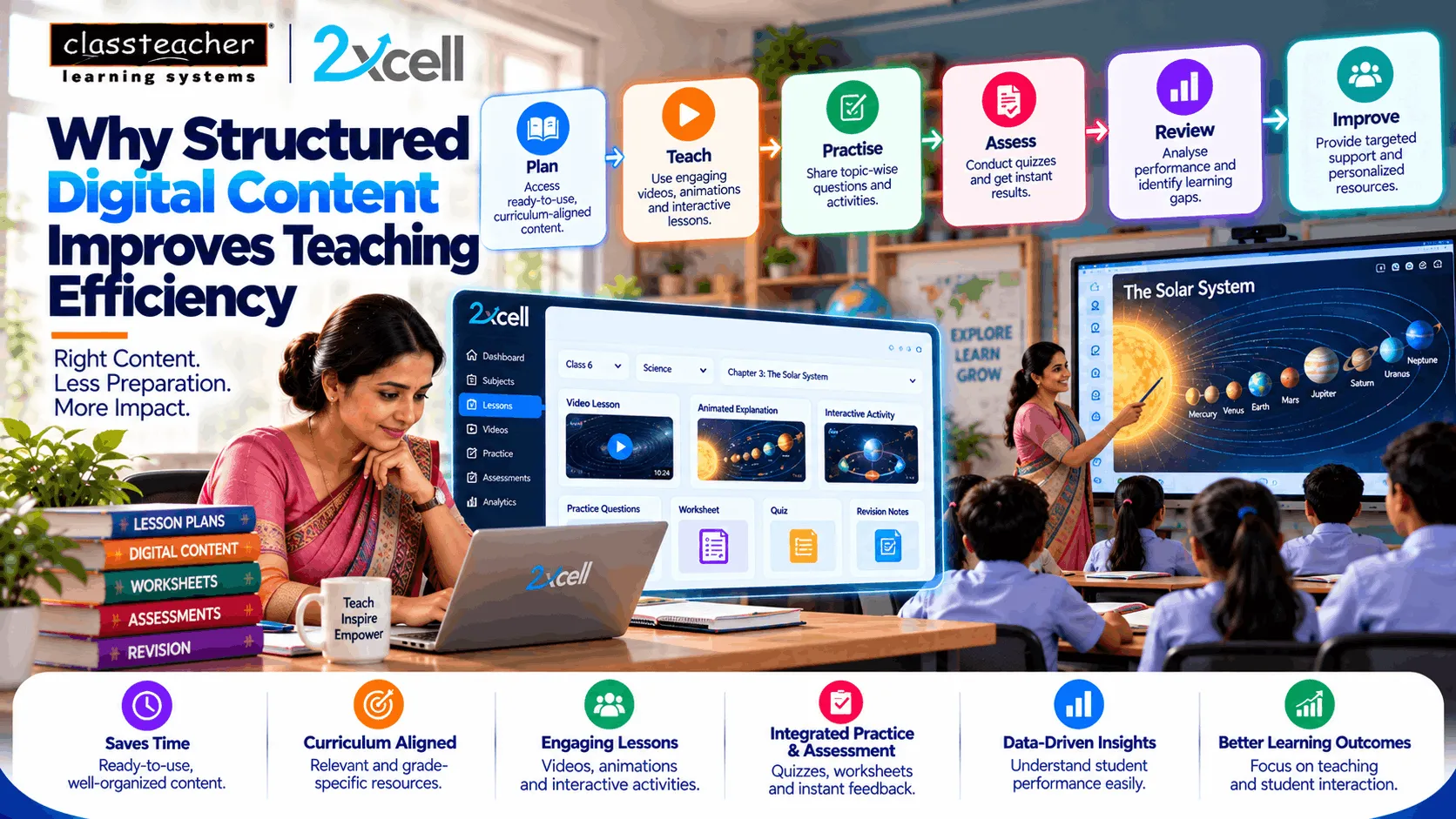
A well-designed digital learning journey can follow:
Plan → Teach → Practise → Assess → Review → Improve
This can help teachers use classroom time more efficiently while giving students a more consistent learning experience.
What Is Structured Digital Content?
Structured digital content refers to learning resources that are organized according to a defined academic framework rather than being presented as a random collection of videos, presentations, documents, or activities.
It may include:
- Curriculum-aligned lessons
- Digital chapters
- Concept explanations
- Videos
- Animations
- Interactive activities
- Practice questions
- Worksheets
- Assessments
- Revision resources
- Learning objectives
- Topic-wise content
- Progress-linked resources
The structure creates a logical connection between different resources.
Instead of:
Content → Content → Content
the learning journey becomes:
Concept → Explanation → Practice → Assessment → Feedback
This organization can make digital resources more useful for teachers.
Why Content Structure Matters for Teachers
Teachers often work with limited classroom time.
They need to complete curriculum requirements while also ensuring that students understand the concepts being taught.
Unorganized digital resources can create additional work.
A teacher may need to:
- Search for appropriate content
- Check whether it matches the syllabus
- Verify the quality
- Adjust the material for the class
- Find practice questions
- Prepare an assessment
- Organize revision material
Structured content can reduce some of this preparation effort by bringing related resources together.
The teacher can spend more time focusing on teaching and student interaction rather than repeatedly searching for supporting material.
1. Structured Content Reduces Lesson Preparation Time
Lesson preparation can involve multiple steps.
For example:
Find Topic → Search Resources → Check Content → Select Material → Prepare Activity → Create Questions
A structured digital platform can organize these resources around the lesson or topic.
A teacher may be able to move through:
Lesson → Explanation → Activity → Practice → Assessment
This can make preparation more organized.
The objective is not to remove teacher planning.
It is to reduce unnecessary repetition.
2. Curriculum Alignment Makes Content More Relevant
A large amount of digital content is available online.
However, not every resource is suitable for a particular curriculum or grade level.
Structured digital content can be organized around:
- Grade
- Subject
- Chapter
- Topic
- Learning objective
- Difficulty level
- Assessment requirement
This allows teachers to select resources that are more closely connected to what students are expected to learn.
For example, a Grade 7 science teacher should not have to spend excessive time adapting advanced content simply to explain a basic curriculum concept.
Curriculum alignment can make digital resources more practical for classroom use.
3. Teachers Can Follow a Clear Learning Sequence
A structured lesson can provide a logical progression.
For example:
Step 1: Introduce
Present the learning objective and topic.
Step 2: Explain
Use digital content, visuals, animation, or demonstrations.
Step 3: Practise
Allow students to apply the concept.
Step 4: Assess
Check whether students understood the lesson.
Step 5: Review
Identify areas that require additional explanation.
Step 6: Reinforce
Provide targeted practice or revision.
This gives teachers a framework without forcing every classroom to follow exactly the same method.
4. Structured Content Can Improve Classroom Flow
A classroom lesson can become less efficient when teachers frequently switch between unrelated resources.
For example:
Search Website → Open Video → Find Worksheet → Open Presentation → Search Questions
This can interrupt the flow of teaching.
With structured content, relevant resources can be connected within the same learning pathway.
The teacher can move more smoothly from one activity to another.
This can be particularly useful when using interactive displays or digital classroom systems.
5. Digital Content Can Support Visual Explanations
Some concepts are difficult to explain through text alone.
Structured digital content can include:
- Diagrams
- Animations
- Simulations
- Videos
- Interactive models
- Infographics
- Demonstrations
For example, a teacher explaining the solar system can use an animation showing planetary movement.
A biology lesson can include an animated representation of a biological process.
A geography lesson can use maps and visual data.
This allows teachers to select the format that best supports the concept.
6. Teachers Can Reuse Resources Across Lessons
One advantage of structured digital content is reusability.
Once a teacher has identified an appropriate resource for a concept, it can potentially be used again for:
- Another class
- Revision
- Remedial teaching
- Homework
- Examination preparation
- Student support
This can reduce repetitive preparation.
Teachers can also adapt how the same resource is used depending on the classroom situation.
For example, a video may be used for concept introduction in one class and revision in another.
7. Structured Content Supports Different Teaching Requirements
Not every student learns at the same pace.
A structured digital environment can give teachers access to different types of resources for different situations.
For Students Who Need More Support
Teachers can use:
- Basic explanations
- Visual examples
- Step-by-step demonstrations
- Additional practice
For Students Who Are Progressing Faster
Teachers can provide:
- Advanced questions
- Application activities
- Extension content
- Challenging problems
This allows teachers to differentiate learning without having to create every resource from scratch.
8. Practice Becomes Part of the Learning Journey
Digital content becomes more useful when it connects naturally with practice.
For example:
Learn → Practise → Check → Improve
After teaching a concept, the teacher can provide relevant questions or activities.
This allows students to apply what they have learned immediately.
The teacher can then use the results to decide whether to:
- Continue to the next topic
- Re-explain the concept
- Provide additional examples
- Give more practice
- Support individual students
9. Structured Content Can Simplify Assessment Planning
Assessment is an important part of teaching.
Teachers need to know whether students have understood the lesson before moving forward.
Structured digital content can connect learning resources with assessments.
A learning sequence might look like:
Lesson → Practice → Quiz → Performance Review
This can make it easier for teachers to conduct formative assessments.
Instead of treating assessment as a completely separate activity, it becomes part of the lesson structure.
10. Teachers Can Identify Where Students Need Support
When digital content and assessments are connected, teachers can gain additional information about student performance.
For example:
Topic: Fractions
Practice Performance: Moderate
Assessment: Low
Observation: Students struggle with application questions
The teacher can then decide to revisit the topic.
This creates a useful cycle:
Teach → Measure → Identify → Support → Reassess
The data does not replace teacher judgement.
It gives the teacher another source of information.
11. Structured Content Can Support Consistency Across Classes
In larger schools, different teachers may teach the same subject to multiple sections.
Structured digital content can help ensure that important curriculum concepts and learning resources are available consistently across classrooms.
This does not mean every teacher must teach identically.
Teachers can still adapt:
- Examples
- Explanations
- Classroom activities
- Questioning
- Pace
- Student support
The structure provides a common foundation while allowing teachers to retain professional flexibility.
12. Digital Resources Can Make Revision More Organized
Revision can become difficult when students have to search through multiple resources.
A structured digital environment can organize revision by:
- Chapter
- Topic
- Concept
- Difficulty
- Assessment
- Practice requirement
For example:
Chapter → Important Concepts → Revision Video → Practice Questions → Quiz
This can make examination preparation more focused.
13. Structured Content Helps Teachers Manage Different Learning Situations
A teacher may need to change the lesson plan based on classroom performance.
Suppose students understand 80% of a topic.
The teacher may continue with the next concept.
If most students struggle, the teacher may need to revisit the lesson.
Structured digital content can give teachers access to different resources for these situations.
For example:
Basic Explanation → Alternative Explanation → Demonstration → Practice → Assessment
This provides flexibility within a structured framework.
14. Teachers Can Spend More Time on Human Interaction
One of the biggest benefits of reducing repetitive preparation work is that teachers can focus more on activities that technology cannot replace easily.
Teachers can spend more time on:
- Student questions
- Classroom discussions
- Mentoring
- Individual support
- Problem-solving
- Group activities
- Feedback
- Encouragement
Technology can organize resources.
The teacher remains responsible for understanding the students and deciding how those resources should be used.
Structured Digital Content vs Unstructured Digital Resources
Unstructured Digital ResourcesStructured Digital ContentResources may be scatteredResources are organizedTeacher searches for materialRelevant resources are groupedCurriculum alignment may varyContent can follow curriculum structurePractice may be separatePractice can connect with lessonsAssessment may be independentAssessment can connect with learningRevision requires additional searchingRevision resources can be organizedMore preparation may be requiredCan streamline preparation
The goal is not to eliminate access to external resources.
Instead, structured content can provide a reliable foundation for regular teaching.
Structured Content and Teacher Autonomy
A structured platform should support teachers rather than restrict them.
Teachers should still be able to decide:
- Which resource to use
- When to introduce it
- How quickly to move through the lesson
- Which examples to provide
- Which students need additional support
- How to assess understanding
The structure should act as a framework.
Teacher Expertise + Structured Digital Resources
can create a more efficient teaching environment.
How Structured Digital Content Supports Blended Learning
Structured content is particularly useful when schools combine classroom teaching with digital learning.
A blended learning cycle can look like:
Classroom Introduction
↓
Digital Learning Resource
↓
Practice Activity
↓
Online Assessment
↓
Teacher Review
↓
Targeted Support
Students can continue learning beyond the physical classroom while teachers maintain visibility into the learning process.
Structured Content and Interactive Classrooms
Interactive Flat Panels and smart classroom systems become more useful when high-quality content is available in an organized format.
A teacher can move from:
Explanation → Visual → Activity → Quiz → Discussion
without having to constantly search for separate resources.
This can help technology become part of the lesson rather than becoming a distraction from it.
How 2xcell Supports Structured Digital Learning
2xcell AI Learning Platform by CLASSTEACHER Learning Systems can support a connected digital learning environment that brings together learning content, practice, assessments, analytics, and personalized learning.
A structured learning journey can follow:
Learn → Practise → Assess → Analyse → Personalize → Improve
This approach can help schools organize digital learning around the learning process instead of treating every digital resource as a separate tool.
Teachers can use structured resources for:
- Classroom teaching
- Practice
- Revision
- Assessment
- Student support
- Personalized learning
The broader objective is to make digital learning more organized and connected.
What Schools Should Look for in Structured Digital Content
Before adopting a digital content solution, schools can evaluate several factors.
Curriculum Alignment
Does the content follow the school's academic requirements?
Organization
Can teachers quickly find the relevant lesson or topic?
Content Variety
Does the platform include videos, activities, explanations, practice, and assessments?
Quality
Is the information accurate and age-appropriate?
Teacher Usability
Can teachers use the platform without unnecessary complexity?
Assessment Integration
Can learning resources connect with practice and assessment?
Analytics
Can teachers understand how students are performing?
Personalization
Can different students receive appropriate learning support?
Scalability
Can the content ecosystem support the school's future requirements?
Avoiding Digital Content Overload
Having thousands of resources does not necessarily make teaching more efficient.
If teachers have too many choices without proper organization, they may spend more time searching.
The important principle is:
More Content ≠ Better Teaching
Instead:
Relevant Content + Clear Structure = Better Usability
A good digital content system should help teachers quickly find the right resource for the right learning objective.
The Future of Structured Digital Content
Digital education is moving towards increasingly connected learning ecosystems.
Future platforms may combine:
Structured Content + AI + Practice + Assessment + Analytics + Personalization
A teacher could select a lesson, introduce the concept, assign practice, review performance, and access additional resources based on student needs.
This creates a continuous teaching-learning cycle.
The focus shifts from simply providing digital content to creating a connected learning experience.
Conclusion
Digital content has changed the possibilities available to modern teachers, but the real value comes from how that content is organized and used.
Structured digital content can help teachers reduce repetitive preparation, access curriculum-aligned resources, organize lessons, integrate practice and assessment, support different learners, and make better use of classroom time.
It does not replace teacher expertise.
Instead, it can give teachers a structured foundation from which they can adapt lessons, interact with students, provide support, and make academic decisions.
With 2xcell AI Learning Platform by CLASSTEACHER Learning Systems, schools can explore a connected approach to structured digital learning, practice, assessment, analytics, and personalized education.
The future of digital education is not simply about having more content.
It is about having the right content, organized in the right way, at the right time.
Structure Content. Simplify Teaching. Strengthen Learning.
2xcell AI Learning Platform
By CLASSTEACHER Learning Systems
Empowering Education with AI & Innovation.